Chemical Bull
662
19-Jun-2026
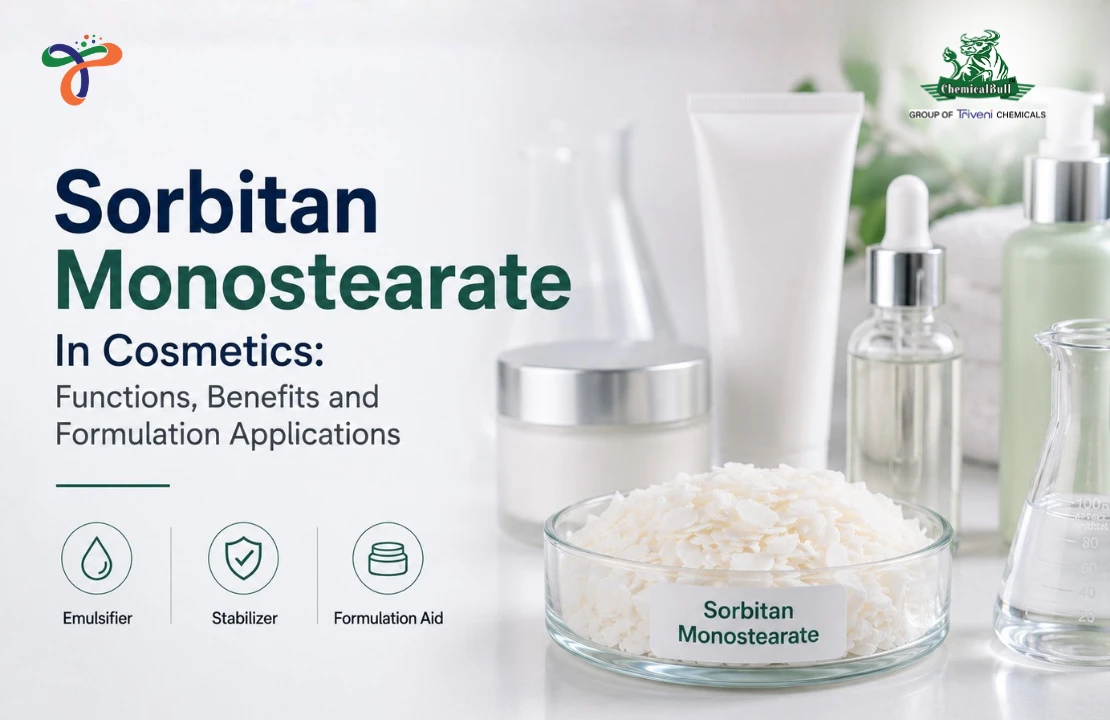
Sorbitan Monostearate in Cosmetics: Functions, Benefits and Formulation Applications
Sorbitan Monostearate is a trusted, multi-functional ingredient in cosmetic and personal care formulations. Listed on product labels under its INCI name Sorbitan Stearate, it serves as an emulsifier, texture modifier, and skin-conditioning agent in a wide range of formulation types — from daily moisturizers and sunscreens to lip balms, hair conditioners, and pharmaceutical-grade topical creams.
For cosmetic formulators and personal care product developers, understanding exactly how Sorbitan Monostearate functions, which product types it suits, how to combine it with other emulsifiers, and what usage levels to apply is essential for building stable, consumer-ready formulations.
This guide focuses entirely on the cosmetic application of Sorbitan Monostearate. For its technical chemical properties and HLB value explanation, refer to our complete technical guide on Sorbitan Monostearate (Span 60) properties and HLB value. For a comparison with Sorbitan Tristearate across formulation types, see our Sorbitan Tristearate vs Sorbitan Monostearate guide.
INCI Name and Cosmetic Identity of Sorbitan Monostearate
In cosmetics, Sorbitan Monostearate is listed on the INCI (International Nomenclature of Cosmetic Ingredients) as "Sorbitan Stearate". This is the ingredient name that appears on finished product labels in most global markets, including the EU, USA, UK, and India.
|
Identity Detail |
Information |
|
INCI Name |
Sorbitan Stearate |
|
Common / Chemical Name |
Sorbitan Monostearate |
|
Trade Name |
Span 60 |
|
CAS Number |
1338-41-6 |
|
Emulsifier Type |
Non-ionic surfactant |
|
HLB Value |
~4.7 |
|
EU Cosmetics Regulation |
Listed in CosIng database; permitted for cosmetic use |
|
US (FDA) |
Permitted in cosmetics and OTC drug products |
|
Typical Function |
Emulsifying agent, surfactant, skin-conditioning agent |
When reading a cosmetic formula, "Sorbitan Stearate" and "Sorbitan Monostearate" refer to the same ingredient. Formulators and procurement teams should align on this naming convention when sourcing raw materials from suppliers.
How Sorbitan Monostearate Functions in Cosmetic Formulations
Sorbitan Monostearate performs several distinct functional roles in personal care formulations. Each role is relevant to a different product category and formulation objective.
1. Primary and Co-Emulsifier
The core function of Sorbitan Monostearate in cosmetics is emulsification — helping oil and water phases mix into a stable, homogeneous product. With an HLB value of approximately 4.7, it is inherently oil-compatible (lipophilic) and works most effectively in water-in-oil (W/O) emulsions when used as the sole emulsifier.
However, its most powerful role in modern cosmetic formulations is as a co-emulsifier — paired with a hydrophilic emulsifier such as Polysorbate 60 (Tween 60, HLB ~14.9) or Polysorbate 80 (Tween 80, HLB ~15.0). Blending these two creates an intermediate target HLB that enables highly stable oil-in-water (O/W) emulsions, which make up the majority of consumer creams, lotions, and body milks.
This Span 60 + Tween 60 system is one of the most widely established emulsifier pairings in cosmetic manufacturing because it is:
- Non-ionic (non-irritating, broadly compatible)
- pH-stable across a wide range
- Effective with both polar and non-polar oil phases
- Compatible with most active ingredients and preservatives
2. Texture and Consistency Builder
Beyond emulsification, Sorbitan Monostearate contributes to the rheological profile (thickness and flow behaviour) of cosmetic products. In creams and semi-solid formulations, it helps:
- Build body and spreadability
- Prevent phase separation on storage
- Contribute to a non-greasy, smooth skin-feel after application
- Support a stable, aesthetically acceptable product texture at varying temperatures
3. Skin-Conditioning Agent
The sorbitan head group of the molecule retains hydroxyl (-OH) groups that interact gently with the skin surface. Sorbitan Monostearate acts as a mild skin-conditioning agent, contributing to:
- Improved softness and moisturization of the skin surface
- Reduced transepidermal water loss (TEWL) in formulations where the product forms an occlusive layer
- Smooth after-feel without tackiness or heaviness
4. Emulsion Stabilizer
Sorbitan Monostearate helps maintain the long-term physical stability of cosmetic emulsions by:
- Forming a stable interfacial film between oil and water phases
- Reducing the tendency for droplets to coalesce (merge) over time
- Supporting product stability across temperature fluctuations (freeze-thaw cycling, warm storage)
- Reducing creaming and sedimentation in lower-viscosity emulsions
5. Wax and Lip Product Structuring Agent
In lip care products, balms, and stick formulations, Sorbitan Monostearate functions as a structuring agent within the wax matrix. It improves the homogeneity of the wax blend, supports smooth pigment or active ingredient dispersion, and contributes to a comfortable, non-sticky application feel.
Cosmetic Product Types That Use Sorbitan Monostearate
Sorbitan Monostearate (INCI: Sorbitan Stearate) is used across a broad range of personal care and cosmetic product formats:
|
Product Category |
Role of Sorbitan Monostearate |
|
Day and Night Face Creams |
Co-emulsifier, texture builder, skin conditioning |
|
Body Lotions and Milks |
Emulsifier in O/W systems with Polysorbate pairing |
|
Moisturizing Creams |
Emulsion stabilizer, smooth skin-feel contributor |
|
Sunscreen Formulations (SPF) |
Co-emulsifier supporting uniform UV filter distribution |
|
Makeup Foundations (Liquid) |
Emulsifier, pigment dispersion aid, stability support |
|
BB Creams and Tinted Moisturizers |
Emulsion consistency and stability |
|
Lip Balms and Lip Butters |
Structuring agent, texture modifier |
|
Lipstick and Lip Gloss |
Oil-phase stabilizer, smooth application |
|
Hair Conditioners |
Emulsifier in conditioning emulsions |
|
Hair Masks and Treatments |
Emulsion stability and texture support |
|
Ointments and Topical OTC Products |
W/O emulsion former, oil-phase stabilizer |
|
Eye Creams |
Mild, non-ionic emulsifier suitable for sensitive skin zone |
|
Body Butters (Emulsified) |
Prevents the characteristic watery feel in emulsified butter textures |
Recommended Usage Levels in Cosmetic Formulations
The appropriate concentration of Sorbitan Monostearate in a cosmetic formulation depends on the product type, the target HLB of the emulsifier blend, and the oil phase content.
|
Application Type |
Typical Usage Level |
|
O/W emulsions (creams, lotions) |
1% – 3% (combined with hydrophilic co-emulsifier) |
|
W/O emulsions (rich creams, ointments) |
2% – 5% (as primary or main emulsifier) |
|
Lip balms and sticks |
1% – 4% |
|
Sunscreen emulsions |
1% – 3% |
|
Hair conditioning emulsions |
0.5% – 2% |
Important formulation note: Sorbitan Monostearate must always be added to the heated oil phase (typically at 70–80°C), not the water phase, due to its lipophilic nature and melting point of 50–58°C. Attempting to disperse it in the aqueous phase will result in ineffective emulsification and poor stability.
Co-Emulsifier Pairings: Getting the HLB Right
One of the most practical aspects of working with Sorbitan Monostearate in cosmetics is understanding how to pair it with complementary emulsifiers to achieve a target HLB. Most stable cosmetic O/W emulsions require a target HLB in the range of 8 to 16, depending on the oil phase.
The standard approach is to blend Sorbitan Monostearate (HLB 4.7) with a hydrophilic co-emulsifier:
|
Sorbitan Monostearate Paired With |
Combined Effect |
Typical Use |
|
Polysorbate 60 (Tween 60) |
Classic Span/Tween O/W system; very stable, widely used |
Creams, lotions, sunscreens |
|
Polysorbate 80 (Tween 80) |
More fluid-feeling emulsions; good for light lotions |
Body milks, lightweight moisturizers |
|
Polysorbate 20 (Tween 20) |
Lighter emulsions; suitable for gel-creams |
Gel-creams, serums with emollient content |
|
Glyceryl Stearate |
Combined emulsification and skin-feel; rich texture |
Rich face creams, body butters |
|
Cetearyl Alcohol + Polysorbate |
Structuring and emulsification |
Standard cosmetic base creams |
Example HLB blending calculation: To target HLB 10 using Sorbitan Monostearate (HLB 4.7) and Polysorbate 60 (HLB 14.9) in a 1:1 ratio: Blended HLB = (4.7 + 14.9) / 2 = 9.8 — close to target for a stable O/W cream.
Adjust the ratio of the two emulsifiers to fine-tune the final HLB to match the required value for your specific oil phase.
Skin Compatibility and Safety Profile
Sorbitan Monostearate has an established safety profile in cosmetic use. Regulatory and safety bodies globally have reviewed and permitted its use in personal care products.
Key safety and compatibility points for cosmetic formulators:
- Non-ionic: Non-ionic emulsifiers are among the mildest and most broadly tolerated surfactant types. Sorbitan Monostearate is suitable for formulations targeting sensitive, dry, or mature skin types.
- Non-irritating: At recommended usage levels, it does not cause significant skin irritation and is compatible with the skin's natural moisture barrier.
- Broad pH compatibility: Performs effectively across the pH range commonly used in cosmetics (pH 4.5 to 8.0), without degradation or loss of emulsifying activity.
- Comedogenicity: Generally considered low-comedogenic at standard usage levels, though finished formulation testing is always recommended for acne-prone skin claims.
- Allergen status: Sorbitan Monostearate itself is not a known allergen. It does not contain ethylene oxide residues (unlike its ethoxylated counterparts such as Polysorbates), making it a preferred choice in formulations where ethoxylate-free positioning is desired.
- Preservative compatibility: Compatible with common cosmetic preservatives including phenoxyethanol, parabens, benzyl alcohol, and natural preservation systems.
Formulation Tips for Working with Sorbitan Monostearate in Cosmetics
1. Always melt before use. Add Sorbitan Monostearate to the oil phase and heat to 70–80°C until fully melted before combining with the aqueous phase at the same temperature.
2. Match your target HLB. Calculate the required HLB of your emulsifier blend based on your oil phase composition. Use the Davies or Griffin HLB method to ensure you are selecting the correct ratio of Sorbitan Monostearate to your hydrophilic co-emulsifier.
3. Combine phases at the same temperature. Add the hot water phase to the hot oil phase (or vice versa, depending on your preferred method) with continuous agitation. Temperature matching prevents premature cooling and uneven emulsification.
4. Homogenize for stability. Use a high-shear mixer or homogenizer for finished cream and lotion systems to ensure small, uniform droplet size and long-term stability.
5. Conduct stability testing. Test finished formulations across temperature cycling (4°C, 25°C, 40°C, 45°C) and at 3-month and 6-month intervals to confirm emulsion stability before commercial launch.
6. Consider clean-label positioning. For brands positioning products as "free from ethoxylated ingredients," Sorbitan Monostearate is a suitable, non-ethoxylated emulsifier that can serve as an alternative or partial replacement for Polysorbates when combined appropriately.
Frequently Asked Questions
1. What is Sorbitan Stearate in cosmetics?
Sorbitan Stearate is the INCI name for Sorbitan Monostearate in cosmetic formulations. It is a non-ionic emulsifier derived from sorbitol and stearic acid, used in creams, lotions, sunscreens, lip care products, and other personal care formulations to stabilize oil-water emulsions and improve product texture.
2. Is Sorbitan Stearate (Sorbitan Monostearate) safe for skin?
Yes. Sorbitan Stearate is a well-established cosmetic ingredient with a broad safety record. It is non-ionic, non-irritating, and compatible with a wide range of skin types at recommended usage levels. It is permitted for cosmetic use by the EU Cosmetics Regulation, the US FDA, and other major regulatory frameworks globally.
3. What is the INCI name for Sorbitan Monostearate?
The INCI name is Sorbitan Stearate. This is the name that must appear on finished cosmetic product ingredient lists in compliance with EU and US labelling regulations.
4. What percentage of Sorbitan Monostearate should be used in a face cream?
For a typical O/W face cream, Sorbitan Monostearate is generally used at 1–3% of the total formula, paired with a hydrophilic co-emulsifier such as Polysorbate 60 at a complementary ratio to achieve the target HLB for your oil phase.
5. Can Sorbitan Monostearate be used alone to make a lotion?
It can be used as the sole emulsifier in water-in-oil (W/O) formulations. For oil-in-water (O/W) lotions and creams — which are more common in consumer products — it is typically used in combination with a high-HLB co-emulsifier like Polysorbate 60 or Polysorbate 80 to achieve the required target HLB for emulsion stability.
6. Is Sorbitan Monostearate vegan and halal?
The stearic acid used to produce Sorbitan Monostearate can be derived from either animal (tallow) or vegetable (palm, soy) sources. For vegan or halal-certified formulations, confirm the raw material origin with your supplier and request the appropriate certification documentation.
7. What products can I replace Sorbitan Monostearate with in cosmetics?
Depending on the formulation, partial alternatives include Glyceryl Stearate (similar HLB range), plant-based lecithins, or other sorbitan esters. However, the combination of performance, stability, cost, and regulatory acceptance makes Sorbitan Monostearate difficult to replace with a single ingredient in most emulsion systems.
Conclusion
Sorbitan Monostearate — sold as Span 60 and listed on cosmetic labels as Sorbitan Stearate — is one of the most versatile and reliable emulsifiers available to cosmetic formulators. Its HLB value of 4.7, non-ionic nature, broad ingredient compatibility, and established safety profile make it a foundation ingredient in stable creams, lotions, sunscreens, lip care products, and conditioning formulations.
Whether used as a primary emulsifier in W/O systems or as part of a carefully blended Span/Tween co-emulsifier system for O/W products, Sorbitan Monostearate delivers consistent emulsification performance, smooth skin feel, and formulation stability that manufacturers across the personal care industry rely on.
For cosmetic-grade sorbitan monostearate emulsifier supply with COA, TDS, SDS, INCI confirmation, and Halal/Kosher documentation, connect with ChemicalBull for bulk sourcing support.

Comment Section