Chemical Bull
1396
19-Jun-2026
Introduction: Two Glycerol Esters, Different Formulation Results
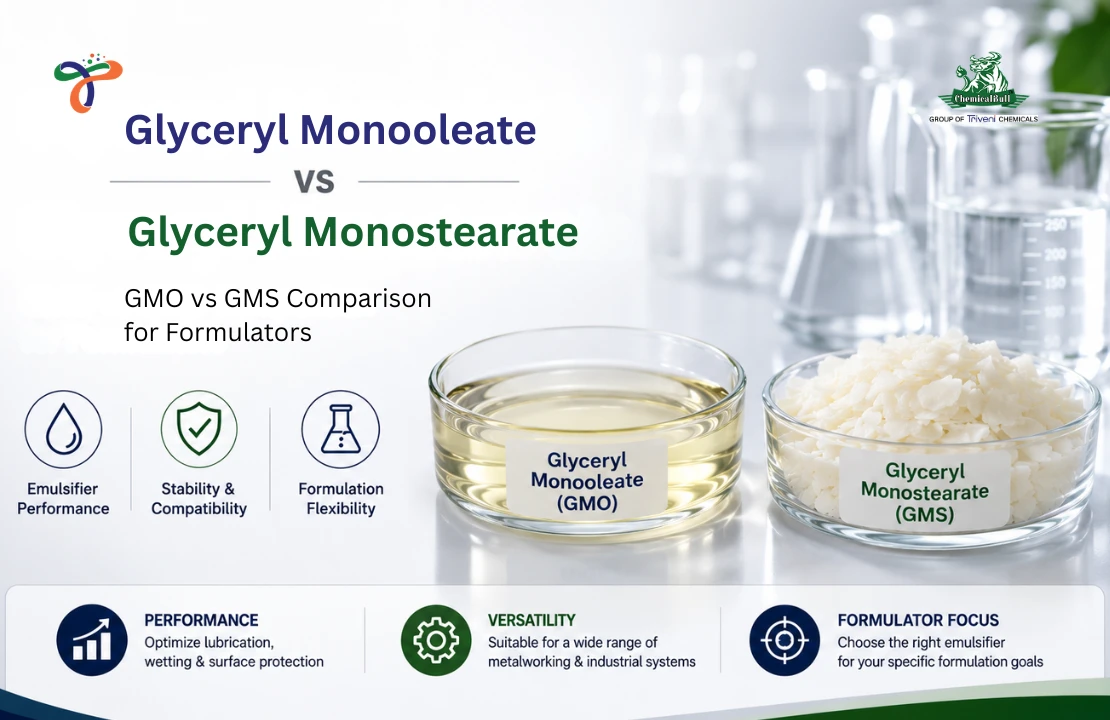
In cosmetic, pharmaceutical, food, and industrial formulations, a small change in fatty acid structure can change the final product’s texture, stability, spreadability, and processing behavior. This is why Glyceryl Monooleate vs Glyceryl Monostearate is an important comparison for formulators working with emulsions, creams, ointments, lipid systems, food products, and specialty formulations.
Both GMO and GMS are glycerol esters and non-ionic surfactants. Both can support emulsification, dispersion, texture, and lipid-phase structure. However, they do not behave the same way. Glyceryl Monooleate is based on oleic acid, while Glyceryl Monostearate is based on stearic acid.
That difference gives GMO a softer, more oil-compatible profile, while GMS gives stronger body, opacity, and structure. For Glyceryl Monooleate, Glyceryl Monostearate, samples, COA, TDS, SDS, and bulk sourcing support, ChemicalBull helps you compare suitable formulation grades and request a quote.
Quick Answer
Glyceryl Monooleate, also called GMO, is an oleic acid ester with a softer, oil-compatible nature and a typical HLB value around 3.8. It is useful in lipid-based systems, water-in-oil emulsions, soft dispersions, and emollient formulations.
Glyceryl Monostearate, also called GMS, is a stearic acid ester with a waxier, more structured nature and a typical HLB value around 3.5–3.8. It is commonly used in creams, lotions, food emulsions, conditioners, and formulations that need body, opacity, and thickness.
What Are Glyceryl Monooleate and Glyceryl Monostearate?
Glyceryl Monooleate and Glyceryl Monostearate are non-ionic glycerol esters made from glycerol and fatty acids. They are widely used as emulsifiers, co-emulsifiers, dispersing agents, texture modifiers, and lipid-phase additives.
The main difference comes from the fatty acid used.
-
Glyceryl Monooleate is based on oleic acid, an unsaturated fatty acid.
-
Glyceryl Monostearate is based on stearic acid, a saturated fatty acid.
Because oleic acid has an unsaturated chain, GMO behaves more like a soft, flexible lipid ingredient. Because stearic acid has a saturated chain, GMS behaves more like a solid waxy co-emulsifier that adds body and structure.
In simple terms, GMO is more fluid and oil-compatible, while GMS is more solid and structure-building.
GMO vs GMS: Property Comparison Table
|
Property |
Glyceryl Monooleate |
Glyceryl Monostearate |
|
Common Short Name |
GMO |
GMS |
|
Common Chemical Name |
Glycerol Monooleate / Monoolein |
Glycerol Monostearate / Monostearin |
|
CAS Number |
111-03-5 / 25496-72-4 |
31566-31-1 / 123-94-4 |
|
Chemical Type |
Glycerol monoester of oleic acid |
Glycerol monoester of stearic acid |
|
Fatty Acid Base |
Oleic acid |
Stearic acid |
|
Lipid Character |
Unsaturated lipid |
Saturated lipid |
|
Typical HLB Value |
Around 3.8 |
Around 3.5–3.8 |
|
Typical Physical Nature |
Oily, waxy, soft paste-like, or liquid depending on grade |
Waxy solid, flakes, powder, or beads |
|
Texture Contribution |
Soft, lubricious, emollient feel |
Creamy, structured, thicker feel |
|
Water Solubility |
Practically insoluble |
Practically insoluble |
|
Oil Compatibility |
Excellent |
Good |
|
Emulsifier Role |
Low-HLB emulsifier, lipid carrier, W/O emulsion support |
Co-emulsifier, O/W stabilizer support, opacifier, thickening agent |
|
Main Function |
Lipid dispersion, wetting, soft emulsification |
Emulsion body, opacity, viscosity, texture building |
|
Best Used In |
Lipid systems, ointments, soft gels, oil-rich systems |
Creams, lotions, food emulsions, bakery, personal care products |
|
Formulation Character |
More flexible and oil-phase friendly |
More body-building and consistency-enhancing |
Key Difference Between Glyceryl Monooleate and Glyceryl Monostearate
The key difference is their fatty acid structure. Glyceryl Monooleate contains oleic acid, which has an unsaturated chain. This gives GMO a softer, more fluid, and more oil-compatible nature.
Glyceryl Monostearate contains stearic acid, which has a saturated chain. This gives GMS a firmer, waxier, and more structure-building character.
For formulators, this difference matters because it affects:
-
Product texture
-
Emulsion body
-
Melting behavior
-
Oil-phase compatibility
-
Stability
-
Spreadability
-
Processing temperature
-
Final sensory feel
How Glyceryl Monooleate Works in Formulations
Glyceryl Monooleate is selected when a formulation needs softness, lipid compatibility, and dispersion support. It is especially useful in oil-rich systems and formulations where a flexible lipid-phase ingredient is needed.
Because GMO is an oleic acid ester, it behaves like an unsaturated lipid with strong oil compatibility. Its typical HLB value around 3.8 makes it useful in low-HLB systems, especially water-in-oil (W/O) emulsion formats, lipid dispersions, and oil-rich formulations.
In cosmetics, GMO can support a smooth skin-conditioning emollient feel. It helps improve spreadability, softness, and the sensory profile of topical products.
Common Glyceryl Monooleate Uses
Glyceryl Monooleate is used in:
-
Pharmaceutical lipid formulations
-
Ointments and topical products
-
Soft gel and capsule-related systems
-
Cosmetic creams and lotions
-
Oil-based dispersions
-
Water-in-oil emulsions
-
Emulsified gels
-
Food emulsifier systems
-
Lubricant and industrial formulations
-
Agrochemical and specialty chemical dispersions
Why Formulators Choose GMO
Formulators choose Glyceryl Monooleate when they need:
-
Better oil compatibility
-
Softer texture
-
Lipid-phase dispersion
-
Wetting support
-
Improved spreadability
-
Flexible emulsion behavior
-
Support for poorly water-soluble ingredients
-
A softer skin-conditioning feel in topical products
In pharmaceutical and cosmetic applications, GMO is often considered when the formulation contains lipophilic actives or requires a soft lipid carrier system.
How Glyceryl Monostearate Works in Formulations
Glyceryl Monostearate is selected when a formulation needs structure, thickness, stability, and creamy texture. It is one of the most widely used glycerol esters in cosmetics, food, pharmaceuticals, and industrial formulations.
Because GMS is a stearic acid ester, it behaves like a saturated lipid with a more solid and waxy profile. It helps give body to creams, lotions, conditioners, and emulsions.
GMS has a typical HLB value around 3.5–3.8, depending on grade and monoester content. It is lipophilic by nature, but it is often used with suitable higher-HLB emulsifiers to support oil-in-water (O/W) stabilizer systems.
It can also act as an opacifier and thickening agent in creams, lotions, conditioners, cleansing creams, and rich personal care products.
Common Glyceryl Monostearate Uses
Glyceryl Monostearate is used in:
-
Face creams
-
Body lotions
-
Sunscreens
-
Hair conditioners
-
Ointments
-
Food emulsions
-
Bakery products
-
Whipped toppings
-
Margarine and spreads
-
Pharmaceutical creams
-
Plastic and polymer processing aids
Why Formulators Choose GMS
Formulators choose Glyceryl Monostearate when they need:
-
Better emulsion body
-
Creamier texture
-
Improved viscosity
-
Stable oil-water systems
-
Opacity and richness
-
Better consistency
-
Texture improvement in food products
-
Cost-effective co-emulsifier support
In cosmetic formulations, GMS is often used with fatty alcohols, waxes, surfactants, and other emulsifiers to create stable creams and lotions.
To understand GMS in more detail, explore our guide on Glycerol Monostearate in cosmetic and industrial formulations.
Application-Based Comparison: GMO vs GMS
|
Application Area |
Better Choice |
Reason |
|
Oil-rich formulation |
Glyceryl Monooleate |
Better lipid compatibility and softer texture |
|
Creams and lotions |
Glyceryl Monostearate |
Better body, viscosity, and emulsion structure |
|
Ointments |
Depends on base |
GMO for softer lipid systems; GMS for firmer structure |
|
Food emulsions |
Glyceryl Monostearate |
Stronger texture and emulsion support |
|
Bakery products |
Glyceryl Monostearate |
Helps improve texture and processing performance |
|
Lipid-based pharma systems |
Glyceryl Monooleate |
Better compatibility with lipophilic ingredients |
|
Sunscreens |
Glyceryl Monostearate |
Supports structure and emulsion stability |
|
Dispersions |
Glyceryl Monooleate |
Better wetting and oil-phase dispersion |
|
Thick creams |
Glyceryl Monostearate |
Better consistency and body |
|
Soft gels / lipid carriers |
Glyceryl Monooleate |
More suitable for lipid carrier systems |
Which One Should Formulators Choose?
Choose Glyceryl Monooleate when the formulation needs stronger oil compatibility, soft texture, wetting support, and lipid-phase flexibility.
Choose Glyceryl Monostearate when the formulation needs creamier texture, structure, viscosity, opacity, and stable emulsion body.
Use this simple rule:
-
GMO = softer, oil-compatible, lipid-friendly
-
GMS = waxier, creamier, structure-building
In many formulations, the best choice depends on the oil phase, final texture, processing temperature, active ingredient type, and desired stability.
If/Then Selection Logic for GMO vs GMS
Use this quick decision guide when selecting between GMO and GMS:
-
If your formulation is oil-rich, choose Glyceryl Monooleate.
-
If your formulation needs cream body, choose Glyceryl Monostearate.
-
If you are building a water-in-oil (W/O) emulsion, start with GMO.
-
If you are building an oil-in-water (O/W) cream, use GMS with a suitable higher-HLB emulsifier.
-
If the product needs a soft emollient feel, choose GMO.
-
If the product needs an opacifier or thickening agent, choose GMS.
-
If you need a liquid emulsifier or soft lipid carrier, choose GMO.
-
If you need a solid waxy co-emulsifier, choose GMS.
How to Choose the Right Grade
Grade selection matters because GMO and GMS can vary by monoester content, purity, fatty acid profile, free fatty acid level, moisture, appearance, and application suitability.
Before choosing a grade, check:
-
Intended application: cosmetic, food, pharma, or industrial
-
Physical form required: liquid, paste, flakes, powder, or beads
-
CAS number and product identity
-
Monoester content
-
HLB value
-
Fatty acid source
-
COA and TDS
-
Regulatory or food-grade requirement
-
Processing temperature
-
Compatibility with oils, waxes, emulsifiers, actives, and preservatives
For commercial production, always test the selected grade in the final formulation before scale-up.
Frequently Asked Questions
-
What is the difference between Glyceryl Monooleate and Glyceryl Monostearate?
Glyceryl Monooleate is an oleic acid ester based on an unsaturated fatty acid, while Glyceryl Monostearate is a stearic acid ester based on a saturated fatty acid. GMO is softer and more oil-compatible, while GMS is waxier and better for structure, opacity, thickening, and creamy texture. -
Is GMS the same as Glyceryl Monostearate?
Yes. GMS is the common short form for Glyceryl Monostearate. It is used as a co-emulsifier, opacifier, thickening agent, texture modifier, and stabilizing aid in cosmetics, foods, pharmaceuticals, and industrial systems.
-
Is GMO the same as Glyceryl Monooleate?
Yes. GMO is the common short form for Glyceryl Monooleate. It is used as a low-HLB non-ionic surfactant, co-emulsifier, lipid carrier, dispersing aid, and emollient in cosmetic, pharmaceutical, food, and industrial formulations. -
What is the HLB value of GMO and GMS?
Glyceryl Monooleate has a typical HLB value around 3.8. Glyceryl Monostearate usually has a typical HLB value around 3.5–3.8, depending on grade and composition. Both are low-HLB, lipophilic non-ionic surfactants. -
Can GMO and GMS be used together?
Yes. GMO and GMS can be used together when a formulation needs both softness and structure. GMO contributes lipid compatibility and emollient feel, while GMS supports body, opacity, viscosity, and stable cream texture. -
Are GMO and GMS biodegradable emulsifiers?
GMO and GMS are fatty acid-based glycerol esters and are often used in formulations aligned with biodegradable emulsifier and green chemistry approaches. Final claims should depend on supplier documentation, grade, regional regulations, and finished product testing.
Conclusion
Glyceryl Monooleate and Glyceryl Monostearate are both useful glycerol esters, but they are selected for different formulation goals. GMO is better for lipid compatibility, soft texture, W/O emulsion support, and oil-rich systems, while GMS is better for structure, viscosity, opacity, O/W cream support, and creamy texture.


Comment Section