Chemical Bull
664
18-Jun-2026
Introduction
In the vast ecosystem of industrial polymers, Sodium Polyacrylate (SAP) and Polyacrylamide (PAM) are two heavyweights that dominate the manufacturing landscape. While both are synthetic polymers derived from acrylic monomers, their molecular architectures dictate entirely different industrial roles.
For formulators, water treatment specialists, and procurement managers, understanding the technical divergence between these two is the first step toward optimizing process efficiency. As a leading Sodium Polyacrylate supplier and a trusted Polyacrylamide distributor, we often find that choosing the wrong polymer doesn't just impact your production efficiency—it hits your bottom line.
In this guide, we break down their properties, applications, and sourcing standards to help you make an informed decision for your industrial requirements.
SAP vs. PAM
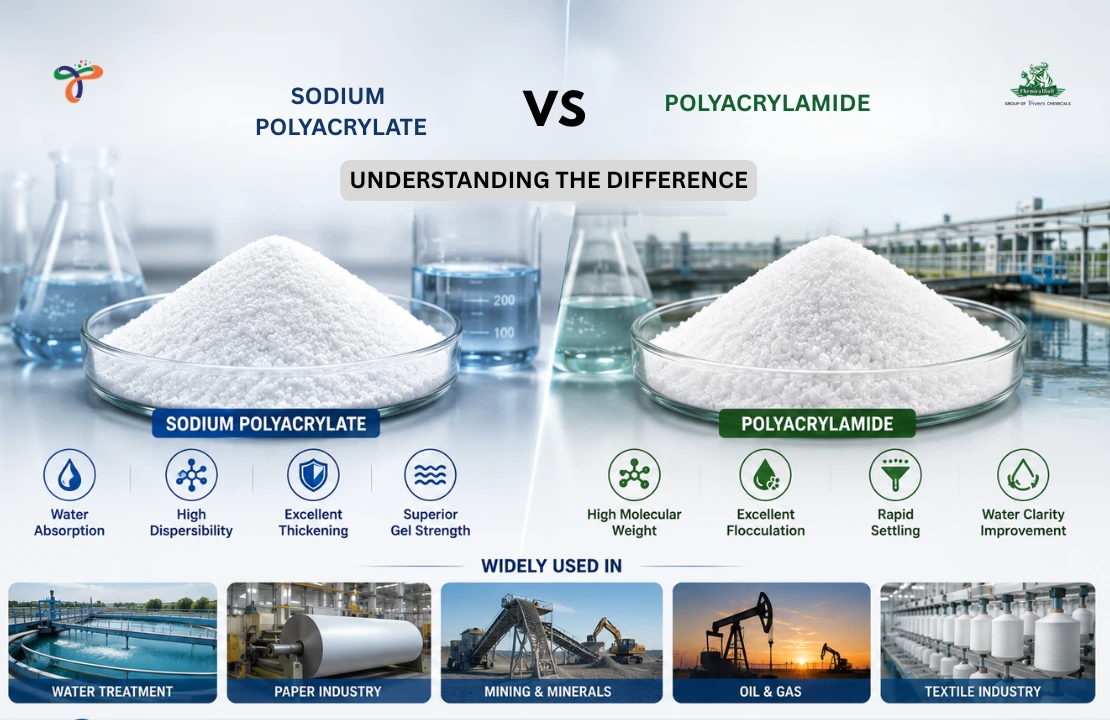
Sodium Polyacrylate (SAP) is a crosslinked superabsorbent polymer designed primarily for water absorption and retention, capable of locking in hundreds of times its weight in liquid. In contrast, Polyacrylamide (PAM) is a linear, water-soluble polymer used mainly for flocculation, sludge dewatering, and viscosity enhancement in industrial processes like wastewater treatment and mining.
Sodium Polyacrylate vs. Polyacrylamide: Key Differences at a Glance
|
Property |
Sodium Polyacrylate (SAP) |
Polyacrylamide (PAM) |
|
Polymer Type |
Crosslinked superabsorbent |
Linear water-soluble |
|
Main Function |
Absorption & Retention |
Flocculation & Thickening |
|
Water Absorption |
Very high (300–800x) |
Low |
|
Gel Formation |
Strong hydrogel |
Weak viscous solution |
|
Charge Type |
Strictly Anionic |
Anionic, Cationic, Nonionic, Amphoteric |
|
Typical Dosage |
Percentage-level (g/L) |
ppm-level (mg/L) |
|
Main Applications |
Diapers, Agriculture, Cable tapes |
Wastewater treatment, Oilfield, Paper |
What is Sodium Polyacrylate?
Sodium polyacrylate C3H3NaO2n is a functional polymer made from the polymerization of acrylic acid neutralized with sodium. It belongs to the class of Superabsorbent Polymers (SAP). Its defining characteristic is its ability to transform from a dry powder into a firm hydrogel upon contact with water.
The Water-Locking Mechanism
Unlike a sponge that releases water when squeezed, sodium polyacrylate uses osmotic pressure to draw water into its crosslinked network. Based on laboratory standards, high-quality SAP can absorb 300–800 times its own weight in deionized water. The sodium ions dissociated within the polymer chain create a concentration gradient, forcing water molecules into the structure where they are physically trapped by the crosslinks.
Typical Applications:
- Hygiene: Absorbent cores for baby diapers and adult incontinence products.
- Agriculture: Soil conditioners that retain moisture near plant roots.
- Industrial: Cable water-blocking tapes and emergency flood bags.
- Spill Control: Solidifying liquid medical waste or chemical spills.
What is Polyacrylamide?
Polyacrylamide (PAM) is a versatile polymer synthesized from acrylamide monomers. Unlike the "net" structure of SAP, PAM consists of long, linear chains that are highly soluble in water. It is the "workhorse" of the water treatment industry.
Understanding PAM Types
PAM is highly customizable based on the electrical charge required for specific particles:
- Anionic Polyacrylamide (APAM): Used for negatively charged particles, common in mineral processing and coal washing.
- Cationic Polyacrylamide (CPAM): Essential for organic sludge dewatering in municipal sewage plants.
- Nonionic Polyacrylamide (NPAM): Effective in acidic or highly saline conditions where charged polymers might fail.
Core Functions: Flocculation (gathering particles for easy removal) and Thickening (fluid viscosity enhancement).
At ChemicalBull, we provide industry-grade Polyacrylamide for large-scale water treatment units. For documentation, please visit our Polyacrylamide MSDS.
How They Work Differently: Swelling vs. Bridging
To understand the industrial utility, we must analyze the mechanism of action:
SAP: Osmotic Expansion
Sodium polyacrylate functions through swelling. When water enters the polymer, the chains expand but do not dissolve because they are chemically tied together (crosslinked). This creates a semi-solid gel that holds water even under moderate pressure.
PAM: Bridging Flocculation
Polyacrylamide functions through bridging. The long polymer chains act like “fishing lines.” One end of the chain attaches to a solid particle in a liquid, and the other end attaches to another particle. This creates a heavy aggregate that settles rapidly out of the suspension. According to particle size analysis, PAM can increase sedimentation rates by over 10 times in industrial settlers.
Safety & Regulatory Considerations
hen sourcing, technical compliance is non-negotiable.
- Regulatory: Always verify the Residual Monomer Content. For PAM, ensure the product meets NSF/ANSI 60 standards (monomer levels <0.02% or 200 ppm) for sensitive projects.
- Dust Control: Both are fine powders; use respiratory protection (N95 masks) to avoid inhalation.
- Slip Hazard: SAP is an extreme slip hazard if spilled on wet surfaces; use dry cleanup methods (shovels/vacuums).
- Storage: Keep in air-tight, moisture-proof bags. Both are hygroscopic—moisture will cause clumping and ruin quality.
Real Industrial Selection Scenarios: SAP vs. PAM
The choice between sodium polyacrylate (SAP) and polyacrylamide (PAM) depends on salinity, shear, and process objectives.
|
Operating Condition |
Sodium Polyacrylate (SAP) |
Polyacrylamide (PAM) |
|
High Salinity |
Poor absorption |
Better stability (specialized grades) |
|
Dynamic Flow |
Weak performance |
Excellent (Flocculation) |
|
Static Retention |
Excellent |
Limited |
|
Sludge Dewatering |
Ineffective |
Industry Standard |
Procurement Strategy: Cost & Dosage Efficiency
Procurement teams must look beyond the price per kilogram to the Total Cost of Operation (TCO).
- Dosage: PAM is used in extremely low concentrations (ppm levels), whereas SAP is often used in percentage levels (grams per liter).
- Efficiency: 1kg of PAM can often replace the performance of 50kg of traditional coagulants in solid-liquid separation.
Conclusion
Conclusion
The first step to achieving peak process efficiency is choosing the right polymer. Sodium Polyacrylate and Polyacrylamide are not just chemicals; they are the foundation of your water management and production stability. When you choose ChemicalBull as your partner, you aren't just selecting a supplier; you are choosing a technical team committed to the success of your industrial operations.
Request a Competitive Quote for Bulk Supply
-
Need a TDS/COA? Click here to request documentation.
-
Looking for a Custom Grade? Contact our technical support team for expert guidance.
-
Bulk Requirements? Get a competitive quote for your next 6 MT order.
Frequently Asked Questions (FAQ)
-
Can sodium polyacrylate replace polyacrylamide in water treatment?
Generally, no. SAP is designed to hold water, while PAM is designed to separate water from solids. Using SAP in a clarifier would create a viscous gel that is impossible to filter. -
Does sodium polyacrylate work in seawater?
Its efficiency drops significantly. In seawater, the absorption capacity of standard SAP can fall from 500x to as low as 20–30x due to ion interference. -
Is polyacrylamide safe for the environment?
PAM is widely used in soil erosion control. However, it is essential to use high-purity grades to prevent acrylamide monomer accumulation in the ecosystem. -
Which polymer is better for dredging operations?
Polyacrylamide is preferred for fast settling of silt, but sodium polyacrylate is sometimes used at the end of the process to solidify the final sludge for transport.
Comment Section