Chemical Bull
218
19-Jun-2026
Introduction
In the precision-driven world of modern industrial manufacturing, the performance of your base fluids determines the efficiency, output, and profitability of your entire production line. Among the various functional additives available to formulators, Glyceryl Monooleate (GMO) stands out as a critical, high-performance component. As a bio-based, versatile ester, GMO has become an indispensable tool for achieving superior lubrication, emulsion stability, and corrosion protection in demanding industrial environments.
This guide provides an in-depth analysis of why GMO is the preferred choice for engineers, process technicians, and procurement managers looking to enhance processing precision and surface quality in metalworking and industrial applications.
What is Glyceryl Monooleate?
Glyceryl monooleate is a non-ionic, lipophilic surfactant derived from the esterification of glycerin and oleic acid. Structurally, it acts as a highly effective emulsifier due to its inherent amphiphilic nature—meaning it possesses both a water-attracting (hydrophilic) head and an oil-attracting (hydrophobic) tail.
- Chemical Formula: C21H40O4
- Physical Form: Depending on the grade and purity, it typically appears as pale yellow, waxy flakes or a viscous, amber liquid.
- Key Industrial Attribute: Its low Hydrophilic-Lipophilic Balance (HLB) value, approximately 3.8, makes it an exceptional candidate for stabilizing water-in-oil (W/O) emulsions, which are standard in many heavy-duty industrial fluids.
Beyond its basic structure, GMO is celebrated for its purity and consistency. For manufacturers seeking a reliable Glyceryl Monooleate Supplier, prioritizing a partner who guarantees bio-derived, biodegradable quality is essential for aligning with modern "Green Chemistry" standards and optimizing industrial performance.
The Chemistry of "Smart" Lubrication
While standard lubricants create a barrier, Glyceryl Monooleate acts as a "Smart" additive. Unlike mineral oils that provide static lubrication, GMO exhibits temperature-dependent surface activity. As friction generates heat during a machining process, the polar head of the GMO molecule becomes more active, increasing its affinity for the metal surface exactly when the load is highest. This dynamic response is why it outperforms generic synthetic esters in high-speed milling, where temperature fluctuations are rapid and unpredictable.
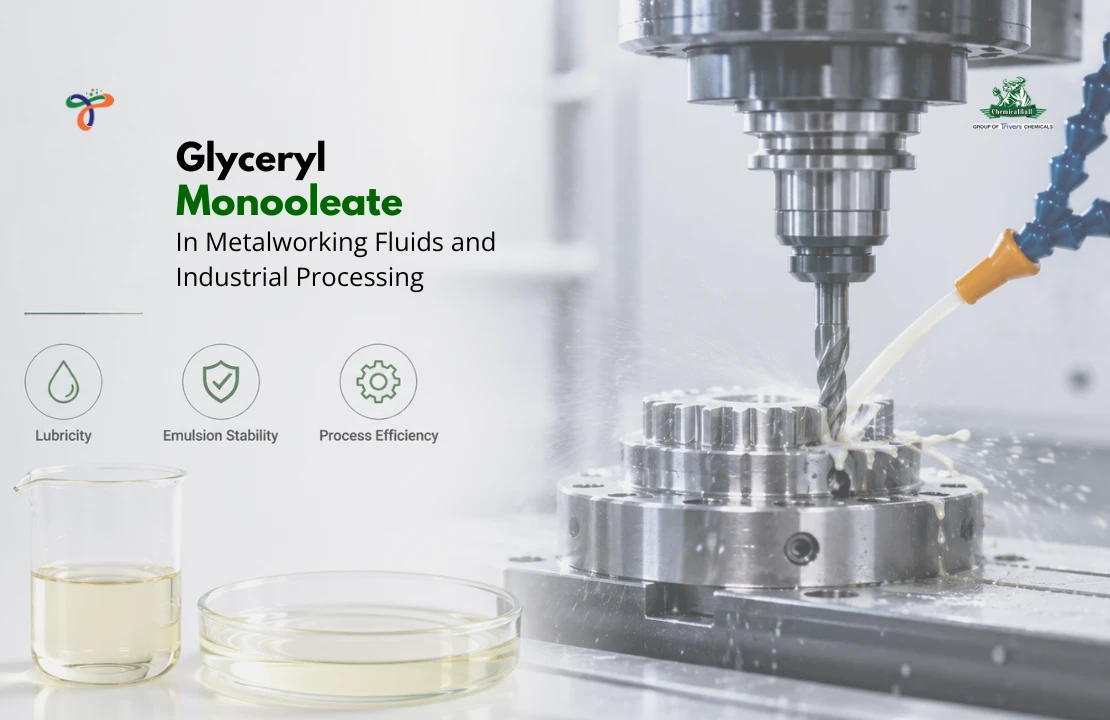
Core Functions in Metalworking Fluids (MWFs)
Metalworking fluids are subjected to extreme operational conditions, including high pressure, localized heat, and aggressive friction. GMO is integrated into these formulations to provide a multi-layered defense.
- Friction Modification: It lowers the coefficient of friction under boundary lubrication conditions by adsorbing onto metal surfaces to prevent metal-to-metal contact.
- Emulsion Stabilization: It functions as a non-ionic W/O co-emulsifier that bridges oil and water phases to maintain fluid integrity.
- Load-Carrying Performance: It forms a robust physical barrier that exhibits advanced load-carrying capabilities under heavy mechanical stress, demonstrating reduced wear in standard industrial testing.
- Corrosion Inhibition: GMO provides a protective barrier that prevents rust and oxidation, ensuring the structural integrity of components.
- Surface Spreading: It enhances the wetting characteristics of fluids across the workpiece, speeding up heat dissipation and ensuring uniform coverage.
Types of Metalworking Fluids
Glyceryl Monooleate is a versatile additive used across four primary types of metalworking fluids:
- Straight Oils (Neat Oils): Used without water. GMO acts as a primary oiliness agent to enhance boundary lubrication in heavy-duty machining.
- Soluble Oils (Emulsifiable): Contains base oil, emulsifiers, and water. GMO serves as a powerful co-emulsifier to maintain emulsion stability.
- Semi-Synthetic Fluids: A balance of low mineral oil and higher emulsifiers. GMO improves surface wetting and corrosion protection.
- Synthetic Fluids: Water-based with no mineral oil. GMO is used in specialized formulations to provide lubrication and eco-friendly performance.
Applications in Industrial Processing: A Detailed Breakdown
|
Process Type |
Role of GMO |
Impact on Production |
|
Metal Removal (Milling, Drilling) |
Boundary lubrication at the cutting edge. |
Extends tool life, prevents chip welding. |
|
Metal Forming (Drawing, Stamping) |
Film thickness and adhesion enhancement. |
Prevents tearing or scoring under die pressure. |
|
Hydraulics & Gear Oils |
Friction modifier and oiliness agent. |
Improves energy transmission and eco-compliance. |
|
Textile & Additive Processing |
Non-staining wetting agent. |
Ensures color consistency and smooth processing. |
Troubleshooting Formulation Failures
Even the best additives fail if the formulation environment is wrong. Use this troubleshooting matrix to optimize your results:
|
Symptom |
Potential Cause |
GMO Solution |
|
Emulsion Splitting |
High water-phase electrolyte count |
Increase GMO concentration to stabilize the interface. |
|
Foaming in Sump |
Excess air entrapment |
Pair GMO with silicone-based defoamers; GMO reduces surface tension. |
|
Poor Surface Finish |
Insufficient boundary film |
Increase GMO dosage to improve surface wetting. |
|
Rust on Workpiece |
Low pH in fluid |
Use GMO as a primary corrosion inhibitor booster. |
Why Choose GMO for Your Formulation?
Manufacturers choose GMO for its ability to optimize performance while adhering to "Green Chemistry" principles.
- Extended Tool Longevity: By reducing the coefficient of friction, GMO minimizes the thermal stress at the cutting edge, which keeps tools sharper for longer periods and reduces machine downtime.
- Superior Surface Finish: GMO ensures uniform fluid distribution, resulting in a cleaner, smoother finish that often eliminates the need for further intervention.
- Eco-Compliance and Sustainability: GMO is a 100% bio-derived additive that naturally breaks down in the environment, helping manufacturers align with ISO standards and reducing the chemical oxygen demand (COD) in wastewater treatment.
Storage, Handling, and Life-Cycle Management
GMO is susceptible to oxidative rancidity if stored incorrectly, which can degrade its performance.
- Optimal Temperature: Store between 15°C and 25°C. Exposure to heat above 40°C for extended periods can cause darkening and loss of emulsification efficiency.
- Nitrogen Blanketing: For bulk storage, using nitrogen blanketing in tanks prevents the ester from reacting with atmospheric oxygen, ensuring the iodine value remains consistent.
- Batch Tracking: Track the Acid Value at the point of receipt; an increasing acid value indicates that the GMO is breaking down and will negatively affect the stability of your cutting oil emulsion.
Market Factors Influencing Procurement
The market for GMO is influenced by three major dynamics:
- Logistical Efficiency: Proximity to industrial hubs like the Vapi-Valsad region allows for just-in-time delivery, reducing inventory holding costs.
- Bio-based Demand: As industries pivot away from toxic synthetic additives, the demand for high-purity, renewable bio-esters has stabilized the market, making it an economically viable long-term strategy.
- Technical Support: Manufacturers now prioritize partners who provide comprehensive laboratory support, including pilot testing and formulation guidance.
Why Choose Chemicalbull as Your Partner?
In an industry where consistency defines your final product quality, Chemicalbull acts as a strategic bridge between raw material excellence and industrial performance. We specialize in providing high-purity Glyceryl Monooleate tailored to your specific formulation needs.
By choosing to work with us, you gain more than just a chemical; you gain:
- Quality Assurance: Every batch is backed by rigorous testing and detailed COA/TDS documentation.
- Supply Reliability: With our strategic presence in the Vapi industrial belt, we ensure just-in-time delivery for your production schedules.
- Technical Partnership: Our team provides expert guidance on formulation troubleshooting to help you get the most out of your additives.
Conclusion
Glyceryl Monooleate is an indispensable asset for modern industrial processing. From achieving precision in heavy-duty metal removal to ensuring ecological compliance in waste management, it addresses the most complex needs of the contemporary manufacturing floor.
At Chemicalbull, we understand that high-performance formulations require uncompromising quality. As a trusted leader in the chemical supply chain, we provide high-purity, batch-consistent GMO that ensures your production stays smooth, efficient, and compliant. When you partner with us, you choose more than just a supplier; you gain a technical ally dedicated to your formulation success.
Ready to enhance your industrial formulations?
If you are looking for a reliable partner who offers technical consultation, competitive pricing, and bulk delivery, contact our procurement team at Chemicalbull today to request a quote.
Frequently Asked Questions (FAQ)
-
How does GMO improve smoothness?
It enhances the fluid's ability to wet the metal surface, preventing surface drag during machining. -
Is it effective in heavy-duty forming?
Yes, its load-carrying capability prevents tearing in high-pressure applications. -
How is it classified for disposal?
It is in the "Easy" treatability tier, lowering disposal costs.

Comment Section