Chemical Bull
2091
17-Jun-2026
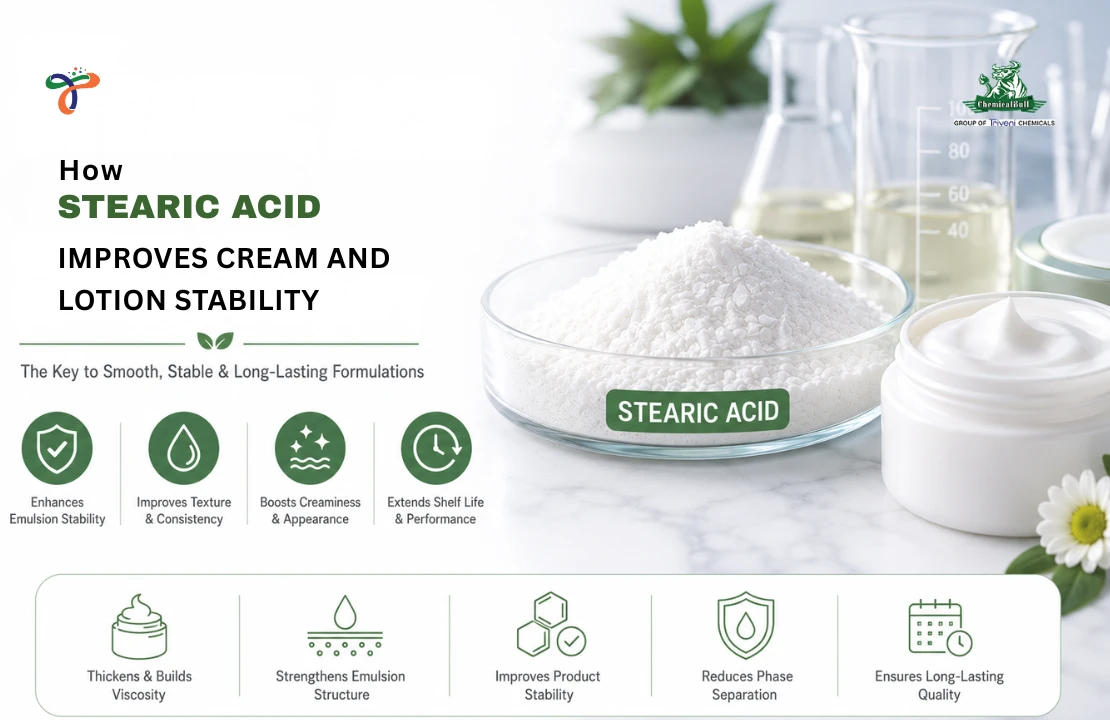
In the high-stakes landscape of cosmetic chemistry, emulsion stability is the ultimate benchmark of product success. A cream that separates on the shelf or a lotion that loses its rheological profile during distribution is a critical failure that compromises product integrity. Achieving a stable, high-performance emulsion requires a precise balance of chemistry and process engineering.
While many complex synthetic polymers dominate modern ingredient lists, the industry continues to rely on a proven, time-tested powerhouse: Stearic Acid.
Are you looking for a reliable supply partner for bulk Personal Care Chemicals?
Beyond our technical support for Stearic Acid, we are a leading stearic acid manufacturer. We provide consistent, high-purity supplies—specifically engineered for premium cosmetic and personal care formulations—backed by complete technical documentation to ensure your products meet the highest industry standards. Click here to explore our Personal Care range.
The Stability Powerhouse: Why Stearic Acid Remains Unbeatable
While modern cosmetic aisles are filled with complex synthetic additives, Stearic Acid remains the benchmark for stability. It is not just another ingredient; it is the foundational backbone that prevents formulation collapse. Its unmatched reliability in maintaining emulsion integrity makes it the preferred choice for formulators who refuse to compromise on quality. Whether it is preventing temperature-induced phase separation or ensuring the perfect viscosity, high-purity Stearic Acid acts as a guarantee of performance, ensuring your creams and lotions maintain their premium texture and stability from the moment of manufacture until the final consumer application.
The Anatomy of an Emulsion: The Thermodynamics of Failure
To understand how Stearic Acid stabilizes a formulation, we must first define the thermodynamic challenges of an emulsion. Creams and lotions are essentially mixtures of two immiscible phases—oil and water—forced into a single system.
Left to their own devices, these systems are inherently unstable. They seek to minimize their interfacial energy by separating. This leads to three primary failure modes:
- Flocculation: The aggregation of oil droplets into clusters without losing their individual identity.
- Creaming/Sedimentation: The movement of droplets due to gravity (density differences), often observed as a thin, watery layer at the bottom of the jar.
- Coalescence: The merging of droplets into a single, larger mass, leading to complete phase inversion.
Stearic Acid's Role: It functions as the "structural architect" of the formula, creating a robust physical barrier that prevents these failure modes from initiating.
Molecular Mechanics: The Science of Stabilization
Stearic Acid (C18H36O2) is a saturated long-chain fatty acid. Its molecular structure is the key to its stabilizing power:
- The Hydrophobic Tail (18-carbon chain): Anchors firmly into the oil phase.
- The Hydrophilic Head (Carboxyl group): Interacts with the aqueous phase.
When incorporated, it aligns at the interface, forming a rigid crystalline barrier. This prevents oil droplets from colliding and merging, even when subjected to external stresses like heat or physical vibrations during logistics.
Technical Insight: While this guide focuses on manufacturing stability, Stearic Acid is a multi-dimensional ingredient. For formulators interested in the interplay between its structural properties and end-user skin performance, you can review our functional analysis here: Stearic Acid: Skin Benefits, Functions, and Uses in Skincare.
The Multi-Functional Stability Toolkit
In a professional formulation, Stearic Acid serves three technical roles:
- Co-Emulsification: Reinforces the film created by primary emulsifiers, providing resilience against pH fluctuations.
- Rheology Control: Creates a crystalline gel network that increases viscosity and provides the luxurious "body" consumers expect.
- Thermal Buffer: Its high melting point (approx. 69°C) prevents the emulsion from breaking during transit in varying climates.
Technical Guidelines for Optimal Formulation
The Melting & Cooling Protocol
Stability starts in the kettle.
- Dissolution: Stearic Acid must be completely dissolved in the oil phase at 75°C–80°C. Any undissolved particle acts as a nucleation site for instability.
- Controlled Cooling: Rapid cooling causes uneven crystallization (graininess). Slow, uniform cooling with constant agitation is the secret to a professional, glossy finish.
Troubleshooting Batch Failures
|
Symptom |
Potential Cause |
Solution |
|
Separation (Syneresis) |
Weak interfacial film |
Increase Stearic Acid/Co-emulsifier ratio |
|
Grainy Texture |
Improper crystallization |
Check cooling rate and melt temperature |
|
Viscosity Drop |
Inconsistent raw materials |
Audit raw material purity/Iodine Value |
Advanced Formulation Tips
- Two-Phase Heating: Ensure water and oil phases are within 3°C of each other before emulsification to prevent "thermal shock."
- High-Shear Management: Use a homogenizer to reduce droplet size into the sub-micron range, creating superior stability.
- Fragrance Compatibility: Fragrance oils act as solvents that can dissolve the crystalline network. Slightly increase Stearic Acid when adding high fragrance loads.
The ChemicalBull Advantage
Stability is the result of precision. We support formulators with:
- Standardized Documentation: Full COA and TDS for every batch to meet ISO compliance.
- Industrial Scalability: Batch-to-batch uniformity that ensures pilot lab success translates to mass production.
- Technical Expertise: We function as an extension of your R&D team, helping you solve complex emulsification challenges.
Conclusion: Ensuring Excellence in Every Batch
Ultimately, stability is not an accident—it is a calculated result of high-quality inputs and precise process execution. By positioning Stearic Acid as the structural backbone of your emulsion, you move away from temporary fixes and toward long-term, shelf-stable product success. Consistency in your supply chain is the final link in this chain of excellence, ensuring that your formulations perform with the same brilliance in mass production as they did in the R&D lab.
Ready to elevate your formulation standards?
If you are looking to secure high-purity inputs that guarantee batch-to-batch uniformity, our technical team is here to help. Contact us today to discuss your specific grade requirements, request technical documentation, or order samples for your next pilot batch.
Frequently Asked Questions (FAQs)
- How does the Iodine Value (IV) of Stearic Acid affect emulsion stability?
The Iodine Value indicates the level of unsaturation in the fatty acid. A lower IV means higher purity and more saturation, which results in a more rigid, stable crystalline network. High IV (due to impurities like Oleic acid) can lead to a softer, less stable structure, potentially causing premature emulsion breakdown. - Can Stearic Acid be used as a standalone emulsifier?
While Stearic Acid provides excellent structural integrity, it is typically used as a co-emulsifier. It is most effective when paired with primary emulsifiers (like Glyceryl Monostearate or non-ionic surfactants) to form a complete, stable emulsification system. - Why does my cream turn "grainy" after a few days?
Graininess is usually the result of "polymorphic transformation" or uncontrolled crystallization. If the cooling rate is too rapid or the melting temperature wasn't consistent, the Stearic Acid may crystallize into large, uneven clusters. Controlled, slow cooling is essential for a smooth, glossy finish. - How do I choose between different grades of Stearic Acid for my formulation?
Selection depends on your required end-texture and stability. "Triple-pressed" grades are preferred for high-end cosmetics due to their superior color stability and lower impurity profile. Always audit the Acid Value (AV) and melting point to ensure they match your specific process parameters. - Does fragrance load impact the stability provided by Stearic Acid?
Yes. Fragrance oils act as solvents and can potentially dissolve or disrupt the crystalline gel network created by Stearic Acid. If you are working with high fragrance loads, it is often necessary to slightly increase the Stearic Acid concentration or adjust the co-emulsifier ratio to maintain viscosity.
Comment Section