Chemical Bull
917
17-Jun-2026
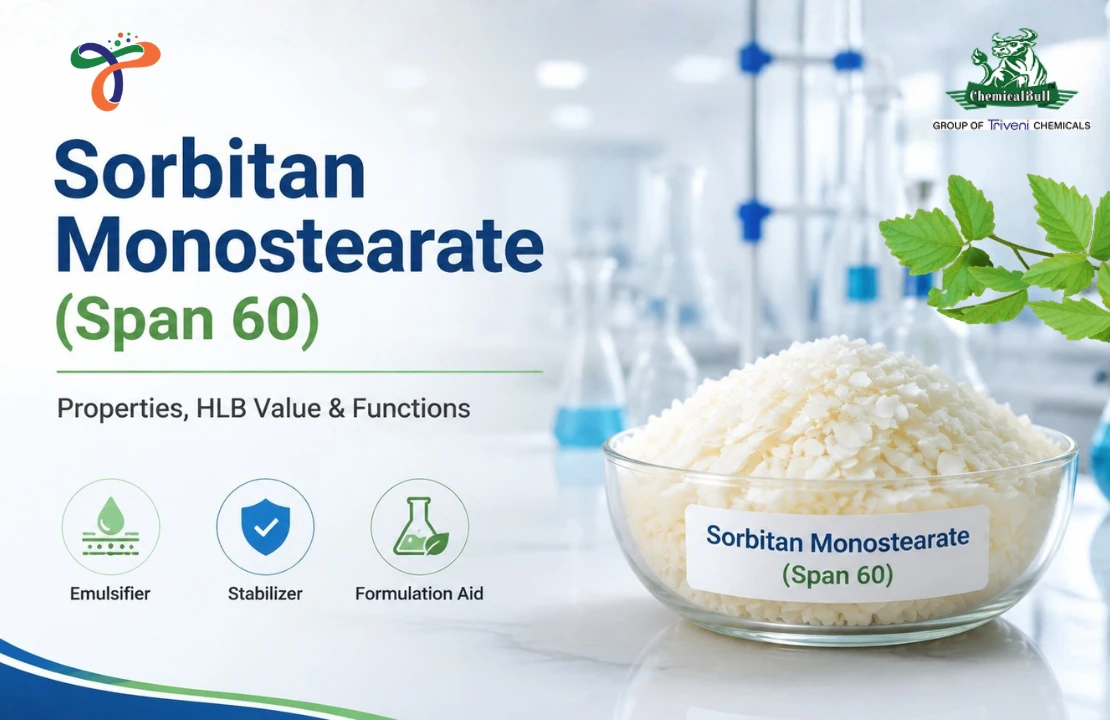
What Is Sorbitan Monostearate (Span 60)? Properties, HLB Value and Functions
Sorbitan Monostearate is one of the most widely used non-ionic emulsifiers in food, cosmetic, pharmaceutical, and industrial formulations. Known commercially as Span 60 and approved as E491 in food systems, it is a monoester of sorbitan and stearic acid that brings reliable emulsification, texture enhancement, and oil-phase compatibility to a broad range of product types.
This guide covers everything a formulator, chemist, or procurement professional needs to know about Sorbitan Monostearate: its chemical identity, physical form, HLB value, solubility behaviour, melting point, molecular structure, and how it actually functions in a formulation.
Looking for a reliable supply partner for bulk Sorbitan Monostearate?
Connect with a trusted industrial-grade Sorbitan Monostearate manufacturer for Food-grade, pharmaceutical-grade, and industrial-grade supply with complete documentation.
Chemical Identity and CAS Number
Sorbitan Monostearate is chemically defined as the monoester formed between sorbitan (a dehydration product of sorbitol) and stearic acid (an 18-carbon saturated fatty acid).
|
Property |
Details |
|
Common Name |
Sorbitan Monostearate |
|
Trade Name |
Span 60 |
|
E-Number (Food) |
E491 |
|
INCI Name (Cosmetics) |
Sorbitan Stearate |
|
CAS Number |
1338-41-6 |
|
Chemical Formula |
C₂₄H₄₆O₆ |
|
Molecular Weight |
Approximately 430.62 g/mol |
|
Emulsifier Class |
Non-ionic surfactant / sorbitan ester |
The CAS number 1338-41-6 is the primary chemical registry identifier used for procurement, customs documentation, regulatory filings, and Safety Data Sheet (SDS) reference. Always verify this number when sourcing Sorbitan Monostearate for food-grade, cosmetic-grade, or pharmaceutical-grade use.
HLB Value of Sorbitan Monostearate (Span 60)
The HLB value (Hydrophilic-Lipophilic Balance) is the most important parameter for selecting the right emulsifier for any formulation. It is a numerical scale, typically ranging from 1 to 20, that describes whether a surfactant is more compatible with oils (low HLB) or water (high HLB).
Sorbitan Monostearate has an HLB value of approximately 4.7.
What Does an HLB of 4.7 Mean?
An HLB value below 6 places Sorbitan Monostearate firmly in the lipophilic (oil-loving) range. This means it disperses more readily in oil phases than in water phases, making it well-suited for:
- Water-in-oil (W/O) emulsion systems
- Fat-phase texture structuring in food products
- Oil-phase stabilization in creams and ointments
- Dough conditioning in baked goods
However, its HLB of 4.7 is significantly higher than that of its closest relative Sorbitan Tristearate (HLB ~2.1), which makes Span 60 more balanced and flexible — it can function within emulsifier blends and co-emulsifier systems targeting a wider HLB range, including oil-in-water (O/W) emulsions when combined with a hydrophilic co-emulsifier such as Polysorbate 60 or Polysorbate 80.
HLB Reference Summary:
|
Emulsifier |
HLB Value |
Primary Use |
|
Sorbitan Monostearate (Span 60) |
~4.7 |
W/O emulsions, fat-phase stabilization |
|
Sorbitan Tristearate (Span 65) |
~2.1 |
High-fat, chocolate, and wax systems |
|
Polysorbate 60 (Tween 60) |
~14.9 |
O/W emulsions, aqueous systems |
|
Polysorbate 80 (Tween 80) |
~15.0 |
O/W emulsions, cosmetic and pharma |
When formulating O/W emulsions with Sorbitan Monostearate as part of the emulsifier system, the target HLB for the blend must be calculated based on the weight ratio of all emulsifiers used. This is a standard emulsifier blending calculation used by formulators.
Physical Properties of Sorbitan Monostearate
Sorbitan Monostearate is commercially available in solid form at room temperature. Its physical appearance and properties depend on the grade and processing method, but standard specifications are broadly consistent across suppliers.
|
Physical Property |
Typical Specification |
|
Physical Form |
Flakes, beads, prills, or waxy solid |
|
Colour |
Cream to tan / off-white |
|
Odour |
Mild fatty or waxy odour |
|
Melting Point |
Approximately 50–58°C (122–136°F) |
|
Boiling Point |
Not applicable (decomposes before boiling) |
|
Density |
Approximately 1.0 g/cm³ |
|
Acid Value |
≤ 10 mg KOH/g (typical food/cosmetic grade) |
|
Saponification Value |
147–157 mg KOH/g |
|
Hydroxyl Value |
235–260 mg KOH/g |
Melting Point Significance
The melting point range of 50–58°C is practically important for formulators. This means Sorbitan Monostearate:
- Melts cleanly during standard hot-process emulsification (typically conducted at 70–80°C)
- Remains solid at room temperature and standard storage conditions
- Is compatible with fat-phase preparation protocols used in both food and cosmetic manufacturing
- Needs to be added to the heated oil phase before combining with the water phase
Solubility and Dispersibility
Understanding solubility behaviour is essential for correct addition method and formulation efficiency.
|
Medium |
Behaviour |
|
Oils and fats (vegetable, mineral) |
Soluble when heated |
|
Ethanol |
Slightly soluble to dispersible |
|
Water (cold) |
Insoluble |
|
Water (hot, above 60°C) |
Dispersible with agitation |
|
Propylene glycol |
Slightly dispersible |
|
Chloroform / dichloromethane |
Soluble |
Key practical insight: Sorbitan Monostearate is not water-soluble. It must be added to the oil phase during emulsification. Attempting to disperse it directly in water at room temperature will result in poor performance and inconsistent texture. This is a common formulation error that affects emulsion stability.
Molecular Structure and Chemical Behaviour
Sorbitan Monostearate is produced through the esterification of sorbitol with stearic acid under controlled temperature and catalyst conditions. During this reaction, sorbitol undergoes partial dehydration to form sorbitan (a cyclic anhydro-sorbitol), and stearic acid is then esterified at one of the available hydroxyl groups.
The resulting molecule has:
- A lipophilic tail: the C18 stearic acid chain, which anchors into oil phases and fat matrices
- A hydrophilic head: the sorbitan ring structure, which retains some polarity from remaining hydroxyl (-OH) groups
This amphiphilic structure (having both oil-compatible and water-compatible regions within the same molecule) is what gives Sorbitan Monostearate its surfactant and emulsifying capability.
The mono in Sorbitan Monostearate refers to the single fatty acid chain attached. This is in contrast to Sorbitan Tristearate, which carries three stearic acid chains, resulting in far greater hydrophobicity (lower HLB, less residual -OH functionality).
Functions of Sorbitan Monostearate in Formulations
Sorbitan Monostearate performs multiple technical roles depending on the formulation type. Its functions go beyond simple emulsification.
1. Emulsification
Its primary function is to reduce interfacial tension between oil and water phases, helping them mix and remain stable. With an HLB of 4.7, it is particularly effective for stabilizing water-in-oil emulsions or as part of a co-emulsifier blend targeting oil-in-water systems.
2. Crystal Modification
In fat-based systems such as shortenings, margarine, and fat fillings, Sorbitan Monostearate interacts with triglyceride crystals to modify their polymorphic form. This results in smoother texture, reduced graininess, and better mouthfeel by promoting beta-prime (β') crystal formation.
3. Dough Conditioning
In bakery applications, Sorbitan Monostearate strengthens gluten networks and interacts with starch during baking. This improves dough tolerance during processing, enhances gas retention, and produces a finer, more uniform crumb structure with improved softness and longer shelf life.
4. Aeration and Foam Stabilization
In whipped toppings, icings, and aerated food products, Sorbitan Monostearate supports fat agglomeration around air cells, helping to create stable foam structure and improve overrun (volume increase from aeration).
5. Texture and Consistency Improvement
In creams, lotions, and ointments, Sorbitan Monostearate contributes to a smooth, non-greasy skin feel, improved spreadability, and stable emulsion structure across temperature variations.
6. Dispersion Aid
In industrial and specialty chemical systems, Sorbitan Monostearate acts as a dispersing agent, helping hydrophobic particles or ingredients distribute more uniformly through oil or fat matrices.
Storage and Handling
Sorbitan Monostearate is stable under standard storage conditions. The following guidelines apply:
- Storage Temperature: Cool, dry environment below 30°C
- Packaging: Sealed bags or drums to prevent moisture uptake and contamination
- Shelf Life: Typically 24 months from date of manufacture when stored correctly
- Handling: Standard industrial hygiene practices; avoid inhalation of fine dust; use gloves for prolonged contact
Sorbitan Monostearate does not require refrigerated storage. It should be kept away from strong oxidizing agents, excessive heat, and direct sunlight.
Sorbitan Monostearate vs. Its Polysorbate Counterpart
A frequently asked question: what is the relationship between Sorbitan Monostearate (Span 60) and Polysorbate 60 (Tween 60)?
Polysorbate 60 is produced by ethoxylating Sorbitan Monostearate — adding polyoxyethylene (POE) chains to the sorbitan head group. This dramatically increases water compatibility and raises the HLB value from ~4.7 to ~14.9.
In practical terms:
- Span 60 alone → better for oil-phase or W/O applications
- Tween 60 alone → better for aqueous or O/W applications
- Span 60 + Tween 60 blended → enables a wide range of target HLB values and is one of the most effective emulsifier systems used in food and cosmetic manufacturing
This combination approach is widely used in cake mixes, whipped toppings, and cosmetic emulsions where a specific intermediate HLB is required for optimal stability.
Frequently Asked Questions
1. What is the CAS number of Sorbitan Monostearate?
The CAS number is 1338-41-6. This applies to the standard commercial grade of Sorbitan Monostearate (Span 60 / E491).
2. What is the HLB value of Span 60?
The HLB value of Span 60 (Sorbitan Monostearate) is approximately 4.7. This places it in the lipophilic range, making it suitable for W/O emulsions and oil-phase compatibility, and effective in blended emulsifier systems.
3. What is the melting point of Sorbitan Monostearate?
The melting point is typically in the range of 50–58°C, depending on grade and fatty acid composition. This allows it to melt cleanly during standard hot-process emulsification conducted at 70–80°C.
4. Is Sorbitan Monostearate soluble in water?
No. Sorbitan Monostearate is not soluble in cold water. It is soluble in oils and fats when heated, and can be dispersed in hot water with agitation. It must always be incorporated into the oil phase during emulsification.
5. What is E491?
E491 is the European food additive code for Sorbitan Monostearate. It is used as an emulsifier and stabilizer in a range of approved food categories including bakery products, confectionery, and fat-based spreads.
6. What is the chemical formula of Sorbitan Monostearate?
The molecular formula is C₂₄H₄₆O₆, with an approximate molecular weight of 430.62 g/mol.
7. What is the difference between Span 60 and Tween 60?
Span 60 is Sorbitan Monostearate (HLB ~4.7), while Tween 60 is the ethoxylated derivative Polysorbate 60 (HLB ~14.9). Span 60 is oil-compatible; Tween 60 is water-compatible. They are often blended together to achieve a target HLB for specific emulsion systems.
Conclusion
Sorbitan Monostearate (Span 60 / E491) is a technically well-defined, multi-functional non-ionic emulsifier with a CAS number of 1338-41-6, an HLB value of approximately 4.7, and a melting point range of 50–58°C. Its amphiphilic molecular structure — combining a lipophilic C18 stearate tail with a sorbitan head group — gives it strong oil-phase compatibility, emulsification capability, crystal-modifying function, and texture-improving properties across food, cosmetic, pharmaceutical, and industrial applications.
For bulk sourcing of Sorbitan Monostearate with COA, TDS, and SDS documentation, or to request a sample for formulation trials, contact ChemicalBull — your reliable Sorbitan Monostearate supplier for food-grade, cosmetic-grade, and industrial-grade requirements.

Comment Section