Chemical Bull
1427
18-Jun-2026
Solubilizer vs Emulsifier in Cosmetic Formulations: Key Differences
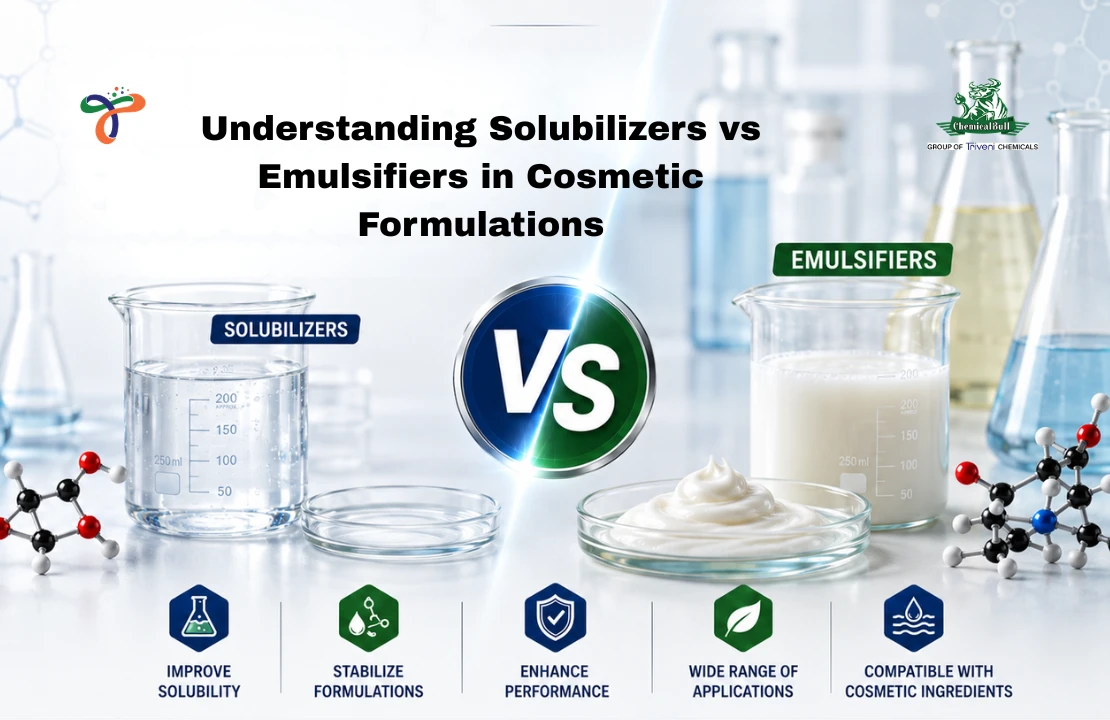
A solubilizer helps disperse small amounts of oil-soluble ingredients into water-based cosmetic products, while an emulsifier helps combine larger oil and water phases into stable creams, lotions, and emulsions.
In cosmetic formulation, this difference matters because using the wrong ingredient can cause cloudiness, oil separation, poor texture, unstable viscosity, or product failure during storage.
Why This Difference Matters in B2B Cosmetic Formulation
For cosmetic manufacturers, contract formulators, personal care brands, and raw material buyers, solubilizers and emulsifiers are not interchangeable.
Both manage oil-water incompatibility, but they solve different formulation problems.
-
Solubilizers are mainly used in clear or transparent water-based products.
-
Emulsifiers are mainly used in creamy, milky, or opaque emulsions.
-
Solubilizers handle low oil loads.
-
Emulsifiers handle larger oil phases.
-
The right selection improves clarity, texture, stability, and shelf life.
What Is a Solubilizer?
A solubilizer is a cosmetic raw material used to disperse small amounts of oil-soluble ingredients into water.
It is commonly used when the final product needs to stay clear, transparent, or slightly translucent.
Common Products That Use Solubilizers
-
Facial toners
-
Micellar water
-
Body mists
-
Hair tonics
-
Transparent shower gels
-
Clear cleansers
-
Fragrance sprays
-
Water-based serums
Ingredients Solubilizers Help Disperse
Solubilizers are useful for low levels of:
-
Fragrance oils
-
Essential oils
-
Oil-soluble vitamins
-
Botanical extracts
-
Preservative boosters
-
Lipophilic actives
Solubilizer Examples (Raw Material)
|
Solubilizer Raw Chemical |
Common Cosmetic Use |
|
PEG-40 Hydrogenated Castor Oil |
Fragrance, essential oil, and oil-soluble active solubilization |
|
Polysorbate 20 |
Toners, sprays, mists, and clear water-based products |
|
Polysorbate 80 |
Heavier oils, oil-soluble ingredients, and emulsified systems |
|
PEG-7 Glyceryl Cocoate |
Mild solubilizer and refatting agent in cleansers |
|
Caprylyl/Capryl Glucoside |
Natural-positioned solubilizer for mild cleansing systems |
|
Decyl Glucoside |
Mild surfactant with solubilizing support |
What Is an Emulsifier?
An emulsifier is a cosmetic ingredient that helps oil and water mix into a stable emulsion.
Emulsifiers are used when a formulation contains a proper oil phase and water phase, such as in creams, lotions, sunscreens, conditioners, and moisturizers.
Unlike solubilizers, emulsifiers usually create products that are creamy, milky, opaque, or rich in texture.
Common Products That Use Emulsifiers
-
Face creams
-
Body lotions
-
Moisturizers
-
Hair conditioners
-
Sunscreens
-
Cleansing creams
-
Makeup foundations
-
Cream masks
Emulsifier Raw Material Examples
|
Emulsifier Raw Chemical |
Common Cosmetic Use |
|
Glyceryl Stearate |
Creams, lotions, and moisturizers |
|
Ceteareth-20 |
Oil-in-water creams, lotions, and conditioners |
|
Cetyl Alcohol |
Viscosity builder and co-emulsifier |
|
Stearyl Alcohol |
Thickener and emulsion stabilizer |
|
Emulsifying Wax |
General-purpose creams and lotions |
|
Lecithin |
Natural-origin emulsifier for skin care |
|
Potassium Cetyl Phosphate |
Creams, lotions, and sunscreen systems |
Solubilizer vs Emulsifier: Key Differences
|
Factor |
Solubilizer |
Emulsifier |
|
Main function |
Disperses small oil-soluble ingredients in water |
Combines oil and water phases |
|
Best for |
Clear water-based products |
Creams, lotions, and emulsions |
|
Oil load |
Low oil content |
Medium to high oil content |
|
Product appearance |
Clear or slightly hazy |
Creamy, milky, or opaque |
|
Common products |
Toners, mists, micellar water, sprays |
Creams, conditioners, sunscreens, lotions |
|
Texture impact |
Light and watery |
Creamy, rich, structured |
|
Stability role |
Prevents floating oil droplets |
Prevents phase separation |
|
Selection basis |
Clarity, oil type, solubilizer ratio |
Oil phase, HLB system, viscosity, emulsion type |
How Solubilizers Work in Clear Cosmetic Formulations
Solubilizers contain both water-loving and oil-loving parts. These structures help surround tiny oil droplets and keep them dispersed in water.
For example, if fragrance oil is added directly into a toner, it may float or create visible droplets. A solubilizer helps distribute the fragrance evenly through the water phase.
Key Formulation Checks for Solubilizers
-
Fragrance or essential oil type
-
Solubilizer-to-oil ratio
-
Desired clarity
-
pH compatibility
-
Preservative compatibility
-
Skin feel
-
Foam impact
-
Temperature stability
How Emulsifiers Work in Creams, Lotions, and Emulsions
Emulsifiers reduce the tension between oil and water. They help create small droplets of one phase inside another phase.
Oil-in-Water Emulsion
Oil droplets are dispersed in water. These are lighter formulas used in:
-
Lotions
-
Day creams
-
Moisturizers
-
Hair conditioners
-
Sunscreens
Water-in-Oil Emulsion
Water droplets are dispersed in oil. These are richer formulas used in:
-
Barrier creams
-
Cold creams
-
Heavy moisturizers
-
Water-resistant sunscreens
When to Use a Solubilizer
Use a solubilizer when:
- The product must stay clear or transparent
- The oil-soluble ingredient is present at low levels (fragrance, essential oil, vitamin, preservative booster)
- The product is primarily water-based with no significant oil phase
Typical products: Facial toner, face mist, micellar water, fragrance spray, hair tonic, transparent shower gel, water-based serum
When to Use an Emulsifier
Use an emulsifier when:
- The product contains both a water phase and an oil phase
- The formula needs to be creamy, milky, or opaque
- Oils, butters, waxes, or silicones make up a significant portion of the formula
Typical products: Face cream, body lotion, moisturizer, conditioner, sunscreen, cleansing cream, makeup foundation
Can Solubilizers and Emulsifiers Be Used Together?
Yes. Some cosmetic formulations use both.
For example, a lotion may use emulsifiers to stabilize the main oil phase, while a solubilizer may help disperse fragrance or a small amount of oil-soluble active.
However, compatibility testing is important because combining both can affect:
-
Viscosity
-
Clarity
-
Foam
-
Skin feel
-
Preservative performance
-
Long-term stability
Conclusion
Solubilizers and emulsifiers both help manage oil-water incompatibility, but they are used for different formulation needs.
Use solubilizers for clear water-based products with low oil content. Use emulsifiers for creams, lotions, conditioners, sunscreens, and formulas with larger oil and water phases.
For B2B cosmetic brands, selecting the right raw material improves product clarity, texture, stability, sensory feel, and shelf life.
Contact a trusted PEG 40 hydrogenated castor oil distributor for reliable sourcing and formulation support, also get bulk supply for related chemicals.
Frequently Asked Questions
-
What is the main difference between a solubilizer and an emulsifier?
A solubilizer disperses small amounts of oil-soluble ingredients in water-based products, while an emulsifier combines larger oil and water phases into stable emulsions. -
What HLB value is best for solubilizers?
Many cosmetic solubilizers have higher HLB values, often around 12–17, because they need strong water compatibility for clear aqueous systems. -
What HLB value is best for emulsifiers?
It depends on the emulsion type. Oil-in-water emulsions usually need higher HLB emulsifiers, while water-in-oil emulsions often use lower HLB emulsifiers. -
Can Polysorbate 20 be used as a solubilizer?
Yes. Polysorbate 20 is commonly used to solubilize fragrances and essential oils in toners, sprays, mists, and other water-based cosmetic products. -
Can a solubilizer replace an emulsifier in creams?
Usually no. Solubilizers are suitable for low oil levels, but creams and lotions with larger oil phases generally need a proper emulsifier system.
Comment Section