Chemical Bull
414
15-Jun-2026
Sorbitan Tristearate vs Sorbitan Monostearate: Key Differences, Properties and Applications
Selecting the wrong emulsifier can affect texture, stability, processing, and shelf life. That is why the comparison of Sorbitan Tristearate vs Sorbitan Monostearate matters in food, cosmetic, pharmaceutical, and industrial formulations.
Both ingredients belong to the sorbitan ester family. Both are non-ionic surfactants. Both are used to improve emulsification, dispersion, and fat-phase stability. However, their structure, HLB value, oil compatibility, and applications are different.
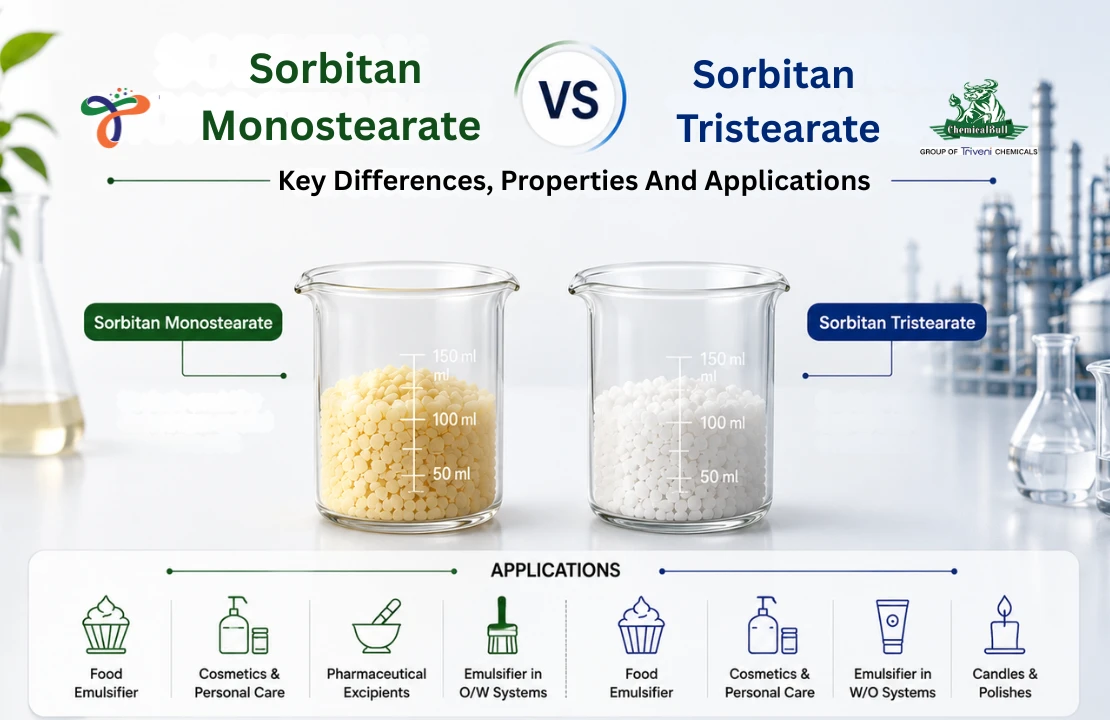
Sorbitan Monostearate, also known as Span 60 or E491, is more versatile and widely used in bakery, margarine, creams, lotions, and topical formulations. Sorbitan Tristearate, also known as Span 65 or E492, is more oil-loving and performs better in chocolate, confectionery coatings, fat-rich systems, and wax-based products.
If you are sourcing either grade in bulk for food, cosmetic, or industrial use, ChemicalBull helps you compare suitable grades, documentation, and supply options for Sorbitan Monostearate and Sorbitan Tristearate.
What Are Sorbitan Esters?
Sorbitan esters are non-ionic emulsifiers made from sorbitan and fatty acids. They help improve mixing, dispersion, texture, and stability in food, cosmetic, pharmaceutical, and industrial formulations.
A sorbitan ester works by helping oil and water phases stay more evenly distributed. In fat-based systems, it can also improve smoothness, structure, and processing performance.
The number of fatty acid chains attached to the sorbitan structure affects the product’s oil-loving or water-loving nature. This is measured using the HLB value, which stands for Hydrophilic-Lipophilic Balance.
A lower HLB value means the emulsifier is more oil-loving. A higher HLB value means it has more water-phase compatibility.
In food applications, Sorbitan Monostearate is E491, while Sorbitan Tristearate is E492. In cosmetics, Sorbitan Monostearate is commonly listed as Sorbitan Stearate, while Sorbitan Tristearate is listed as Sorbitan Tristearate.
Sorbitan Monostearate vs Sorbitan Tristearate: Key Properties at a Glance
|
Property |
Sorbitan Monostearate |
Sorbitan Tristearate |
|
Common Name |
Span 60 |
Span 65 |
|
E-Number |
E491 |
E492 |
|
INCI Name |
Sorbitan Stearate |
Sorbitan Tristearate |
|
Emulsifier Type |
Non-ionic emulsifier |
Non-ionic emulsifier |
|
Chemical Nature |
Monoester of sorbitan and stearic acid |
Triester of sorbitan and stearic acid |
|
Typical HLB Value |
Around 4.7 |
Around 2.1 |
|
Oil Compatibility |
Good |
Excellent |
|
Water Dispersibility |
Better than Sorbitan Tristearate |
Very limited |
|
Physical Form |
Cream to tan flakes, beads, or waxy solid |
White to cream flakes, beads, or waxy solid |
|
Odor |
Mild fatty odor |
Mild waxy or fatty odor |
|
Main Function |
Emulsification, texture support, dispersion |
Fat-phase stability, oil compatibility, structure support |
|
Application Range |
Broad |
More specific |
Span 60 vs Span 65: Functional Differences and Best-Use Comparison
|
Comparison Point |
Sorbitan Monostearate |
Sorbitan Tristearate |
|
Main Difference |
More balanced emulsifier |
More oil-compatible emulsifier |
|
Best Performance Area |
Bakery, margarine, creams, lotions, topical products |
Chocolate, compound coatings, confectionery, wax-rich systems |
|
HLB Meaning |
More flexible in emulsifier blends |
Stronger fat and oil compatibility |
|
Food Role |
Dough conditioning, texture improvement, emulsion stability |
Fat crystal control, chocolate stability, coating performance |
|
Cosmetic Role |
Cream and lotion stabilization |
Balm, stick, and wax matrix structuring |
|
Pharma Role |
Topical creams, ointments, semi-solid products |
Lipid-based or oil-rich formulations |
|
Industrial Role |
Dispersing aid, surfactant, processing aid |
Oil/wax dispersant, lubricant aid, hydrophobic systems |
|
Best Choice When |
Balanced emulsification is needed |
Fat-phase performance is needed |
Sorbitan Tristearate Uses
- Used in oil-rich, fat-rich, and wax-based systems.
- Common in chocolate, compound coatings, confectionery fats, fat spreads, and low-moisture fat-based products.
- Used in balms, sticks, lip products, heavy creams, wax-based products, and oil-rich formulations.
- Helps support smooth processing, stable texture, and fat-phase performance.
- Preferred in chocolate and compound coatings because it works well in fat-continuous systems.
- Used in waxes, plastics, PVC, lubricants, coatings, and hydrophobic systems for oil compatibility and dispersion support.
Sorbitan Monostearate Uses
- Used in bakery items, cake mixes, whipped toppings, icings, margarine, and fat-based spreads.
- Helps improve softness, aeration, consistency, and product stability.
- Used in creams, lotions, sunscreens, ointments, body butters, and emulsified products.
- Supports smooth spreadability, texture, and emulsion stability in personal care products.
- Works as a non-ionic surfactant, dispersing agent, or processing aid in coatings, plastics, lubricants, textile auxiliaries, and specialty formulations.
- Supports crumb softness and better texture in bakery systems.
How to Choose Between Sorbitan Tristearate and Sorbitan Monostearate
Choose Sorbitan Monostearate when you need balanced emulsification, smooth texture, and wider use in bakery, margarine, creams, lotions, and ointments.
Choose Sorbitan Tristearate when the formula is oil-rich, fat-based, or wax-based, such as chocolate, compound coatings, balms, sticks, and confectionery fats.
Always test the selected emulsifier before scale-up, as performance depends on dosage, temperature, mixing order, and final formulation.
Frequently Asked Questions
-
Is Sorbitan Monostearate the same as Span 60?
Yes. Sorbitan Monostearate is commonly known as Span 60. It is also identified as E491 in food applications. It is widely used in bakery, margarine, whipped toppings, creams, lotions, ointments, and other emulsified formulations. -
Which is better for chocolate: Sorbitan Tristearate or Sorbitan Monostearate?
Sorbitan Tristearate is generally better for chocolate and compound coatings because it has stronger oil and fat compatibility. Its low HLB value makes it suitable for fat-continuous systems where smooth processing, structure, and storage stability are important. -
Which is better for creams and lotions?
Sorbitan Monostearate is generally better for creams, lotions, sunscreens, and emulsified personal care products. It offers balanced emulsification, smooth texture, and better flexibility when used alone or with other emulsifiers. -
Are sorbitan esters safe for food use?
Sorbitan esters are used as approved food emulsifiers in many markets when used within permitted limits and suitable food categories. Sorbitan Monostearate is known as E491, and Sorbitan Tristearate is known as E492. Always check local regulations, grade suitability, and supplier documentation before use. -
What is the difference between E491 and E492?
E491 is Sorbitan Monostearate, also known as Span 60. E492 is Sorbitan Tristearate, also known as Span 65. E491 is more versatile for bakery, margarine, creams, and emulsions, while E492 is more suitable for chocolate, confectionery, and fat-rich systems.
Conclusion
The main difference between Sorbitan Tristearate and Sorbitan Monostearate is application fit. Sorbitan Monostearate is the better choice for balanced emulsification and broad use, while Sorbitan Tristearate is better for oil-rich, fat-rich, and wax-based systems.
For Sorbitan Monostearate, Sorbitan Tristearate, samples, COA, TDS, SDS, and bulk sourcing support, explore suitable grades with ChemicalBull.

Comment Section