Chemical Bull
9035
08-Dec-2025
Vanillin for Industrial use and Bulk Requirements
ChemicalBull Pvt. Ltd. supplies Vanillin (CAS 121-33-5) for industrial and commercial applications, supporting manufacturers, flavour houses, fragrance companies, cosmetic formulators, pharmaceutical manufacturers and other B2B buyers.
Vanillin is available for bulk and recurring industrial requirements, with supply suited to applications including:
- Food and beverage flavour formulations
- Bakery and confectionery products
- Chocolate and dairy applications
- Flavour manufacturing
- Fragrances and perfumery
- Cosmetics and personal care formulations
- Pharmaceutical formulations
- Industrial aroma and speciality chemical applications
For commercial procurement, buyers can evaluate Vanillin based on purity, specification, documentation, packaging, quantity requirements and supply consistency.
Why Source Vanillin from ChemicalBull?
- Bulk supply for industrial requirements
- Consistent product specifications
- Support for B2B and recurring requirements
- COA and relevant product documentation
- Domestic and export supply capabilities
- Competitive commercial pricing based on quantity
- Support for manufacturers, formulators and distributors
If you are looking for Vanillin in bulk, contact ChemicalBull Pvt. Ltd. with your required quantity, application and delivery location to discuss availability and commercial supply options.
Request a quotation for Vanillin (CAS 121-33-5) for your industrial requirement.
Vanillin (CAS 121-33-5): Uses, Industrial Applications & Bulk Purchasing
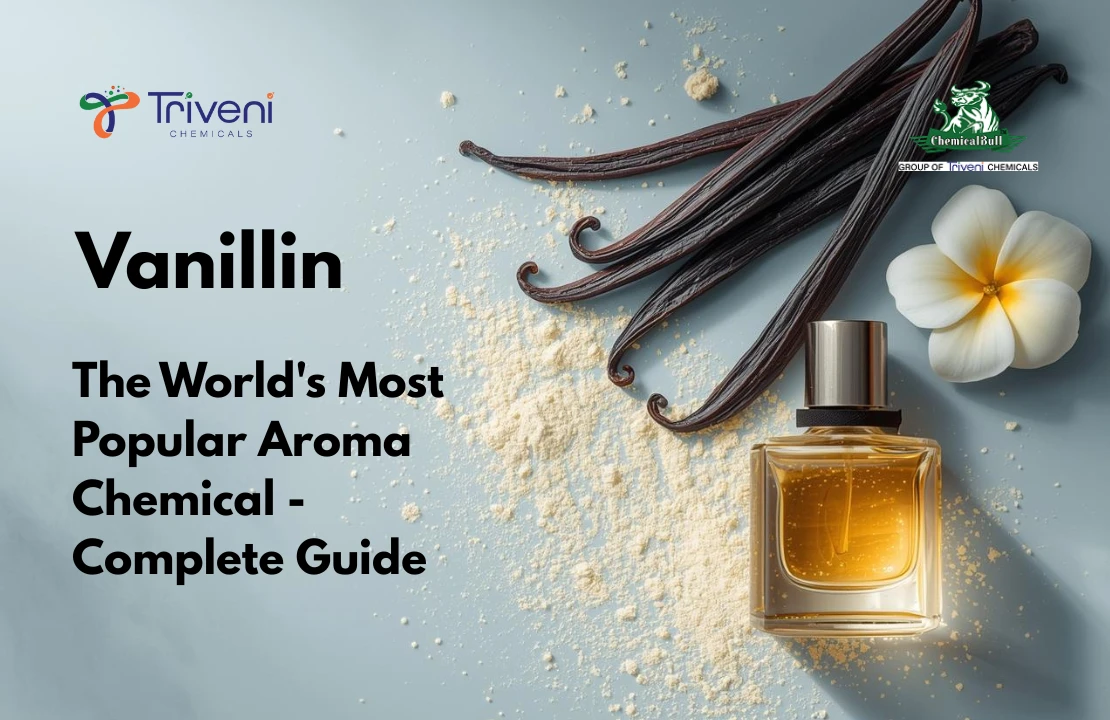
Vanillin is one of the most important aroma chemicals used worldwide in fragrances, flavours, cosmetics and personal care formulations. Its soft, creamy and comforting profile makes it a universal favourite for both consumers and manufacturers.
As a leading supplier of aroma chemicals, Chemicalbull Pvt. Ltd. supports B2B flavour houses, perfumers, and chemical manufacturers with high-quality vanillin suitable for industrial applications.
This guide explains the structure of vanillin, its uses across industries, formulation behaviour in perfumes and flavours, blending tips, purity identification and market insights relevant for B2B buyers.
1. Understanding Vanillin and Its Chemical Profile
Vanillin (C₈H₈O₃) is the primary molecule responsible for the classic vanilla aroma. It is a white crystalline powder known for its warm, sweet and slightly spicy character. The molecule belongs to the phenolic aldehyde family and dissolves well in alcohol, making it ideal for perfumery and flavour blends. Vanillin CAS number is 121-33-5.
Its melting point of 81–83°C and consistent stability ensure predictable performance in a wide range of industrial applications.
2. How Vanilla Flavour Is Created in Industry
Natural vanilla beans contain vanillin along with hundreds of minor aroma compounds. However, natural extraction is costly and limited, so most global industries rely on high-purity synthetic or bio-based vanillin.
Flavour houses use vanillin to build vanilla profiles in bakery, dairy, chocolate and beverage formulations because it is stable, cost-effective and offers consistent quality.
For deeper learning on aroma chemicals, Explore these blogs:
3. Natural vs Synthetic Vanillin: What B2B Buyers Need to Know
Both grades are widely used, but the choice depends on the application, cost structure and regulatory requirements.
|
Feature |
Natural Vanillin |
Synthetic Vanillin |
|
Source |
Extracted from vanilla beans |
Produced from guaiacol or lignin |
|
Consistency |
May vary by harvest |
Highly consistent |
|
Supply Availability |
Limited, seasonal |
Stable year-round |
|
Preferred For |
Premium gourmet products |
Mass-scale fragrances & flavours |
|
Environmental Impact |
Depends on farming practices |
Depends on production method |
4. Industrial Applications of Vanillin
Vanillin plays a key role across various sectors because of its pleasant aroma, chemical stability and cost efficiency.
Flavours
Used in chocolates, bakery mixes, ice creams, beverages and confectionery where a sweet vanilla note enhances overall taste.
Fragrances
Perfumers include vanillin in fine fragrances, body mists, deodorants, soaps and candles. It brings warmth and acts as an anchor for spicy, gourmand and oriental themes.
Pharmaceuticals
Applied as a taste-masking agent and aromatic stabiliser in syrups and oral medicines.
Chemical Industry
Used as an intermediate and is widely preferred in R&D because of its predictable behaviour.
5. Vanillin in Perfumery: A Practical Guide for Formulators
Respected in modern perfumery, vanillin adds softness and emotional warmth. It works best with spices, ambers, musks, woods and nutty characters. Its ability to slow down evaporation gives it a natural fixative effect, improving the lasting power of fragrance compositions.
Vanillin also enhances festive and winter blends, making it a common choice for seasonal perfumes, holiday room fragrances and scented candles.
In an Eau de Parfum (EDP), vanillin is generally used at 1% to 3% of the total formula, as it acts as a warm base note and provides good fixation and lasting power.
For more aroma industry insights:
Complete Guide to Aroma Chemicals
Aroma Chemicals page
6. Blending Vanillin for Complex Fragrance & Flavour Profiles
Vanillin blends naturally with other aroma chemicals to create richer and more expressive compositions. Perfumers and flavour developers often pair it with ethyl vanillin, coumarin, linalool, benzaldehyde, musks and amber notes to enhance sweetness, warmth and depth.
Vanillin vs Ethyl Vanillin:
Vanillin gives a soft, creamy and natural vanilla character, suitable for gentle flavours and fragrances. Ethyl vanillin is much stronger and sweeter, offering a sharper impact at lower dosages. Because of this intensity, it is commonly used in bold flavour systems and oriental-style perfumes where a powerful vanilla note is needed.
7. Identifying Vanillin Purity for Industrial Formulation
Purity plays a major role in performance, odour impact and batch consistency. High-quality vanillin maintains a uniform crystalline appearance, steady melting point and clean sweetness without burnt notes.
Industrial buyers should always check COA, GC data and physical characteristics before finalising procurement, especially when sourcing large commercial quantities.
8. Difference Between Vanillin and Vanilla Extract
Many buyers confuse these two, but they differ significantly in origin, performance and cost.
|
Aspect |
Vanillin |
Vanilla Extract |
|
Composition |
Single aroma chemical |
Natural mix of many compounds |
|
Source |
Synthetic or bio-based |
Extracted from vanilla beans |
|
Odour Profile |
Predictable creamy sweetness |
Complex, floral, woody and spicy |
|
Stability |
Higher heat and storage stability |
Sensitive to oxidation and heat |
|
Industrial Use |
Flavours, fragrances, cosmetics |
Gourmet and premium food applications |
9. Vanillin in Holiday Spice Blends and Winter Flavor Accords
Vanillin is widely used to round off holiday spice blends and create smooth winter flavor accords. Its gentle sweetness helps connect warm notes like cinnamon, nutmeg and clove, giving seasonal formulations a balanced and comforting profile. For perfumes and flavours launched during the colder months, vanillin adds a subtle creamy warmth that enhances overall depth without overpowering other ingredients. This makes it a reliable choice for brands developing winter collections with a refined vanilla character.
Vanillin Market Trends and Future Outlook
Demand for vanillin continues to grow due to rising usage in bakery, confectionery, home fragrances, and personal care products. Synthetic vanillin remains the most preferred grade for industrial sectors because it delivers reliability and scalability at competitive pricing.
Future trends indicate increasing interest in:
-
Bio-based vanillin from renewable sources
-
Cleaner label ingredients in flavours
-
Growing demand for gourmand and warm fragrance profiles
-
Expansion of vanillin derivatives for speciality formulations
As one of the top vanillin suppliers for industrial applications, Triveni Chemicals ( ChemicalBull Pvt. Ltd.) remains committed to supporting manufacturers with consistent quality, competitive pricing and technical guidance.
Top FAQs for vanillin
1. What is vanillin used for?
Vanillin is used in flavours, fragrances, chocolates, ice creams, baked goods, cosmetics, pharmaceuticals and aromatic blends.
2. Can vanillin be used in perfumes?
Yes, vanillin is widely used in perfumes for its warm and long-lasting creamy note.
3. Is vanillin made from petroleum?
Some synthetic vanillin is produced from guaiacol, which is petroleum-derived, while bio-based alternatives are also available.
4. What is the aroma chemical in vanilla?
The primary aroma chemical in vanilla is vanillin, which gives it its sweet and creamy signature scent.
5. Is vanillin bad for you?
Vanillin is considered safe when used within regulated limits for food, fragrance and cosmetic formulations.
Comment Section