Chemical Bull
6752
14-Feb-2026
Introduction
Within the world of chemistry and manufacturing, there are many different chemicals that are not the same. A similar compound, whether it's citric acid, ethanol, or sodium chloride, can be found in a variety of grades based on the intended usage. The distinction between industrial chemicals and pharmaceutical ones is vital for chemical manufacturers, as well as quality experts and all those who are involved in purchasing chemicals.
Chemicals that are industrial grade and pharmaceutical grade may be able to share the exact molecular formula; however, they are vastly different in their purity, test requirements, regulation oversight, and cost. If you choose the wrong one, it could cause serious problems, from recalls of products to health risks. This complete guide explains the meaning of pharmaceutical grade in relation to industrial grade and the reasons why this distinction is important for real-world situations.
If you want to read more so, visit our complete guide : Pharmaceutical Chemicals: Complete Guide to Types, Applications, and Quality Standards
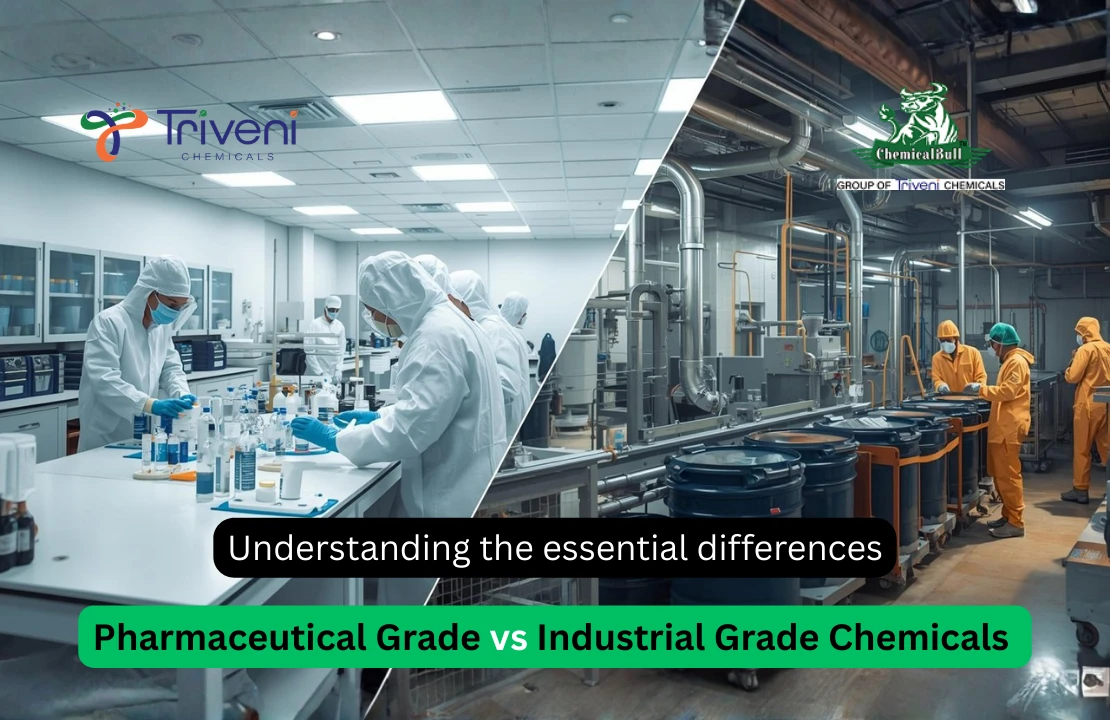
What Does Pharmaceutical Grade Mean?
"Pharmaceutical Grade" is a reference to substances that meet the highest requirements for quality in veterinary or human medicines. Chemicals that are pharmaceutical grade must meet guidelines set forth in authoritative pharmacopoeias, such as those in the United States Pharmacopeia (USP), European Pharmacopoeia (EP), and the Japanese Pharmacopoeia (JP).
The pharmaceutical-grade chemicals can be defined by:
- Extraordinary Pure : Typically has at least 99% purity and strictly controlled impurity limits
- Prolonged Tests : Each batch goes through rigorous analysis and testing
- Full documentation : Complete documentation, traceability using COA certificates (COA)
- Regulatory Compliance : Manufacturing follows Good Manufacturing Practices (GMP)
- Consistency : Batch-to-batch uniformity is guaranteed
- Safe Verification : Tests for toxicological checks ensure that it is safe for the human body
If you see "USP grade" or "BP grade" (British Pharmacopoeia), this is an expression of the chemicals that could be utilized in the pharmaceutical industry. The standards of quality for pharmaceutical chemicals are created to protect the safety and health of patients as well as to ensure the efficacy of treatment.
To ensure that pharmaceutical chemicals are certified and meet international standards of pharmacopeial quality, working with reliable manufacturers guarantees high-quality and conformity.
Understanding Industrial Grade Chemicals
Industrial-grade chemicals have a totally distinct purpose. These chemicals are designed for manufacturing processes, industrial applications, or commercial usage. They are not to be used for food or manufacturing pharmaceuticals.
Industrial chemicals use spans countless applications:
- Chemical production and the synthesis
- Processing of metals as well as surface treatments
- Purification and treatment of water
- Production of paper and textiles
- Products for cleaning and maintenance
- Agricultural applications
- Formulations for coatings and paints
- Petroleum refining
Although industrial-grade chemicals have to conform to specific specifications, they are much less strict than the pharmaceutical requirements. Industrial grade usually is a reference to:
- Functional Purity: It is undiluted enough to be used in the manufacturing process (often 95-98 for a %)
- Cost-Effective: Lower price point due to less rigorous testing
- Useful for the Purpose meets technical requirements, without excess purification
- Different Standards. The quality is dependent on the supplier and the application
- limited testing, the basic quality tests, rather than a full analysis
Explore top-quality industrial-grade chemicals used in manufacturing processes, commercial, and industrial applications.
Key Differences: Pharmaceutical Grade vs Industrial Grade
1. Purity Requirements
The primary distinction between industrial and pharmaceutical chemicals is the specifics of purity.
Chemical purity requirements for pharmaceutical chemical products are extremely rigorous. Pharmaceutical-grade solvents may require 99.9 100% purity and each impurity limited to a certain amount of parts per million (ppm) or perhaps parts per billion (ppb). All potential contaminants-heavy metals, residual solvents, Microbial content, and endotoxins are all tested and controlled.
However, industrial-grade chemicals typically have a purity of 95-98 that is sufficient to be used in most industrial procedures. The remaining 25% could be contaminated with impurities, which don't impact the performance of industrial processes, but are unacceptable in pharmaceuticals.
2. Testing and Documentation
The quality requirements for pharmaceutical chemicals are based on extensive tests of analytical quality. Every batch of pharmaceutical-grade chemicals goes through a series of tests:
- Identification verification (FTIR, NMR, or any other methods of spectroscopic analysis)
- Purity tests employing HPLC and GC
- Testing of heavy metals
- Residual solvent analysis
- Microbial limits testing
- Endotoxin test (for injectable drugs)
- Verification of physical property (melting point, pH, etc. )
Each test's results are documented with a complete Certificate of Analysis (COA) to accompany the material. The documentation enables the complete traceability of raw materials until the final product.
Industrial-grade chemicals are provided with the most basic quality assurance, often only identity verification, as well as purity tests. Even though reputable vendors offer COAs, their testing depth is much lower than the requirements for pharmaceuticals.
3. Manufacturing Standards
The manufacturing of pharmaceutical-grade substances must take place according to GMP (Good Manufacturing Practices) guidelines. This is a reference to:
- Automated manufacturing environments
- Validated production processes
- Personnel who have been trained to follow normal operating procedures
- Qualification and calibration of equipment
- Environmental monitoring
- Change control systems
- Regular quality audits
Industrial-grade chemicals are manufactured within standard manufacturing facilities for chemicals, but without the strict controls needed for GMP. Safety and quality are paramount, but the oversight of regulatory agencies is not as strict as that of manufacturing pharmaceuticals.
4. Regulatory Oversight
The pharmaceutical grade vs industrial grade distinction extends to regulatory supervision. Pharma-grade chemicals fall under FDA oversight (in the US) or equivalent regulatory bodies worldwide. Companies must sign up their facilities as well as submit documents and be subject to inspection.
Chemicals used in industrial processes usually require much less inspection unless they're employed within specific industries that require regulation, like food manufacturing or cosmetics.
5. Cost Implications
The intense documenting, testing, and GMP conformity required for pharmaceutical-grade products result in much greater costs, often 2-to-10 times higher than equivalent industrial-grade materials.
This price difference is logical when you look at:
- More expensive purification processes
- A vast batch test and documents
- GMP maintenance of the facility and validation
- The cost of ensuring compliance with the law
- Supply chain qualification
To be used for Industrial use in chemical industries, in which the purity of the product isn't crucial. Paying the premium for pharmaceuticals does not make economic sense.
When to Use Pharmaceutical Grade vs Industrial Grade
Choose Pharmaceutical Grade When:
- Manufacturing human or veterinary medications
- Producing dietary supplements or nutraceuticals
- Creating cosmetic products that make drug-like claims
- Developing medical devices or diagnostic products
- Any application where the chemical contacts humans directly
- Regulatory compliance requires pharmacopeial grades
Using pharma-grade chemicals in these applications isn't optional—it's a regulatory requirement that ensures patient safety.
Choose Industrial Grade When:
- Non-pharmaceutical manufacturing products
- Chemical processing in industrial settings and synthesizing
- Development and research (non-clinical)
- Maintenance and cleaning
- Agricultural applications
- Water treatment
- General manufacturing
To be used for the above industry chemicals, Pharmaceutical-grade is a waste of time and is a waste of money, without adding any benefit.
The Gray Area: Reagent and Technical Grades
In the space between the pharmaceutical quality Industrial grade and pharmaceutical grade are several different intermediate classes:
Reagent Grade (ACS Grade) meets American Chemical Society specifications for use in laboratories. More pure than industrial grade, however, less rigorous than pharmaceutical grade.
Technical grade: The technical grade is similar to industrial grade and appropriate for industrial processes, but not intended for use in laboratories or pharmaceutical uses.
Food Grade: Meets FDA specifications regarding food contact. However, they might not be able to meet the standards for the purity of pharma chemicals.
Cosmetic grade is suitable for formulations of cosmetics that meet certain purity standards.
Knowing these grades can help to select the most appropriate standard of quality for chemical products for pharmaceuticals, as well as for other uses.
Common Misconceptions
Myth 1: "Industrial grade is just as good if the purity is similar." The reality is that even at the same levels of purity, the kinds and concentrations of impurities vary dramatically. Pharmaceutical-grade filters out particular impurities that are believed to harm the human body's health.
Myth 2: "You can use pharmaceutical-grade for industrial applications." The truth is that while technically achievable, it is economically unwise to purchase expensive pharmaceutical-grade chemicals when industrial-grade chemicals are sufficient.
Myth 3: "All chemicals from the same supplier are the same quality." Truth: Reputable suppliers have separate lines of production and quality management systems for different kinds of chemicals to avoid cross-contamination.
Ensuring Quality: Supplier Selection
When it comes to sourcing industrial-grade or pharmaceutical-grade chemicals, the qualification of the supplier is crucial:
In pharmaceutical applications:
- Validate GMP certification and ensure regulatory conformity
- Audit audits and review reports, as well as documents of high quality
- Confirm pharmacopeial compliance (USP, EP, JP)
- Establish quality agreements
- Conduct supplier audits
For industrial applications:
- Check that the specifications are in line with the requirements of your procedure
- Check technical Data Sheets and COAs
- Check for consistent supplies and the quality of your products
- Review pricing and delivery dependability
Working with trusted suppliers of chemical products for both industrial and pharmaceutical chemicals guarantees you get the right materials to meet your particular requirements.
Conclusion
The difference between pharmaceutical chemicals and industrial chemicals goes far beyond simple purity percentages. Pharmaceutical grade vs industrial grade represents fundamentally different quality philosophies, manufacturing approaches, and regulatory frameworks.
Pharmaceutical grade meaning encompasses the highest standards of purity, testing, documentation, and safety—essential for protecting human health. The purity requirements for pharma chemicals and rigorous quality standards for pharmaceutical chemicals ensure every batch meets exacting specifications.
Meanwhile, industrial-grade chemicals serve equally important roles in manufacturing and processing, where their fit-for-purpose quality delivers excellent value. Understanding industrial chemical uses helps optimize material selection without unnecessary costs. At the Group of Triveni, we are the supplier and Global exporter of Active pharmaceutical ingredients chemical products.



Comment Section