Chemical Bull
563
05-Feb-2026
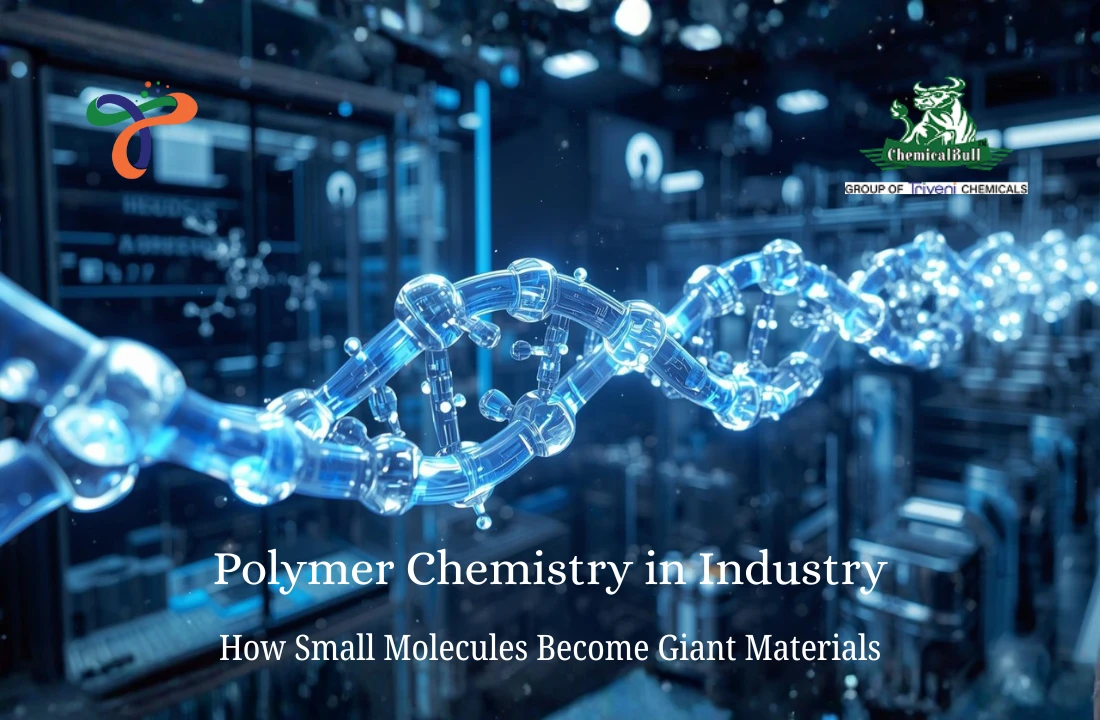
The modern world runs on polymers—from plastic bottles and synthetic fibers to automotive parts and medical devices. Understanding polymer chemistry is essential for anyone working with industrial chemicals, as polymers represent one of the most versatile categories in modern manufacturing.
What Are Polymers?
Polymers are large molecules built up from small molecules called monomers.
Key points:
- The word "polymer" comes from Greek: "poly" (many) + "mer" (parts)
- Each monomer acts as a link in a molecular chain
- Bonding creates materials with dramatically different properties from individual monomers
Are Polymers Giant Molecules?
Yes—polymers are giant molecules (macromolecules) containing thousands to billions of atoms.
Size comparison:
- Water molecule: 3 atoms
- Typical polymer: thousands to millions of atoms
- Polyethylene molecular weight: 10,000 to several million atomic mass units
Example transformation:
- Ethylene monomer = gas at room temperature
- Polyethylene polymer = solid plastic material
How Small Molecules Form Polymers: The Polymerisation Process
Addition Polymerisation (Chain-Growth)
Mechanism:
- Monomers add to the growing chain one at a time
- Requires the initiator to start the reaction
- Three stages: initiation → propagation → termination
Types of initiators:
- Free Radical - Most common industrial method (uses peroxides)
- Ionic - Better control over molecular weight (cationic or anionic)
Common examples:
- Polyethylene (PE) - Plastic bags, containers, industrial packaging
- Polystyrene (PS) - Electronics casings, foam insulation, packaging
- PVC - Construction pipes, medical devices, vinyl siding
- PMMA (Acrylic) - Transparent alternative to glass
Condensation Polymerisation (Step-Growth)
Mechanism:
- Monomers react and release small molecules (water, methanol)
- Any two molecular species can combine
- More gradual build-up than addition polymerisation
Advantages:
- Precise control over copolymer composition
- Functional groups allow further reactions
- Reversible (enables chemical recycling)
Key industrial polymers:
- Nylon - Textiles, carpets, automotive parts, industrial fibres
- Polyesters (PET) - Beverage bottles, textile fabrics, packaging films
- Polycarbonates - Safety equipment, automotive components, electronics
- Polyurethanes - Flexible/rigid foams, coatings, elastomers
- Silicones - Medical devices, sealants, high-temperature applications
Types of Polymers: A Diverse Family of Materials
Based on Origin: Natural vs Synthetic Polymers
Natural Polymers:
- Cellulose (plant cell walls)
- Proteins (enzymes, hair, silk)
- DNA and RNA (genetic material)
- Natural rubber (rubber trees)
- Starch (energy storage)
Synthetic Polymers:
Derived from organic industrial chemicals and petrochemical feedstocks:
- Plastics (PE, PP, PVC)
- Synthetic rubbers (neoprene, silicone)
- Synthetic fibres (nylon, polyester, acrylic)
- Advanced materials (Kevlar, carbon fibre)
Key differences:
- Source: Natural (plants/animals) vs Synthetic (petroleum/bio-based feedstocks)
- Biodegradability: Natural polymers generally biodegrade; most synthetics don't
- Customisation: Synthetics offer highly customizable, consistent properties
- Cost: Synthetics are generally lower due to mass production
- Sustainability: Natural uses renewable resources; synthetics shifting to bio-based
Based on Structure
Linear Polymers:
- Chains arranged in simple lines
- Can be melted and reshaped
- Valuable for recycling
Branched Polymers:
- Side chains from the main backbone
- Affects density and crystallinity
Cross-linked Polymers:
- 3D network structure
- Cannot be melted or reshaped once formed
Based on Thermal Behaviour: Thermoplastic vs Thermoset
Thermoplastics (reversible):
- Polyethylene - Bags, bottles
- Polypropylene - Automotive parts, containers
- PET - Beverage bottles, textiles
- Polystyrene - Packaging, insulation
Thermosets (irreversible):
- Epoxy resins - Adhesives, coatings
- Polyurethanes - Foam, coatings
- Bakelite - Electrical insulators
- Vulcanised rubber - Tires
Comparison Table: Thermoplastic vs Thermoset Polymers
|
Characteristic |
Thermoplastics |
Thermosets |
|
Molecular Structure |
Linear or branched chains |
Cross-linked 3D network |
|
Heating Behavior |
Softens and melts when heated |
Does not melt; may degrade at high temps |
|
Cooling Behavior |
Hardens reversibly |
Remains rigid |
|
Reprocessing |
Can be remelted and reshaped multiple times |
Cannot be remelted or reshaped |
|
Chemical Resistance |
Moderate |
Generally excellent |
|
Mechanical Strength |
Lower at elevated temperatures |
Maintains strength at high temperatures |
|
Processing Methods |
Injection moulding, extrusion, blow moulding |
Compression moulding, casting, and reaction injection |
|
Recyclability |
Highly recyclable |
Difficult to recycle (mechanical grinding only) |
|
Cost |
Generally lower |
Often higher due to processing |
|
Common Examples |
PE, PP, PVC, PS, PET, Nylon, Acrylic |
Epoxy, Polyester, Polyurethane, Phenolic, Melamine |
|
Typical Applications |
Packaging, consumer goods, pipes |
Coatings, adhesives, composites, and electrical insulation |
Polymers in Packaging
Market share: 40% of all polymer production
Applications:
- Polyethylene films - Moisture barriers, food wrapping
- PET bottles - Beverage containers (clarity, strength, light weight)
- Polystyrene foam - Protective packaging for fragile items
- Multilayer composites - Oxygen/moisture barriers for shelf life
- Biodegradable films - PLA-based eco-friendly alternatives
Innovation areas:
- Smart polymers indicating freshness
- Sustainable alternatives to traditional plastics
Polymers in the Automotive Industry
Modern vehicles contain hundreds of pounds of polymer materials.
Interior:
- Dashboard/panels (ABS, polypropylene)
- Seat cushions (flexible polyurethane foam)
- Carpet/upholstery (polyester, nylon)
- Door panels/trim (thermoplastic olefins)
Exterior/Structural:
- Bumpers/body panels (reinforced polymer composites)
- Exterior trim (thermoplastic polyolefins)
- Paint/coatings (polyurethane, acrylics)
Under-Hood:
- Engine covers/manifolds (glass-filled nylon)
- Coolant reservoirs (high-temp resistant polymers)
- Electrical connectors (PBT, PET, nylon)
Functional:
- Tires (synthetic rubber with carbon black)
- Adhesives/sealants (polyurethane, epoxy, silicone)
- Sound dampening (polymer foams)
Electric vehicle trend: New applications in battery housings, thermal management, lightweight structures
Polymer Materials in Daily Life
Everyday examples:
- Clothing - Polyester, nylon, spandex
- Furniture - Polyurethane foam, composites
- Electronics - Polymer casings, circuit boards
- Medical devices - Catheters, syringes, artificial joints
- Cookware - Non-stick Teflon coatings
Polymer Composites Applications
High-performance combinations:
- Fibreglass (polymer + glass fibres) - Boats, construction
- Carbon fibre composites - Aerospace, sports equipment
- Wood-plastic composites - Outdoor decking, furniture
Polymer Processing Methods: From Raw Material to Finished Product
Many processes utilise industrial solvents for cleaning, dissolving, or modifying polymers during production.
Key Processing Methods
Injection Moulding:
- For: Thermoplastics
- Products: Bottles, containers, automotive parts, medical devices
- Advantages: High precision, automation, complex shapes
- Best for: High-volume production
Extrusion:
- For: Thermoplastics, some thermosets
- Products: Pipes, films, sheets, wire coating
- Advantages: Continuous production, cost-effective
- Best for: Constant cross-section products
Blow Moulding:
- For: PE, PP, PET
- Products: Bottles, containers, fuel tanks
- Advantages: Hollow parts without assembly
- Best for: Large hollow containers
Compression Moulding:
- For: Thermosets, rubber
- Products: Automotive parts, electrical components, gaskets
- Advantages: Low material waste, good for thermosets
- Best for: High-strength parts
Rotational Moulding:
- For: Polyethylene primarily
- Products: Large tanks, playground equipment, kayaks
- Advantages: Large hollow parts, low tooling cost
- Best for: Large, complex hollow items
3D Printing (Additive Manufacturing):
- For: Various thermoplastics, resins
- Products: Prototypes, custom parts, medical implants
- Advantages: Complex geometries, no tooling required
- Best for: Custom, low-volume production
How Are Polymers Broken Down: Degradation and Recycling
Natural Degradation Processes
Common degradation mechanisms:
Photo-degradation:
- UV sunlight breaks polymer chains
- Causes brittleness and discolouration
- Affects: PE, PP, PS, PVC
- Solution: UV stabilisers for outdoor applications
Thermal Degradation:
- Excessive heat breaks chemical bonds
- Shortens polymer chains
- Limits processing temperatures
Oxidative Degradation:
- Oxygen reacts with polymer chains
- Accelerated by heat and light
- Antioxidants extend polymer lifetime
Hydrolytic Degradation:
- Water cleaves polymer bonds
- Critical for: Polyesters, polyamides, polycarbonates
- Important in biomedical and marine applications
Mechanical Degradation:
- Physical stress breaks chains
- Caused by shear, tension, and fatigue cycles
Biodegradation:
- Microorganisms break down polymers
- Requires: Microbes, moisture, temperature
- Works on: PLA, PHAs, starch-based polymers
Chemical Degradation:
- Acids, bases, and solvents attack the polymer structure
- Varies by polymer type and exposure
Biodegradable Polymers: A Growing Solution
These materials are increasingly important in pharmaceutical applications for drug delivery systems.
Common Biodegradable Polymers and Applications
|
Polymer Type |
Source |
Degradation Time |
Key Properties |
Main Applications |
|
Polylactic Acid (PLA) |
Corn starch, sugarcane |
6-24 months (composting conditions) |
Good mechanical strength, transparent |
Food packaging, 3D printing, medical implants |
|
Polyhydroxyalkanoates (PHAs) |
Bacterial fermentation |
3-12 months (natural environments) |
Fully biodegradable, biocompatible |
Medical devices, packaging films, agricultural films |
|
Polybutylene Succinate (PBS) |
Petrochemical or bio-based |
6-12 months (composting) |
Good heat resistance, processability |
Mulch films, food packaging, disposable items |
|
Starch-based Polymers |
Corn, potato, cassava starch |
2-6 months (composting) |
Low-cost, renewable |
Shopping bags, food service items, loose-fill packaging |
|
Cellulose Acetate |
Wood pulp, cotton |
3-9 months (composting) |
Transparent, rigid |
Films, cigarette filters, and tool handles |
|
Polycaprolactone (PCL) |
Synthetic (petroleum) |
12-24 months |
Low melting point, biocompatible |
Medical sutures, drug delivery, 3D printing |
|
Polyglycolic Acid (PGA) |
Glycolic acid |
2-4 weeks (body) |
High strength, fast degradation |
Medical sutures, tissue engineering scaffolds |
Polymer Recycling
Three main approaches:
-
Mechanical Recycling
- Physical reprocessing through melting/reforming
- Works for thermoplastics
- Properties may degrade over multiple cycles
-
Chemical Recycling
- Breaks polymers down to monomers
- Enables a true circular economy
- Allows repolymerization with virgin-quality properties
-
Energy Recovery
- Controlled burning for energy
- Last-resort option
- Better than landfilling
Challenges:
- Sorting mixed polymer waste
- Managing contamination
- Designing for recyclability
The Future of Polymer Chemistry in Industry
Emerging trends:
Smart Polymers:
- Respond to temperature, pH, and light
- Applications in medicine, sensors, and adaptive materials
Bio-based Polymers:
- Moving away from petroleum feedstocks
- Renewable resources with maintained performance
Polymer Nanotechnology:
- Nanoparticle incorporation
- Enhanced strength, conductivity, barrier properties
Sustainable Design:
- Recyclable and biodegradable options
- Addressing environmental concerns
Advanced Composites:
- Next-generation aerospace materials
- Automotive lightweighting
- Infrastructure applications
Conclusion: From Molecules to Materials
Key takeaways:
- Polymers are giant molecules built from small monomers
- Polymerisation transforms simple molecules into versatile materials
- Understanding polymer types, processing, and degradation is essential
- Sustainability drives innovation in polymer chemistry
For businesses:
Working with a trusted manufacturer and supplier like Chemical Bull ensures:
- Access to high-quality polymer materials
- Reliable industrial chemicals for production
- Technical expertise and support
- Consistent quality control
Future outlook:
- Integration of bio-based organic chemicals
- Advances in biodegradable formulations
- Improved recycling technologies
- More sustainable polymer materials
Partner with Chemical Bull for Your Polymer Material Needs
We provide:
- Polymer raw materials
- Industrial solvents for polymer processing
- Specialised chemical additives
- Technical expertise and reliable supply chains
Related Resources:
- Understanding Industrial Chemicals: Selection, Properties, and Real-World Manufacturing Applications
- Organic Industrial Chemicals Explained: From Petrochemicals to Bio-Based Compounds
- Chemistry Behind Medicines: How Industrial Chemicals Transform into Life-Saving Drugs
- Industrial Solvents Decoded: The Chemistry of Dissolving, Extracting, and Processing
Contact Chemical Bull today to discuss your polymer material requirements and discover how our expertise can support your manufacturing success.

Comment Section