Chemical Bull
204
17-Aug-2026
Quick Answer
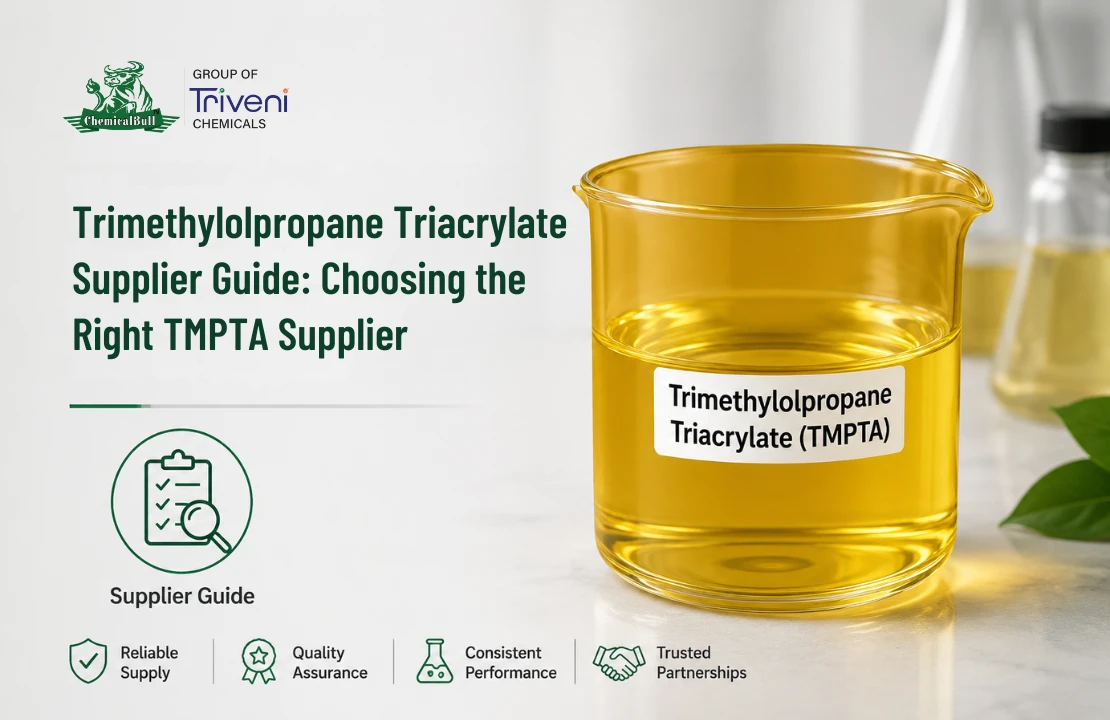
Choosing a Trimethylolpropane Triacrylate (TMPTA) supplier for UV-curable coatings, inks, or adhesives comes down to more than acrylate purity on a spec sheet. The factors that actually affect your production consistency are: whether you're buying from the manufacturer or a trading intermediary, the supplier's batch-to-batch consistency for cure speed and viscosity, their handling of the inhibitor system that governs shelf life, and their documentation practices (COA, MSDS, REACH where applicable). Getting these right avoids the cure-speed drift, premature gelling, and QC rejections that come from an inconsistent or poorly managed supply source.
Sourcing a reactive monomer like TMPTA isn't the same as sourcing a commodity solvent. Because TMPTA reacts through a controlled inhibitor system to stay stable in storage, and because even small variations in acrylate content affect cure speed and network density in your final formulation, the supplier you choose matters as much as the material's spec sheet. For the chemistry and application side, see our detailed guides on TMPTA uses, properties, and applications, TMPTA as a crosslinking agent for UV coatings, inks, and adhesives, and TMPTA in industrial coatings for wood, plastic, and metal. This guide focuses specifically on what to evaluate when choosing who to buy it from.
If you're currently vetting suppliers, Chemical Bull supplies TMPTA to UV coatings manufacturers, printing ink formulators, and adhesive producers with batch-specific documentation and export support. You can review current availability through our Trimethylolpropane Triacrylate supplier page.
Why Supplier Selection Matters More for a Reactive Monomer Like TMPTA
Inhibitor consistency affects your shelf life:
TMPTA is supplied with an inhibitor system to prevent premature polymerization during storage and transport. Inconsistent inhibitor dosing between batches, or poor storage conditions before it reaches you, can shorten usable shelf life or cause unexpected viscosity drift before you've even opened the drum.
Acrylate content directly affects cure performance:
Small shifts in acrylate functionality or purity change cure speed, crosslink density, and final film hardness in your formulation. A supplier without tight batch-to-batch control can force your formulation team to re-tune photoinitiator loading or line speed every time a new batch arrives, which is a real production cost even when the material technically passes spec.
Handling and safety documentation isn't optional:
TMPTA is a skin and eye sensitizer, which means your incoming SDS, labeling, and handling documentation need to be current and accurate for your own workplace safety compliance, not just for the supplier's own liability coverage.
Manufacturer vs. Trader: Why It Matters for TMPTA
Buying from the manufacturer typically gives you:
- Direct visibility into inhibitor dosing and production quality control
- Faster resolution if a batch shows unexpected viscosity or cure-speed deviation
- Better access to technical support for formulation-specific questions
- More reliable long-term supply continuity for ongoing production
Trading companies can still be a legitimate option, particularly for smaller order volumes or consolidated logistics, but for a reactive monomer where batch consistency has a real formulation impact, it's worth asking directly whether you're speaking with the manufacturer or an intermediary reselling material sourced elsewhere. If working with a trader, ask about their own quality oversight of the manufacturer they source from.
Certifications and Documentation to Verify
|
Certification/Documentation |
Why It Matters for TMPTA Buyers |
|
Batch-specific COA |
Confirms actual acrylate content, viscosity, and inhibitor level for your specific shipment |
|
MSDS/SDS (current version) |
Required for safe handling given TMPTA's skin/eye sensitizer classification |
|
ISO certification |
Indicates a formal quality management system at the manufacturing site |
|
REACH compliance (for EU-bound buyers) |
Confirms the material and supplier meet EU chemical registration requirements |
|
Inhibitor system disclosure |
Confirms what stabilizer is used and at what level, relevant to your shelf-life planning |
Ask specifically whether COAs report actual tested values per batch or a generic specification range. This is one of the clearest differentiators between suppliers who look similar on paper but differ in real quality control rigor.
What UV-Curable Formulators Should Look for Beyond Documentation
Technical support for formulation questions:
A supplier who can discuss photoinitiator compatibility, typical usage ranges for your application type, or troubleshoot an unexpected cure-speed issue is genuinely more valuable during supplier qualification than one who only processes purchase orders.
Export and logistics track record:
If importing, confirm the supplier's experience shipping reactive/sensitizer-labeled material to your region, including any special documentation or hazard-classification handling required for customs clearance.
Sample availability before bulk commitment:
Request a sample batch to run your own incoming QC and a small formulation trial before committing to a full bulk order, particularly when qualifying a new supplier for the first time.
Packaging and storage guidance:
Confirm the supplier provides clear storage recommendations (cool, dark conditions, away from heat and radical-generating sources) and that their own packaging and transport practices are consistent with maintaining inhibitor effectiveness before it reaches you.
Common Red Flags When Evaluating a TMPTA Supplier
- Reluctance to provide a batch-specific COA with actual tested values, offering only a generic specification sheet
- No clear answer on whether they're the manufacturer or a reselling intermediary
- Vague or outdated SDS documentation for a sensitizer-classified material
- Unwillingness to disclose inhibitor type or level
- Inconsistent viscosity, color, or cure performance between quotation samples and bulk shipment
Questions to Ask Before Placing a Bulk TMPTA Order
- Are you the manufacturer, or are you sourcing this material from another producer?
- Can you provide a batch-specific COA showing actual tested acrylate content and viscosity?
- What inhibitor system do you use, and what shelf life does it support under recommended storage?
- What is your typical lead time for my required order volume and destination?
- Can you support a sample quantity before I commit to a bulk order?
- What certifications (ISO, REACH) does your production facility currently hold?
- How do you handle a quality deviation if a batch doesn't meet the agreed specification?
Frequently Asked Questions
1. Should I buy TMPTA directly from a manufacturer or a trading company?
Both can work, but buying from the manufacturer generally gives better visibility into batch consistency and faster resolution if a cure-performance issue arises. If working with a trader, confirm their upstream manufacturing relationship and quality oversight.
2. What documentation should a TMPTA supplier provide?
At minimum, a batch-specific COA with actual tested values, a current MSDS/SDS, and REACH compliance documentation if you're manufacturing for or exporting to the EU market.
3. Why does batch consistency matter more for TMPTA than for a typical solvent?
Because TMPTA is a reactive crosslinking monomer, small variations in acrylate content or inhibitor level directly affect cure speed, network density, and shelf life in your formulation, unlike inert solvents where minor purity variation has less functional impact.
4. Should I request a sample before placing a bulk TMPTA order?
Yes. A sample lets you run incoming QC and a small formulation trial to confirm cure performance before committing to bulk volume, which is especially important when qualifying a new supplier.
5. What should I ask about TMPTA's inhibitor system before ordering?
Ask what inhibitor is used, at what concentration, and what shelf life it supports under the supplier's recommended storage conditions, since this affects how long you can hold stock before use.
6. Does TMPTA require special handling documentation?
Yes, TMPTA is classified as a skin and eye sensitizer, so current SDS documentation and appropriate labeling are required for safe handling and workplace compliance.
Evaluating suppliers for an upcoming UV-curable formulation?
ChemicalBull supports coatings, ink, and adhesive manufacturers with batch-specific documentation, sample availability, and export logistics. Reach out through our Trimethylolpropane Triacrylate supplier page.
Comment Section