Chemical Bull
2481
03-Jul-2026
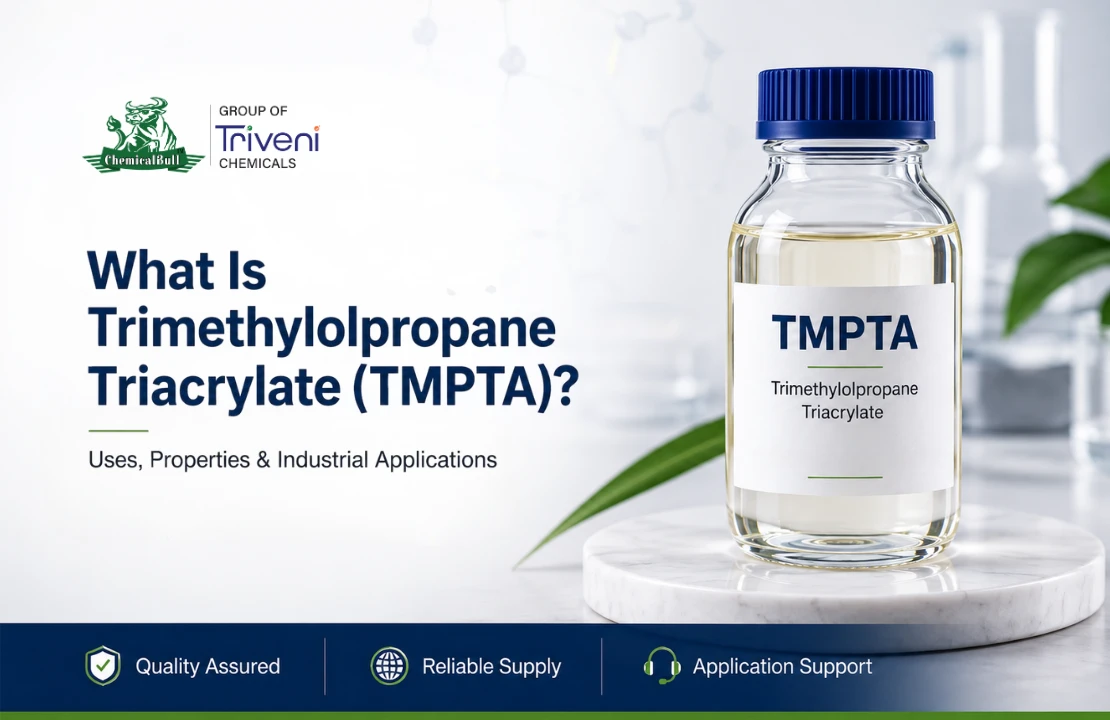
Trimethylolpropane Triacrylate (TMPTA) For Industrial Applications
Trimethylolpropane Triacrylate (TMPTA) is a trifunctional acrylate monomer used in fast-curing and high-performance polymer systems. It functions as a reactive diluent and crosslinking monomer in coatings, printing inks, adhesives, rubber and specialty polymers, helping improve cure speed, hardness, gloss, abrasion resistance and chemical resistance.
For industrial buyers, TMPTA is not only a technical raw material. It also affects production efficiency, batch consistency, formulation cost and final product quality. Procurement teams usually check TMPTA properties, application suitability, packaging, documentation and supply consistency before placing regular orders.
TMPTA is widely used in radiation-curable systems such as UV and electron beam curing. It is also used in selected rubber, plastic, adhesive and specialty polymer applications. This guide explains what Trimethylolpropane Triacrylate (TMPTA) is, how it works, where it is used and what buyers should check before sourcing it for industrial use.
Quick Answer:
TMPTA stands for Trimethylolpropane Triacrylate. It is a trifunctional acrylate monomer and reactive diluent used in UV-curable coatings, printing inks, adhesives, rubber, plastics and specialty polymers. TMPTA, CAS 15625-89-5, supports fast curing, hardness, gloss, chemical resistance and crosslinked film strength.
For bulk requirements, explore TMPTA grade, packing and availability details with a reliable Trimethylolpropane Triacrylate Distributor, and submit your enquiry to Chemical Bull.
What Is Trimethylolpropane Triacrylate (TMPTA)?
Trimethylolpropane Triacrylate, commonly known as TMPTA, is a trifunctional acrylate ester monomer. The word “trifunctional” means that the molecule has three reactive acrylate groups. These three reactive points allow TMPTA to form a strong crosslinked polymer network during curing.
In simple terms, TMPTA helps liquid formulations convert into harder, stronger and more durable cured films or polymer structures. Because of this, it is widely used in UV-curable coatings, inks, varnishes, adhesives, sealants and specialty resin systems.
TMPTA also works as a reactive diluent. This means it can reduce the viscosity of a formulation, making it easier to apply, coat, print or process. Unlike normal solvents, TMPTA does not simply evaporate after application. It reacts during curing and becomes part of the final polymer network. This makes it useful in low-solvent, high-solids and energy-curable formulations.
Commercial TMPTA grades are usually supplied as clear to pale yellow liquids. They are often stabilised with inhibitors to reduce the chance of premature polymerisation during storage and transport.
Why Is TMPTA Called a Trifunctional Acrylate Monomer?
TMPTA is called a trifunctional acrylate monomer because it contains three reactive acrylate groups. During UV, electron-beam or free-radical curing, these groups form a highly crosslinked polymer network. This structure supports fast curing, high surface hardness, chemical resistance and abrasion resistance.
TMPTA Identification Table
|
Parameter |
Details |
|
Chemical name |
Trimethylolpropane Triacrylate |
|
Common abbreviation |
TMPTA |
|
CAS No. |
15625-89-5 |
|
Molecular formula |
C15H20O6 |
|
Molecular weight |
296.32 g/mol |
|
Appearance |
Clear to pale yellow liquid |
|
Main function |
Reactive diluent, UV curing monomer, crosslinking co-monomer |
|
Common applications |
Coatings, inks, varnishes, adhesives, sealants, electronics, rubber, plastics and specialty polymers |
Key Physical and Chemical Properties
TMPTA properties may vary slightly depending on grade, inhibitor level and production method. Buyers should always confirm final specifications through the latest COA, TDS and SDS.
|
Property |
Typical / Common Information |
|
Physical form |
Liquid |
|
Appearance |
Clear to pale yellow liquid |
|
Viscosity at 25°C |
Low to moderate viscosity, depending on grade |
|
Density at 25°C |
Around 1.1 g/mL |
|
Polymerisation |
Reacts through free-radical polymerisation |
|
Stabiliser / inhibitor |
Commonly supplied with MEHQ or similar inhibitor |
|
Solubility |
Soluble in organic solvents; insoluble in water |
These properties make TMPTA suitable for applications where formulators need faster curing, viscosity adjustment and improved cured-film performance.
TMPTA vs Similar Chemicals: TMP, TMPTMA and HDDA
TMPTA is sometimes compared with TMP, TMPTMA and HDDA, but these chemicals are not the same.
|
Chemical |
Type |
Key Difference |
Typical Use Direction |
|
Triol building block |
Has hydroxyl groups, not acrylate groups |
Used in resins, alkyds, polyesters and acrylate derivatives |
|
|
Trimethylolpropane Triacrylate (TMPTA) |
Trifunctional acrylate |
Has three acrylate groups for fast free-radical curing |
Used where hardness, cure speed and crosslinked strength are needed |
|
Trimethylolpropane trimethacrylate (TMPTMA) |
Trifunctional methacrylate |
Methacrylate version of TMP-based monomer |
Used where methacrylate chemistry is preferred |
|
1,6-Hexanediol diacrylate (HDDA) |
Difunctional diacrylate |
Has two acrylate groups and lower functionality than TMPTA |
Used where lower viscosity and different flexibility balance are required |
How TMPTA Works in Formulations
TMPTA works through its three acrylate groups. During curing, these acrylate groups react with other monomers, oligomers or resins. This reaction links the molecules together and creates a crosslinked polymer network.
In UV curing, a photoinitiator absorbs UV light and generates free radicals. These free radicals start the polymerisation reaction. In electron beam curing, high-energy electrons start the reaction without the same type of photoinitiator requirement.
Once the curing reaction begins, TMPTA becomes part of the final film or polymer. Because it has three reactive groups, it can increase crosslink density. This usually helps improve hardness, chemical resistance, abrasion resistance and overall film strength.
As a reactive diluent, TMPTA also improves processing. It helps lower viscosity so the formulation can be coated, printed, sprayed or applied more easily. This is useful for production teams that need better application flow without adding high levels of non-reactive solvent.
Key benefits of TMPTA in Industrial Formulations
TMPTA is used because it offers both processing benefits and performance benefits. It can help a formulation move smoothly during production and also improve the properties of the cured product.
Key reasons include:
- Fast curing: TMPTA supports quick free-radical curing in UV and EB systems.
- Improved hardness: It helps increase surface hardness in cured films.
- Better chemical resistance: A crosslinked network can improve resistance to many chemicals.
- Gloss and surface finish: TMPTA can support high-gloss coatings and varnishes.
- Abrasion resistance: It is useful where the surface is exposed to rubbing, handling or wear.
- Viscosity control: It reduces formulation viscosity while still reacting into the final polymer.
- Production efficiency: Faster curing can support better line speed and shorter processing time.
- Formulation flexibility: It can be used with many acrylated oligomers and resin systems.
From a buyer’s point of view, TMPTA can help improve the balance between cost, performance and productivity. However, dosage and compatibility should always be checked through lab trials before commercial production.
Chemical Bull supports bulk TMPTA requirements for coatings, inks, adhesives, rubber and polymer applications across India.
TMPTA Uses in Coatings, Inks, Adhesives and Polymers
TMPTA uses cover several industrial sectors. It is mainly selected where reactive acrylate chemistry is required and where fast curing or crosslinked strength is important.
UV-curable coatings
TMPTA is used in UV-curable coatings to improve cure speed, hardness, gloss and resistance properties. It can be used in coatings for wood, metal, plastic and industrial surfaces. The exact performance depends on the resin system, photoinitiator, substrate and application method.
For a detailed explanation of formulation roles, typical use levels and performance benefits, read our guide on TMPTA as a crosslinking agent for UV-curable coatings, inks and adhesives.
Printing inks and varnishes
In printing inks and overprint varnishes, TMPTA helps adjust viscosity and supports fast curing. It is used where quick processing, good surface finish and film strength are needed. This includes selected flexographic, offset, screen, inkjet and varnish systems.
Adhesives and sealants
TMPTA is used in some adhesive and sealant formulations where fast curing and better network strength are required. It can help improve hardness and resistance, but formulators must balance this with flexibility and bonding performance.
Electronics
In electronics, TMPTA can be used in selected radiation-curable materials, conformal coatings and specialty systems. The final choice depends on curing method, adhesion, dielectric performance, heat resistance and long-term reliability requirements.
Rubber and plastics
TMPTA can be used in selected rubber and plastic systems as a co-monomer or coagent. In rubber applications, it may support curing and crosslink formation. The dosage, rubber type and peroxide system should be tested carefully before final approval.
Specialty polymers
TMPTA is also used in specialty polymers, composites, photosensitive materials, advanced resins and thermoset systems. Its trifunctional structure makes it useful where formulators need a tighter polymer network and improved cured properties.
Industries That Use Trimethylolpropane Triacrylate
TMPTA applications are common in industries that need fast curing, durable surfaces and crosslinked polymer systems.
|
Industry |
Why TMPTA Is Used |
|
Paints and coatings |
Hardness, gloss, cure speed and resistance |
|
Printing and packaging |
Fast curing inks, varnishes and surface protection |
|
Adhesives and sealants |
Reactive formulation support and network strength |
|
Electronics |
Specialty coatings, printed materials and protection systems |
|
Rubber manufacturing |
Support for selected crosslinked rubber systems |
|
Plastics and composites |
Polymer modification and cured network strength |
|
3D printing and advanced materials |
Reactive acrylate chemistry and fast cure response |
|
Specialty polymers |
Custom polymer networks and performance modification |
How to Choose the Right TMPTA Grade
Choosing the right TMPTA grade is important for consistent production. A lower-cost material may not always be the best option if the colour, purity, inhibitor level or viscosity does not match the formulation requirement.
Before selecting a grade, buyers should check:
- Application type, such as coating, ink, adhesive, rubber, plastic or polymer.
- Required viscosity and dilution effect.
- Cure speed requirement.
- Compatibility with oligomers, resins and photoinitiators.
- Final hardness, gloss and flexibility target.
- Colour requirement, especially for clear coatings and varnishes.
- Inhibitor type and inhibitor level.
- Packaging size and bulk availability.
- COA, SDS and TDS availability.
- Import, export and logistics support.
For regular procurement, it is better to work with a supplier who can support documentation, batch traceability and repeat supply. This helps reduce purchase delays and quality variation during production planning.
Safety, Handling and Storage Guidelines
TMPTA should be handled with care because acrylate monomers may irritate the skin, eyes and respiratory system. Use gloves, safety goggles and protective clothing while handling. Work in a well-ventilated area, avoid direct contact, and follow the latest SDS and local safety rules.
Store TMPTA in original, tightly closed containers in a cool, dry and well-ventilated place. Keep it away from direct sunlight, heat, sparks, contamination and incompatible chemicals. Check shelf life, storage temperature and handling limits before warehouse approval.
Where to Buy Trimethylolpropane Triacrylate (TMPTA)?
B2B buyers should source TMPTA from a supplier that can provide consistent grade quality, current technical documents, suitable packing and dependable delivery support. Product selection should be based on the intended coating, ink, adhesive, rubber or polymer application.
Chemical Bull supports bulk Trimethylolpropane Triacrylate requirements with COA, TDS, SDS, packing information and quantity-based quotation assistance. Share your required grade, quantity, packing preference and delivery location to receive a quotation.
Frequently Asked Questions (FAQs)
-
What is Trimethylolpropane Triacrylate used for?
TMPTA is used in UV-curable coatings, printing inks, varnishes, adhesives, sealants, rubber, plastics and specialty polymers. It helps improve cure speed, hardness, gloss, chemical resistance and crosslinked polymer strength. -
Is Trimethylolpropane Triacrylate a monomer?
Yes, TMPTA is a trifunctional acrylate monomer. It reacts during free-radical polymerisation and becomes part of the final cured polymer network. -
What is the CAS number of TMPTA?
The CAS number of Trimethylolpropane Triacrylate is 15625-89-5. Buyers should verify the CAS number, grade and specification documents before procurement.
-
Is Trimethylolpropane Triacrylate (TMPTA) the same as Trimethylolpropane?
No. Trimethylolpropane is a triol building block, while TMPTA is a triacrylate ester monomer. TMPTA has three acrylate groups that take part in curing reactions. -
Can Trimethylolpropane Triacrylate (TMPTA) be used in rubber?
Yes, TMPTA can be used in selected rubber applications. It may support crosslinking and performance improvement, but the final suitability depends on rubber type, peroxide system, dosage and processing conditions. -
How should Trimethylolpropane Triacrylate (TMPTA) be stored?
TMPTA should be stored in original closed containers in a cool, dry and well-ventilated area. It should be protected from heat, direct sunlight, ignition sources and contamination.
Conclusion
Trimethylolpropane Triacrylate (TMPTA) is a useful trifunctional acrylate monomer for manufacturers who need fast curing, improved hardness, chemical resistance and strong crosslinked polymer networks. Its role as a UV curing monomer and reactive diluent makes it valuable in coatings, inks, adhesives, electronics, rubber, plastics and specialty polymer systems.
For buyers, the right TMPTA grade should be selected based on application, purity, colour, viscosity, inhibitor level, documentation and supplier reliability. A consistent grade can support better formulation performance and smoother production.
Comment Section