Chemical Bull
14
05-Oct-2026
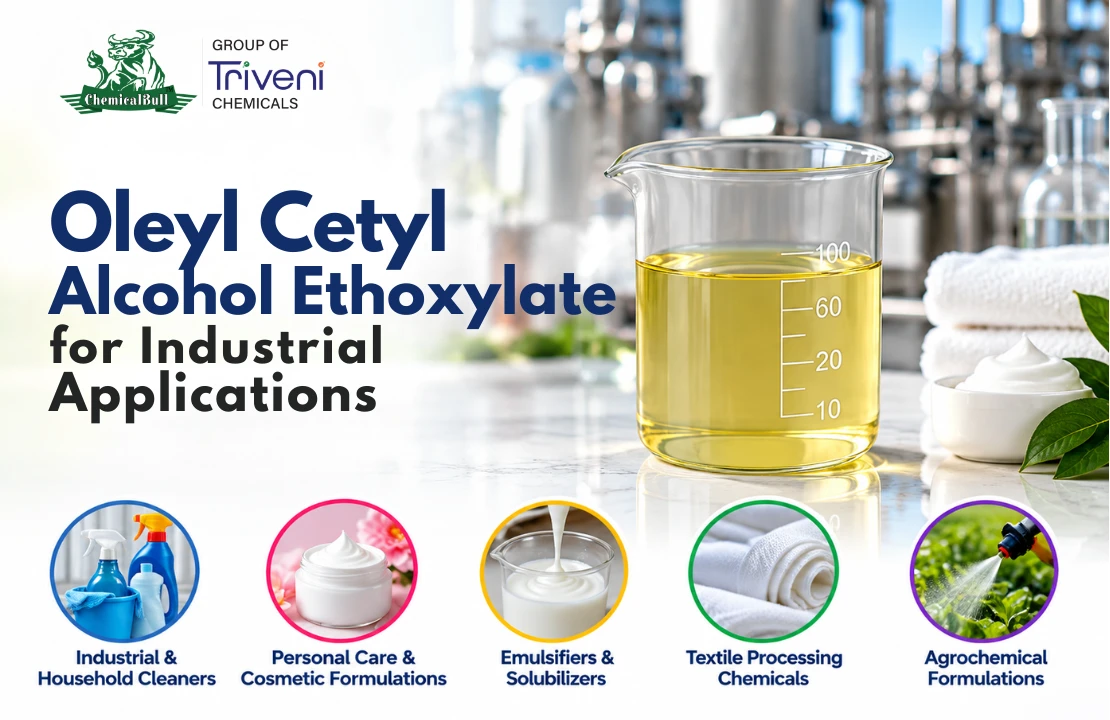
Oleyl Cetyl Alcohol Ethoxylate for Industrial Applications
Oleyl Cetyl Alcohol Ethoxylate-5 is a nonionic surfactant produced by ethoxylating a blend of oleyl and cetyl fatty alcohols, combining the properties of an unsaturated (oleyl) and saturated (cetyl) alcohol base. This blended structure gives it a balanced hydrophilic-lipophilic profile that formulators use across emulsification, wetting, and dispersion applications in industrial and agrochemical systems.
Because consistent EO grade and blend ratio directly affect emulsifying performance, working with an established Oleyl Cetyl Alcohol Ethoxylate 5 supplier helps formulators maintain reliable results across production batches. Chemical Bull supplies this Oleyl Cetyl Alcohol Ethoxylate-5 chemical in bulk quantities at competitive pricing for industrial and specialty formulation manufacturers.
Chemical Identity & Properties
|
Property |
Detail |
|
Base Alcohols |
Blend of oleyl alcohol (unsaturated, C18) and cetyl alcohol (saturated, C16) |
|
Ethoxylation Level |
Approximately 5 moles of ethylene oxide |
|
Appearance |
Pale yellow to amber liquid or soft paste, depending on temperature |
|
Classification |
Nonionic surfactant, blended fatty alcohol ethoxylate |
|
Solubility |
Dispersible in water; soluble in common organic solvents |
What Makes Oleyl Cetyl Alcohol Ethoxylate-5 Different?
Most fatty alcohol ethoxylates are produced from a single alcohol type, such as lauryl or cetyl alcohol alone. Oleyl Cetyl Alcohol Ethoxylate-5 instead starts from a blend of two different fatty alcohols:
- Oleyl Alcohol Contribution: Being unsaturated, oleyl alcohol contributes better low-temperature fluidity and solvency within the blend.
- Cetyl Alcohol Contribution: As a saturated alcohol, cetyl alcohol contributes stability and a firmer structural character to the finished surfactant.
- Combined HLB Profile: The blend, ethoxylated to approximately 5 moles EO, results in an intermediate HLB value suited to water-in-oil and specialty emulsion systems where a single-alcohol ethoxylate might not perform as well.
Industrial Applications of Oleyl Cetyl Alcohol Ethoxylate-5
-
Agrochemical Formulations:
Used as an emulsifier and wetting agent in pesticide, herbicide, and fungicide concentrates, where its balanced HLB supports stable emulsifiable concentrate (EC) systems. -
Industrial Cleaning Formulations:
Functions as a wetting and emulsifying agent in degreasers and industrial cleaning products requiring oil-water emulsification. -
Textile Processing:
Applied as a processing aid in textile finishing and dyeing auxiliary formulations. -
Metalworking Fluids:
Used to help stabilize oil-in-water emulsions in cutting and rolling oil formulations. -
Personal Care and Cosmetic Intermediate Use:
Used in select cosmetic formulations as an emulsifier, often blended with other surfactants to fine-tune texture and stability. -
Specialty Coatings and Dispersions:
Contributes to pigment wetting and dispersion stability in certain coating formulations.
Why Formulators Choose This Blended Ethoxylate
|
Factor |
Advantage |
|
Balanced HLB |
Suits formulations between fully water-soluble and fully oil-soluble surfactant needs |
|
Blend Versatility |
Combines properties of two base alcohols in a single raw material, simplifying formulation |
|
Emulsifiable Concentrate Performance |
Well-suited to agrochemical EC systems requiring stable oil-water emulsification |
|
Formulation Flexibility |
Compatible with a range of co-surfactants across industrial and specialty applications |
How to Evaluate This Surfactant for Your Formulation
-
Confirm the EO Grade:
Verify the ethoxylation level matches your target HLB range, since even small EO differences affect emulsification behavior. -
Check Blend Ratio Consistency:
Since this is a blended product, confirm the supplier maintains a consistent oleyl-to-cetyl ratio across batches. -
Run Compatibility Trials:
Test the surfactant in a small-batch formulation to confirm emulsion stability with your specific active ingredient or oil phase before scaling to bulk volumes. -
Evaluate Co-Surfactant Pairing:
Many formulations combine this ethoxylate with a higher-HLB surfactant to fine-tune overall system performance.
Oleyl Cetyl Alcohol Ethoxylate-5 vs. Single-Alcohol Ethoxylates
Formulators choosing between a blended ethoxylate and a single-alcohol ethoxylate like Lauryl Alcohol Ethoxylate or Cetyl Alcohol Ethoxylate should understand a few key differences:
|
Factor |
Oleyl Cetyl Blend |
Single-Alcohol Ethoxylate |
|
Base Material |
Combination of unsaturated and saturated fatty alcohols |
One fatty alcohol type only |
|
Physical Form |
Liquid to soft paste, temperature-dependent |
Varies by chain length, often more predictable |
|
Formulation Flexibility |
Offers a middle-ground performance profile in one material |
Requires blending multiple ethoxylates to achieve similar balance |
|
Typical Use Case |
Agrochemical EC systems, specialty industrial emulsions |
Broader range of standard detergent and cleaning applications |
Choosing between the two often comes down to whether a formulator wants a single raw material that already balances two alcohol characteristics, or prefers to build that balance themselves by blending separate single-alcohol ethoxylates.
Manufacturing Process Overview
This surfactant is produced by first combining oleyl alcohol and cetyl alcohol in a controlled ratio, then reacting the blend with ethylene oxide under catalytic conditions until the target degree of ethoxylation, approximately 5 moles, is reached. Because the starting material is already a blend rather than a single alcohol, maintaining a consistent ratio between the two base alcohols at the start of the process is what allows manufacturers to deliver a product with repeatable performance characteristics from batch to batch.
What to Look for in a Supplier
- Batch Documentation:
Request a Certificate of Analysis (CoA) and Safety Data Sheet (SDS) for each batch, confirming EO content and blend consistency. - Consistent Supply:
Confirm the supplier can reliably support your ongoing production volume without unexplained formulation drift between batches. - Technical Support:
A supplier familiar with ethoxylated surfactant chemistry can offer useful guidance on grade selection and co-surfactant pairing for your specific application. - Packaging Options:
Confirm available packaging, from drums for smaller orders to bulk tanker delivery for high-volume industrial users.
Handling and Storage Considerations
Oleyl Cetyl Alcohol Ethoxylate-5 should be stored in tightly sealed containers away from extreme temperatures, since its physical form can shift between liquid and soft paste depending on ambient conditions. Gentle warming and mixing before use can help restore a uniform liquid state if the material has thickened or partially solidified during cold storage. Standard handling precautions, including gloves and eye protection, are recommended, along with reviewing the current Safety Data Sheet before use.
Frequently Asked Questions
-
What is Oleyl Cetyl Alcohol Ethoxylate-5 used for?
It is used as a nonionic surfactant in agrochemical formulations, industrial cleaning products, textile processing, metalworking fluids, and select cosmetic and coating applications. -
What makes it different from a single fatty alcohol ethoxylate?
It combines two base alcohols, oleyl (unsaturated) and cetyl (saturated), giving it a blended performance profile not achievable with either alcohol alone. -
Why is it used in agrochemical emulsifiable concentrates?
Its balanced HLB from the blended alcohol base and approximately 5-mole ethoxylation level supports stable oil-water emulsification in EC formulations. -
What documentation should I request from a supplier?
At minimum, request a Certificate of Analysis and Safety Data Sheet for each batch to confirm EO content, blend ratio, and appropriate handling information. -
Can this surfactant be combined with other emulsifiers?
Yes, it is commonly paired with higher-HLB surfactants to fine-tune emulsion stability for a specific formulation's oil phase and application requirements.
Conclusion
Oleyl Cetyl Alcohol Ethoxylate-5's blended alcohol base gives formulators a versatile nonionic surfactant for agrochemical, industrial cleaning, and specialty formulation applications. Selecting a supplier who can provide consistent EO grade, blend ratio, and proper documentation helps manufacturers maintain reliable emulsification performance across production batches.

Comment Section