Chemical Bull
8
10-Oct-2026
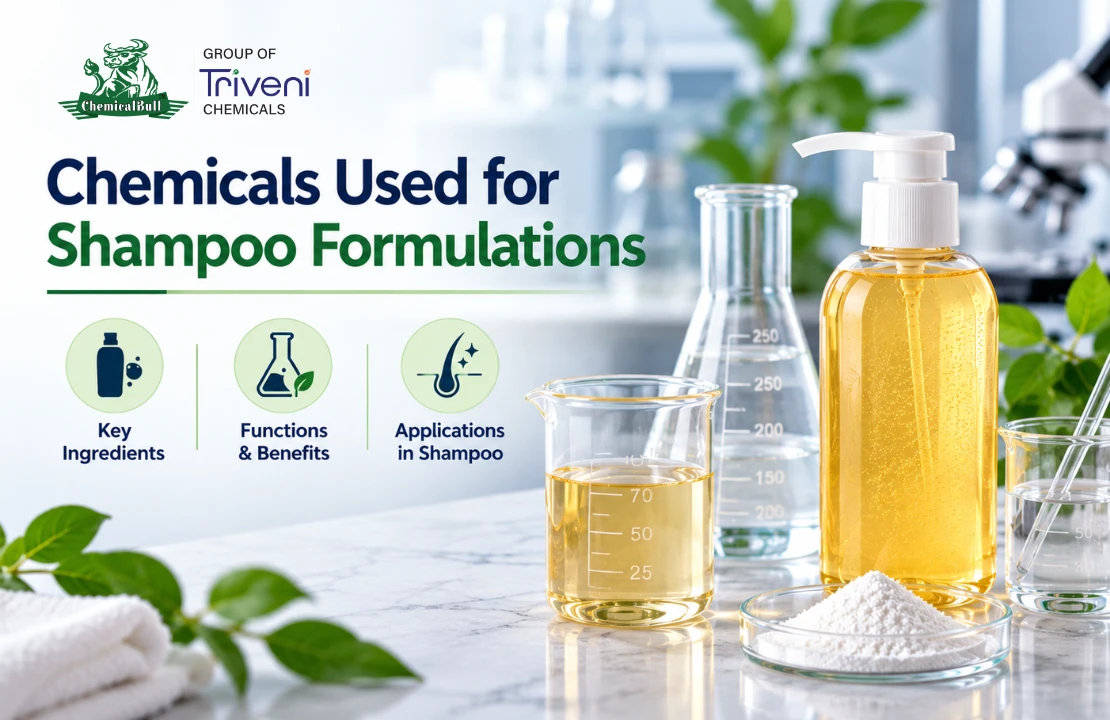
Chemicals Used for Shampoo Formulations
A good shampoo does several jobs at once: it cleans the scalp, creates a pleasant lather, leaves hair manageable, and stays stable on the shelf. Each of these jobs is handled by a different group of raw materials, and getting the combination right is what separates a basic shampoo from a premium one.
Core Ingredient Groups in a Shampoo
|
Ingredient Group |
Role in the Shampoo |
|
Primary Surfactants |
Provide the main cleansing action (commonly SLES-based systems) |
|
Secondary Surfactants |
Boost foam, improve mildness, and build viscosity |
|
Conditioning Agents |
Reduce tangling and improve softness after washing |
|
Pearlizing and Opacifying Agents |
Create the creamy, pearly appearance consumers expect |
|
Solubilizers |
Keep fragrance and oils evenly dispersed in clear formulas |
|
pH Adjusters |
Balance the formulation for scalp compatibility and stability |
Secondary Surfactants and Foam Boosters
Primary surfactants such as SLES do the heavy cleaning, but they can feel harsh on their own. Secondary surfactants soften the formulation and improve lather quality.
- Cocamidopropyl Betaine: The most widely used secondary surfactant in shampoos, valued for boosting foam, building viscosity with anionic surfactants, and reducing irritation.
- Cocamidopropyl Hydroxysultaine: A mild amphoteric surfactant with good hard water tolerance, which is useful for shampoos sold in regions with hard water.
- Cocamidopropylamine Oxide: Used to stabilize foam and add thickness in shampoo bases.
- Cocamide DEA: A foam booster and thickener that has long been used in shampoos. Some markets apply specific labeling or restrictions to DEA-based ingredients, so confirm requirements for your target market.
- PEG-7 Glyceryl Cocoate: A mild nonionic surfactant that adds gentle cleansing and a soft after-feel.
Conditioning Agents
- Polyquaternium-7: A cationic conditioning polymer widely used in shampoos to improve wet combing, reduce frizz, and leave hair softer without heavy buildup.
Pearlizing and Opacifying Agents
- Glycol Distearate: The classic pearlizing agent that gives shampoos a smooth, pearly shine.
- Ethylene Glycol Monostearate: Used as an opacifier and pearlizer, often alongside glycol distearate to adjust the level of opacity.
Solubilizers for Fragrance and Actives
- Polysorbate 20: A nonionic solubilizer that helps blend fragrance oils evenly into water-based shampoo formulas.
- PEG-40 Hydrogenated Castor Oil: A widely used solubilizer for fragrances and oil-based actives, especially in clear shampoos.
pH Adjusters
- Triethanolamine: Commonly used to adjust and buffer pH so the shampoo stays within a scalp-friendly range and remains stable over time.
Chemical Bull supplies personal care chemicals in bulk quantities with competitive pricing, giving Indian shampoo manufacturers one place to source the surfactants, conditioning agents, and performance additives their formulations need.
How Shampoo Types Change the Ingredient Mix
|
Shampoo Type |
Formulation Focus |
Ingredients Often Emphasized |
|
Clear Everyday Shampoo |
Clarity, good lather |
Betaines, solubilizers, light conditioning polymer |
|
Creamy or Pearly Shampoo |
Rich appearance and feel |
Glycol Distearate, Ethylene Glycol Monostearate |
|
Conditioning Shampoo |
Softness and manageability |
Polyquaternium-7, mild co-surfactants |
|
Mild or Baby-Style Shampoo |
Gentleness |
Hydroxysultaine, PEG-7 Glyceryl Cocoate, lower primary surfactant levels |
Comparing the Main Secondary Surfactants
|
Ingredient |
Main Strength |
Best Suited For |
|
Cocamidopropyl Betaine |
Foam boost, viscosity build, mildness |
General-purpose everyday shampoos |
|
Cocamidopropyl Hydroxysultaine |
Hard water and electrolyte tolerance |
Shampoos sold in hard water regions |
|
Cocamidopropylamine Oxide |
Foam stability and thickening |
Shampoos needing a richer, longer-lasting lather |
|
PEG-7 Glyceryl Cocoate |
Gentle cleansing, soft after-feel |
Mild and sensitive-scalp formulations |
Many shampoo bases combine two or more of these, since each one covers a different weakness of the primary surfactant.
Basic Shampoo Manufacturing Process
Most shampoo batches follow a similar order of addition, which helps avoid lumps, foaming problems, and viscosity surprises:
- Water Phase Preparation: Start with water in the mixing vessel and begin gentle agitation.
- Primary Surfactant Addition: Add the primary surfactant slowly to limit excess foam.
- Secondary Surfactants and Pearlizers: Add betaines, amine oxides, and pre-heated pearlizing agents such as Glycol Distearate, then mix until uniform.
- Conditioning Agents: Add conditioning polymers like Polyquaternium-7 once the base is smooth.
- Solubilizer, Fragrance, and Actives: Pre-mix fragrance with a solubilizer such as Polysorbate 20, then blend it in.
- pH Adjustment and Viscosity Check: Adjust pH with an agent like Triethanolamine, then confirm viscosity and appearance.
- Quality Testing: Test pH, viscosity, foam, clarity, and stability before release.
Supply Chain and Sourcing Considerations
- Multiple Raw Materials: A single shampoo uses many ingredients, so consolidating purchases with one supplier reduces paperwork and delivery coordination.
- Lead Time Planning: Plan reorders ahead of production schedules, especially for specialty conditioning polymers.
- Seasonal Demand: Demand for personal care products often rises before festive and wedding seasons in India, so confirm stock availability early.
- Volume-Based Pricing: Ask about tiered pricing for larger recurring orders to stabilize raw material costs.
Formulation Tips for Indian Manufacturers
- Plan for Hard Water: Many Indian cities have hard water, so ingredients like Cocamidopropyl Hydroxysultaine help maintain lather and performance.
- Balance Cost and Performance: Premium conditioning agents add cost, so match ingredient levels to your product tier.
- Check Compatibility: Cationic conditioners and anionic surfactants can interact, so test stability across temperature and shelf life.
- Confirm Regulatory Compliance: Follow applicable Indian cosmetic regulations for ingredient limits and labeling before launch.
- Run Pilot Batches: Test viscosity, foam, clarity, and stability in small batches before bulk production.
What to Look for in a Personal Care Chemical Supplier in India
- Cosmetic-Grade Quality: Confirm each ingredient suits personal care use.
- Batch Documentation: Request a Certificate of Analysis (CoA) and Safety Data Sheet (SDS) for every material.
- GST and HSN Clarity: Confirm GST-compliant invoicing and correct HSN classification.
- Domestic Availability: Sourcing from the Gujarat chemical corridor typically means shorter lead times than importing.
- Broad Range: A supplier carrying surfactants, conditioners, pearlizers, and solubilizers simplifies purchasing.
- Sample Support: Request trial quantities before committing to bulk volumes.
Common Buyer Mistakes to Avoid:
- Judging by Price per Kilogram Only: Active content differs between grades, so compare cost per unit of performance.
- Skipping Stability Testing: Pearlizers and conditioners can behave differently across temperatures.
- Ignoring Fragrance Solubilization: Without a good solubilizer, fragrance can cloud clear shampoos.
- Not Verifying Batch Consistency: Small changes in raw material quality can change viscosity and lather.
Frequently Asked Questions
-
What are the main chemicals used in shampoo?
Shampoos use primary and secondary surfactants, conditioning agents, pearlizers, solubilizers, and pH adjusters. -
Why is Cocamidopropyl Betaine used in shampoo?
It boosts foam, builds viscosity, and makes the formula milder on the scalp. -
What gives shampoo its pearly look?
Pearlizing agents such as Glycol Distearate and Ethylene Glycol Monostearate create the pearly appearance. -
What does Polyquaternium-7 do in shampoo?
It conditions hair, making it softer and easier to comb after washing. -
Does Chemical Bull supply shampoo raw materials in bulk in India?
Yes, Chemical Bull supplies personal care chemicals in bulk quantities with competitive pricing.
Conclusion
A well-balanced shampoo comes from combining the right surfactants, conditioning agents, pearlizers, and solubilizers. Sourcing these from a supplier with consistent quality, clear documentation, and bulk availability helps Indian manufacturers keep every batch performing the same way.
Comment Section



