Chemical Bull
1851
07-Jul-2026
Trimethylolpropane Triacrylate (TMPTA): Crosslinking Agent for UV-Curable Coatings, Inks and Adhesives
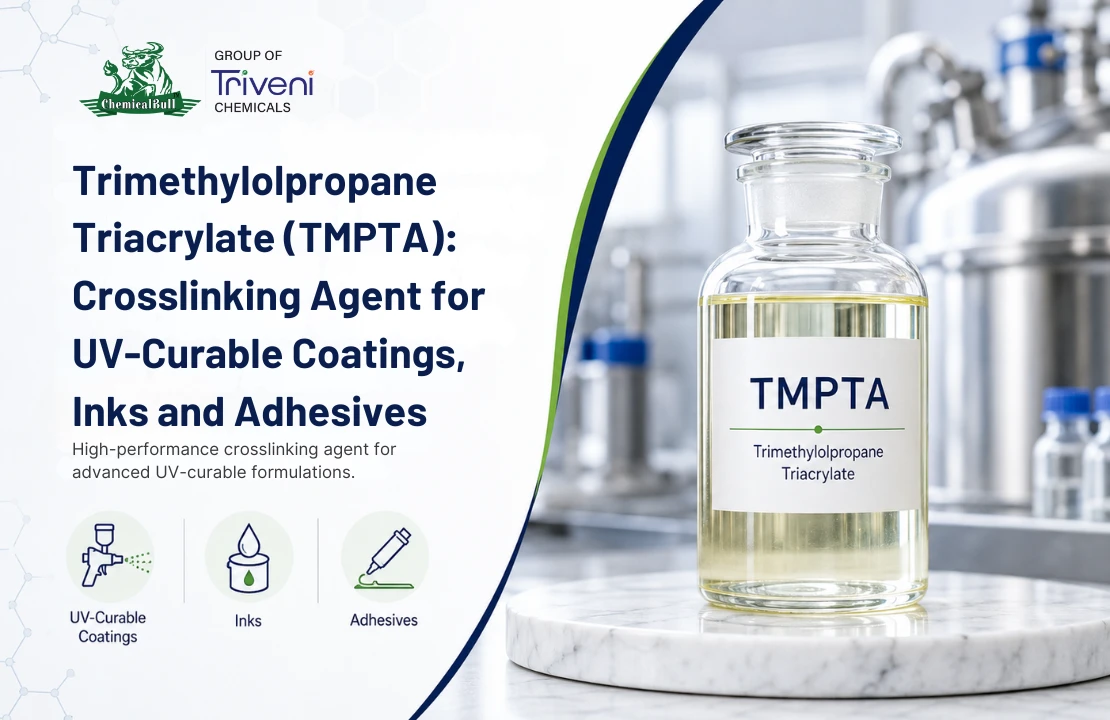
Trimethylolpropane Triacrylate (TMPTA) is a trifunctional acrylate monomer produced by reacting Trimethylolpropane (TMP) with acrylic acid. It is one of the most widely used crosslinking agents in radiation-curable chemistry, valued for its ability to build dense, three-dimensional polymer networks with exceptional speed, hardness, and chemical resistance.
In UV-curable systems, the number of acrylate groups per monomer molecule directly determines how fast and how densely the polymer network forms during curing. With three reactive acrylate groups per molecule, TMPTA contributes significantly more crosslinking than mono- or difunctional alternatives, making it the go-to trifunctional crosslinker in coatings, printing inks, adhesives, and optical fiber coatings.
For a broader overview of its chemical properties, industrial functions, safety requirements and sourcing considerations, read our complete guide to Trimethylolpropane Triacrylate uses, properties and industrial applications.
For consistent-quality TMPTA with full documentation, ChemicalBull is a trusted trimethylolpropane triacrylate supplier serving coatings manufacturers, ink formulators, and adhesive producers across India and global markets.
What Makes TMPTA a Crosslinking Agent?
In free radical photopolymerization, UV light activates a photoinitiator that generates radicals, which trigger acrylate double bonds to react and form polymer chains. A monofunctional acrylate creates linear chains. A difunctional acrylate allows some branching.
TMPTA, with three acrylate groups per molecule, creates a branch point at every unit incorporated into the network. This produces a three-dimensional crosslinked structure delivering:
- Higher crosslink density per unit volume
- Faster cure speed from three reactive sites per molecule
- Greater hardness and scratch resistance in cured films
- Improved chemical and solvent resistance
- Reduced oxygen inhibition at the film surface
TMPTA as a Reactive Diluent
Beyond crosslinking, TMPTA serves as a reactive diluent in UV-curable formulations. Oligomers such as epoxy acrylates and urethane acrylates are high in viscosity but essential for film performance. TMPTA reduces overall formulation viscosity without adding solvent, then reacts completely into the polymer network during cure, leaving no volatile residue.
TMPTA, as a reactive diluent, delivers:
- Viscosity reduction without VOC addition
- Improved substrate wetting and flow
- Complete reactive incorporation into the cured network
- Contribution to crosslink density even at low loading levels
Application 1: UV-Curable Coatings
TMPTA is a standard crosslinking component across a wide range of UV-curable coating systems.
Wood and Furniture Coatings
In UV-cured wood coatings, TMPTA contributes:
- Scratch and abrasion resistance: High crosslink density produces a hard, wear-resistant film suitable for flooring, furniture, and cabinetry
- Fast cure speed: Multiple reactive sites per molecule accelerate network formation, enabling high line speeds in industrial UV coating operations
- Gloss and surface quality: The dense, uniform network supports high gloss retention and smooth surface appearance
Plastic and Film Coatings
On substrates such as polycarbonate, PET, and ABS, TMPTA-based UV coatings provide hard, scratch-resistant protective layers for consumer electronics, optical lenses, and display films. Chemical resistance to cleaning agents, alcohols, and mild solvents is a key performance attribute in these applications.
Industrial and Functional Coatings
TMPTA is used in release coatings where crosslink density controls release force level, in overprint varnishes requiring fast cure and scuff resistance, in anti-graffiti coatings where chemical resistance is essential, and in optical fiber secondary coatings and electronic encapsulants.
Application 2: UV-Curable Printing Inks
TMPTA is used across UV-curable ink formulations for both sheetfed and web offset, flexographic, screen, and inkjet applications.
Key functions in UV inks:
- Crosslinking the ink film: After UV exposure, TMPTA reacts completely, converting the wet ink film into a solid, non-tacky, durable print layer in fractions of a second
- Viscosity adjustment: As a low-viscosity trifunctional monomer, TMPTA reduces ink formulation viscosity to match the requirements of different printing processes without solvent
- Rub and scratch resistance: High crosslink density directly translates into improved rub, scratch, and abrasion resistance of the printed ink film.
- Chemical resistance: Dense TMPTA network resists attack by common post-print chemicals, including cleaning agents and packaging contents
Performance by ink application:
|
Ink Application |
TMPTA Benefit |
|
Sheetfed offset UV inks |
Fast cure, tack control, gloss |
|
Flexographic UV inks |
Viscosity reduction, cure speed |
|
Screen printing UV inks |
Film hardness, chemical resistance |
|
UV inkjet inks |
Reactive diluent, jetting viscosity control |
|
UV LED inks |
Efficient cure under LED wavelengths with suitable photoinitiator |
Application 3: UV-Curable Adhesives
In UV-curable adhesive formulations, TMPTA contributes crosslink density and cohesive strength to the cured adhesive layer.
-
Structural and semi-structural adhesives:
TMPTA crosslinks the acrylate polymer backbone during UV cure, building cohesive strength and resistance to creep under sustained load. In bonding rigid substrates such as glass, metal, and rigid plastics, TMPTA crosslinking improves bond strength retention at elevated temperatures. -
Pressure-sensitive adhesives (PSA):
In UV-crosslinked PSA systems, TMPTA loading is carefully controlled. The level of crosslinking directly determines the balance between tack, peel adhesion, and shear resistance. Even small adjustments to TMPTA concentration significantly change the gel fraction and performance profile of the cured PSA. -
Lamination and optical bonding adhesives:
UV-curable laminating adhesives for film-to-film, glass-to-plastic, and optical bonding use TMPTA as a crosslinking component to ensure the cured bond layer resists delamination under thermal cycling, humidity, and mechanical stress.
Application 4: Optical Fiber Coatings
Optical fiber primary and secondary coatings are among the most technically demanding UV-curable acrylate applications. In secondary (outer) coatings, TMPTA contributes to the hard, stiff layer that protects the fiber from mechanical damage, moisture ingress, and microbending. Its fast cure speed at low UV doses supports high coating line speeds. Blending TMPTA with softer, lower-functionality acrylates allows formulators to engineer the exact modulus and elongation profile required for each fiber coating layer.
Formulation Tips for Using TMPTA
Typical usage levels:
|
Application |
Typical TMPTA Level |
|
UV wood coatings |
5% to 20% |
|
UV overprint varnishes |
5% to 25% |
|
UV printing inks |
5% to 20% |
|
UV-curable adhesives |
3% to 15% |
|
PSA crosslinking |
0.5% to 5% (precisely controlled) |
|
Optical fiber coatings |
5% to 30% (layer-dependent) |
Key formulation guidance:
- Blend with oligomers first: Dissolve TMPTA into the oligomer phase before adding photoinitiators and additives for uniform distribution.
- Balance functionality: TMPTA's high crosslink density can increase brittleness in thick films. Blend with mono- or difunctional diluents when flexibility is required.
- Match photoinitiator to light source: Use photoinitiators compatible with broadband mercury or UV LED sources (365 nm, 385 nm) for optimal cure efficiency
- Handle with care: TMPTA is a skin and eye sensitizer. Use gloves and eye protection at all times. Refer to the MSDS for full guidance.
- Storage: Store in a cool, dark environment away from heat and radical-generating sources. Use inhibited grades for shelf-life stability.
TMPTA vs Other Multifunctional Acrylate Crosslinkers
|
Monomer |
Functionality |
Key Difference vs TMPTA |
|
HDDA (Hexanediol Diacrylate) |
Difunctional |
Lower crosslink density, more flexible films |
|
TPGDA (Tripropylene Glycol Diacrylate) |
Difunctional |
Lower viscosity, softer cured network |
|
DPHA (Dipentaerythritol Hexaacrylate) |
Hexafunctional |
Higher crosslink density, harder films, higher viscosity |
|
PETA (Pentaerythritol Triacrylate) |
Trifunctional |
Similar functionality, slightly higher viscosity than TMPTA |
|
OTA 480 (Glycerol Propoxylate Triacrylate) |
Trifunctional |
Lower shrinkage, more flexible than TMPTA |
TMPTA's combination of low viscosity, trifunctionality, fast cure speed, and proven performance across multiple applications makes it the reference standard trifunctional crosslinker in most UV-curable formulation work.
Frequently Asked Questions
1. What is TMPTA used for in UV-curable systems?
TMPTA is a trifunctional crosslinking monomer and reactive diluent used in UV-curable coatings, printing inks, adhesives, and optical fiber coatings.
2. Why is TMPTA preferred as a crosslinker over difunctional acrylates?
Three acrylate groups per molecule create a denser, three-dimensional crosslinked network with faster cure speed and better chemical resistance.
3. What is the CAS number for TMPTA?
CAS 15625-89-5, molecular formula C12H18O6, molecular weight approximately 296 g/mol.
4. Can TMPTA be used in UV LED curing systems?
Yes. With a UV LED-compatible photoinitiator, TMPTA performs well under 365 nm and 385 nm LED light sources.
5. What is the typical usage level of TMPTA in UV coatings?
Typically 5% to 20% by weight in UV wood and plastic coatings, adjusted based on target hardness and cure speed.
6. Is TMPTA safe to handle?
TMPTA is a skin and eye sensitizer. Always wear gloves and eye protection. Refer to the product MSDS for full guidance.
7. How does TMPTA differ from PETA in UV formulations?
Both are trifunctional acrylates. TMPTA has lower viscosity for easier processing; PETA has slightly higher hydroxyl content that can influence adhesion on some substrates.
Conclusion
Trimethylolpropane Triacrylate is the trifunctional crosslinking monomer that UV-curable formulation chemistry relies on across coatings, inks, adhesives, and optical fiber applications. Its three reactive acrylate groups per molecule deliver the crosslink density, cure speed, hardness, and chemical resistance that mono- and difunctional alternatives cannot match at equivalent loading levels. As a reactive diluent, it simultaneously reduces formulation viscosity without adding VOC content, making it doubly valuable in 100% solids UV systems.
For TMPTA with consistent purity, Certificate of Analysis, MSDS, and bulk supply support, connect with Chemical Bull, a trusted trimethylolpropane triacrylate supplier serving UV coatings manufacturers, printing ink producers, adhesive formulators, and specialty chemical buyers across India and global export markets.

Comment Section