Chemical Bull
1835
28-Jan-2026
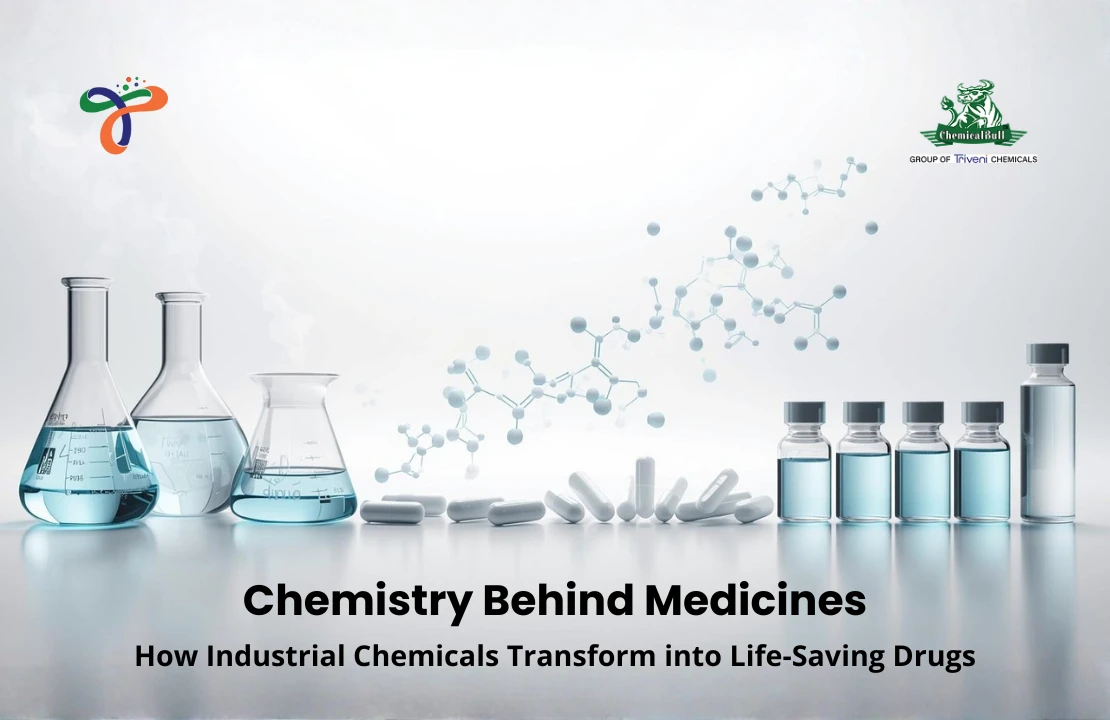
The journey from raw industrial chemicals to life-saving pharmaceutical medicines represents one of the most important transformations in modern science. Every tablet, capsule, injection, or syrup begins not in a pharmacy, but within carefully controlled chemical manufacturing environments where industrial compounds are transformed into therapeutic molecules.
Industrial chemistry and pharmaceutical manufacturing are deeply interconnected. Without reliable access to chemical raw materials, intermediates, solvents, and speciality compounds, the development and large-scale production of medicines would not be possible. This is why pharmaceutical manufacturers depend heavily on trusted chemical suppliers and distributors to maintain consistency, quality, and supply chain stability.
This blog explores how industrial chemicals evolve into medicines, the chemistry behind drug development, and the crucial role chemical suppliers play in supporting global healthcare.
Understanding Industrial Chemicals in Pharmaceutical Manufacturing
Pharmaceutical manufacturing is an extension of industrial chemistry, refined to meet stringent purity, safety, and regulatory standards. At its foundation, drug production relies on the same principles that govern broader industrial chemical applications.
Industrial chemicals used in pharmaceuticals include:
- Organic and inorganic raw materials
- Chemical intermediates
- Solvents and reagents
- Speciality chemicals for precision reactions
- Commodity chemicals for large-scale processing
A comprehensive understanding of how industrial chemicals are selected and applied across industries is covered in our pillar guide:
👉 Understanding Industrial Chemicals: Selection, Properties, and Real-World Manufacturing Applications
This knowledge forms the basis for understanding pharmaceutical chemistry.
How the Chemical Industry Supports the Pharmaceutical Industry
The pharmaceutical industry does not operate independently. It is built upon the infrastructure of the global chemical industry, which supplies the essential building blocks required for drug development and manufacturing.
Industrial chemical suppliers support pharmaceutical companies by providing:
- Consistent raw material quality
- Scalable chemical supply for production
- Speciality compounds for advanced formulations
- Reliable logistics for uninterrupted manufacturing
From early research to commercial production, chemical trading companies ensure that pharmaceutical manufacturers can operate efficiently and safely.
Role of Organic Industrial Chemicals in Drug Development
Most pharmaceutical molecules are based on organic chemistry. Organic industrial chemicals form the structural backbone of many active pharmaceutical ingredients (APIs).
Organic chemicals are used in:
- API synthesis pathways
- Multi-step chemical reactions
- Reaction solvents and catalysts
- Intermediate compound formation
These chemicals may be petrochemical-derived or bio-based, depending on application and sustainability goals.
A detailed explanation of this category is available here:
👉 Organic Industrial Chemicals Explained: From Petrochemicals to Bio-Based Compounds
Importance of Inorganic Industrial Chemicals in Pharmaceuticals
While organic compounds dominate pharmaceutical chemistry, inorganic industrial chemicals play a vital supporting role throughout drug manufacturing.
Inorganic chemicals are commonly used for:
- pH regulation and buffering systems
- Catalysis in chemical reactions
- Mineral-based therapeutic compounds
- Stabilisation and purification processes
Examples include acids, bases, metal salts, and inorganic reagents essential for reaction control and product consistency.
Learn more about their role here:
👉 Inorganic Industrial Chemicals: The Foundation of Modern Manufacturing
Speciality Chemicals and Precision Medicine Manufacturing
As pharmaceutical formulations become more complex, the reliance on speciality chemicals increases. These chemicals are engineered for specific performance characteristics and high-precision applications.
Speciality chemicals support:
- Advanced API synthesis
- Controlled-release formulations
- Biopharmaceutical processing
- High-purity and low-variability reactions
Their use minimises variability, enhances safety, and improves therapeutic outcomes.
Explore this category in detail here:
👉 Speciality Chemicals Revolution: High-Value Solutions for Specific Industrial Needs
Commodity Chemicals in Large-Scale Drug Production
Once a drug moves from laboratory development to commercial manufacturing, commodity chemicals become essential. These chemicals enable pharmaceutical companies to scale production efficiently and cost-effectively.
Commodity chemicals are used for:
- Bulk solvent requirements
- Equipment cleaning and sterilisation
- Auxiliary reaction steps
- High-volume processing operations
Their importance in industrial manufacturing is explored here:
👉 Commodity Chemicals at Scale: The Backbone of High-Volume Industrial Manufacturing
From Industrial Chemicals to Active Pharmaceutical Ingredients (APIs)
The transformation of industrial chemicals into APIs involves several tightly controlled stages:
Raw Material Sourcing
Pharmaceutical manufacturers source industrial and pharmaceutical-grade chemicals from reliable distributors. Consistency, traceability, and documentation are critical at this stage.
Chemical Synthesis
Multiple chemical reactions convert raw materials into pharmaceutical intermediates and ultimately APIs. Reaction conditions must be precisely controlled to ensure safety and yield.
Purification and Isolation
Solvents, separation agents, and filtration chemicals are used to remove impurities and achieve pharmaceutical-grade purity levels.
Formulation Support
Excipients and stabilisers are added to ensure proper drug delivery, stability, and shelf life.
Quality Control and Regulatory Compliance in Pharmaceutical Chemistry
The conversion of industrial chemicals into medicines demands strict quality standards. Regulatory authorities require comprehensive control at every stage of pharmaceutical manufacturing.
Key quality measures include:
- Raw material verification
- Process validation
- Analytical testing (HPLC, GC, NMR, IR)
- Impurity profiling
- Stability and dissolution testing
These controls ensure that pharmaceutical products meet global safety and efficacy requirements.
Scaling Pharmaceutical Chemistry from Lab to Industry
Scaling chemical reactions from laboratory to industrial volumes presents significant challenges, including:
- Heat and mass transfer control
- Reaction safety management
- Cost-effective reagent selection
- Waste reduction and sustainability
Both batch and continuous manufacturing models rely heavily on consistent supplies of industrial and speciality chemicals.
The Role of Trusted Chemical Suppliers and Distributors
Pharmaceutical manufacturing depends on uninterrupted chemical supply chains. Delays or inconsistencies can directly impact medicine availability.
A trusted chemical supplier and distributor supports pharmaceutical manufacturers by:
- Ensuring consistent material quality
- Maintaining reliable logistics
- Supporting regulatory documentation
- Providing technical sourcing expertise
ChemicalBull supports pharmaceutical and industrial manufacturers with a wide range of industrial chemicals suitable for diverse applications.
The Future of Chemistry in Medicine Manufacturing
Advances in green chemistry, process optimisation, and speciality materials continue to reshape pharmaceutical manufacturing. Innovations such as bio-based raw materials, continuous processing, and precision drug delivery systems are increasing the demand for specialised chemical solutions.
Chemical suppliers who understand both industrial chemistry and pharmaceutical applications will remain critical partners in this evolving landscape.
Conclusion
The transformation of industrial chemicals into life-saving medicines is a complex, precise, and highly regulated process. From raw material sourcing to API synthesis and large-scale production, chemistry underpins every stage of pharmaceutical manufacturing.
By supporting pharmaceutical companies with consistent, high-quality chemical supplies, reliable chemical distributors play an essential role in global healthcare. Industrial chemistry remains the foundation upon which modern medicines are built.
Frequently Asked Questions (FAQs)
-
How Is the Chemical Industry Linked to the Pharmaceutical Industry?
The chemical industry supplies essential raw materials, intermediates, solvents, and speciality compounds required for pharmaceutical manufacturing. Pharmaceutical companies rely on industrial chemical manufacturers and distributors to synthesise active pharmaceutical ingredients (APIs), formulate medicines, and scale production efficiently while maintaining quality and regulatory compliance. -
How Do We Use Chemistry in Medicine in Everyday Life?
Chemistry is used in everyday medicine through products such as pain relievers, antibiotics, vaccines, antiseptics, and nutritional supplements. Each of these medicines is developed and manufactured using industrial chemical processes that ensure safety, effectiveness, stability, and consistent performance. -
What Types of Industrial Chemicals Are Used in Pharmaceutical Manufacturing?
Pharmaceutical manufacturing uses a wide range of industrial chemicals, including organic chemicals, inorganic salts, chemical intermediates, solvents, speciality chemicals, and commodity chemicals. These substances support API synthesis, purification, formulation, and large-scale production processes. -
Why Are Chemical Suppliers Important for the Pharmaceutical Industry?
Chemical suppliers play a critical role by ensuring consistent quality, reliable availability, and proper documentation of chemical raw materials. Trusted chemical suppliers and distributors help pharmaceutical manufacturers avoid production disruptions, maintain compliance, and meet global healthcare demand. -
What Is the Difference Between Industrial Chemicals and Pharmaceutical Drugs?
Industrial chemicals are raw materials or intermediates used in manufacturing processes, while pharmaceutical drugs are finished products designed for therapeutic use. Industrial chemicals undergo controlled chemical synthesis, purification, and formulation processes before becoming safe, effective medicines.

Comment Section