

Chemical Bull
514
02-Feb-2026
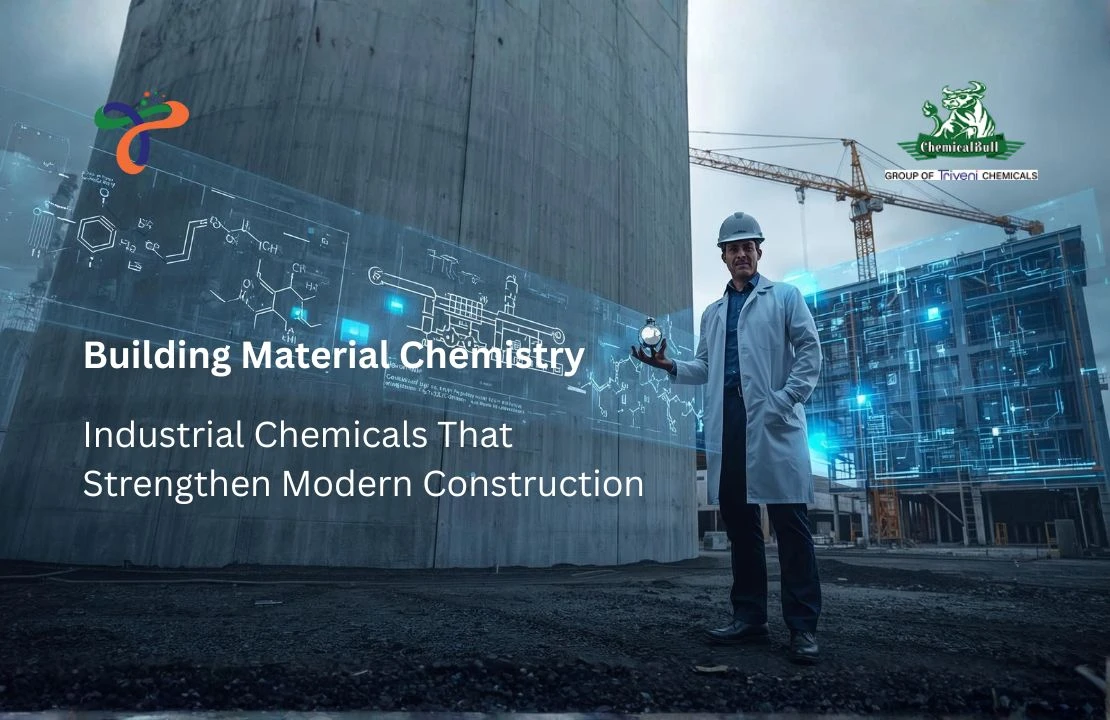
Modern construction is heavily dependent on an array of industrial chemicals. Of these chemical substances, construction and building have a crucial role to play. From waterproofing and durability of concrete to finishing the surface, strengthening structural stability and reinforcement, the industrial construction chemicals can be crucial for enhancing material performance as well as maintaining its long-term durability.
Contrary to organic chemicals that are used to make specialised coatings or adhesives, these building chemicals generally come from minerals such as polymers, salts, and inorganic sources. They can help optimise the building process, improve the strength of buildings, and aid in large infrastructure developments.
This blog explores building material chemistry, its chemical processes, key types, applications, and why these specialised chemicals remain at the core of modern construction science.
Understanding Building Material Chemistry
Building material chemistry focuses on the study and use of chemical additives in construction that enhance the behaviour, durability, and performance of building materials. These additives include binders, polymers, accelerators, fillers, and strengthening agents.
They are valued for their:
- Chemical stability
- High mechanical strength
- Ability to improve curing and setting
- Resistance to moisture, temperature, and corrosion
- Long-term durability and structural integrity
As part of the broader category of construction chemical, these chemicals are produced in large quantities and serve as essential components in cement, mortar, concrete, and composite structures.
To learn more about essential industrial chemicals used in construction, you can explore our Understanding Industrial Chemicals: Selection, Properties & Real-World Manufacturing Applications
What Are Construction Chemicals?
Chemicals used in construction are employed to strengthen or modify the building material. They are made by the process of mineral processing, polymerisation, controlled chemical reactions and heating processes.
Common examples of chemical compounds in building materials include:
- Calcium Carbonate (filler and strength enhancer)
- Silicon Dioxide (reinforcement and durability agent)
- Polyvinyl Alcohol (binder and surface resistance polymer)
- Calcium Formate (construction accelerator)
- Plasticisers and superplasticisers
- Waterproofing agents
- Adhesives and bonding chemicals
These chemicals are widely used as primary building material modifiers, performance enhancers, catalysts, curing agents, and structural additives.
Key Types of Construction Chemicals
Construction chemicals are generally classified according to their function and application.
1. Chemical additives to concrete
Concrete forms the foundation of building, and its efficiency is contingent greatly on additives.
Key examples:
- Superplasticisers to improve flow
- Retarders for controlled setting
- Accelerators such as Calcium Formate for faster curing
- Fillers like Calcium Carbonate for higher density
These ingredients help improve the strength, workability, endurance, and environmental protection.
2. Building Material Strengthening Chemicals
These substances improve the mechanical characteristics of building materials.
Common strengthening agents include:
- Silicon Dioxide (improves hardness and compressive strength)
- Additives made of polymers
- mineral-based fillers
- Reinforcement compounds
These help to enhance the load-bearing capacity as well as longer-term structural efficiency.
3. Modern Construction Chemicals
They are advanced technologies designed for better performance for massive infrastructure.
Examples:
- Polyvinyl Alcohol (improves bonding and resistance to cracks)
- Waterproofing chemicals
- Durable surface coatings
- Specialized adhesives
- Reinforcement polymers
These chemical compounds support the latest application in construction, including smart structures, as well as high-rise structures and fast-setting construction material.
4. Construction Chemistry Applications
Chemicals used in construction are crucial for:
- Cement manufacturing
- Highway and road construction
- Commercial and housing projects
- Industrial flooring
- Tunnels, bridges and massive infrastructure
- Reconstruction and repairs
The flexibility can be used in every sector of construction.
Production of Construction Chemicals
The production of industrial construction additives involves large-scale chemical processing, blending, thermal treatment, polymerisation, and mineral refinement.
Key production methods include:
- Grinding and beneficiation of minerals like limestone and silica
- Thermal processing and calcination for strength-enhancing compounds
- Polymer production, including substances like Polyvinyl Alcohol
- Chemical reactions to produce accelerators and binders
- Blending and formulation for ready-to-use construction additives
These processes ensure that chemicals are stable, scalable, and meet construction-grade standards.
Industrial Applications of Building Material Chemistry
Industrial chemicals utilised in construction are integrated into each step of the process.
Construction and Infrastructure
Materials such as concrete, cement, mortar, and concrete are based on:
- Silicon Dioxide for durability
- Calcium Carbonate to increase the strength of the dentin
- Calcium Formate for fast curing
- Polyvinyl Alcohol to create bonds as well as crack control
These ingredients improve efficiency, endurance, and structural integrity.
Building Material Enhancement
Industrial chemicals help:
- Improve workability
- Reduce water demand
- Improve resistance to moisture and temperature
- Enhance bonding and adhesion
- Enhance appearance and finish, and look
These improvements make current materials more effective and stable.
Chemical Engineering in Construction
In construction material science, chemicals serve as:
- Processing aids
- Performance enhancers
- Curing agents
- Protective coatings
- Structural stabilizers
They guarantee security, durability and conformity to building regulations.
Safety as well as Environmental Risks
Due to the large-scale usage, construction chemicals must be used with the highest standards of safety and environmental protection.
Important considerations comprise:
- Storage and Handling Properly
- Ensuring non-toxic application
- Dust and pollution control during mineral processing
- Waste management that is safe and Recycling methods
- Conformity with the construction and environment regulatory requirements
Modern-day manufacturers are focused on environmentally friendly formulations and sustainable methods.
The Role of Industrial Chemicals in Modern Construction
These chemicals are preferred because they offer:
- High performance under extreme conditions
- Cost-effectiveness in bulk applications
- Long-term reliability and stability
- Compatibility with advanced construction technologies
From smart cities to infrastructure megaprojects, construction chemicals support both traditional and modern engineering needs.
Future Trends in Construction Chemistry
The construction chemical industry continues to innovate.
Key trends include:
- Eco-friendly building additives
- Nanomaterials for strength and durability
- Advanced polymer-based reinforcement
- Smart materials for energy-efficient buildings
- Improved mineral-based additives, such as Silicon Dioxide
- Rapid-curing formulations using Calcium Formate
These advancements ensure that construction materials continue to evolve with modern engineering demands.
Conclusion
Construction chemicals are the foundation of modern building material science. Their role in enhancing cement, concrete, mortars, and structural materials makes them indispensable to global infrastructure development. While eco-friendly technologies are growing rapidly, these industrial construction additives continue to offer essential performance, strength, and durability.
ChemicalBull Pvt Ltd, part of the Triveni Group, is an ISO 9001:2015 certified supplier of industrial chemicals for construction, manufacturing, and engineering applications.
Pharmaceutical Grade Vs Industrial Grade Chemicals: Understanding The Essential Differences
14-Feb-2026

Sustainable Api Production: Green Chemistry, Continuous Flow Manufacturing And Strategic Sourcing
12-Feb-2026

Comment Section