Chemical Bull
2147
03-Feb-2026
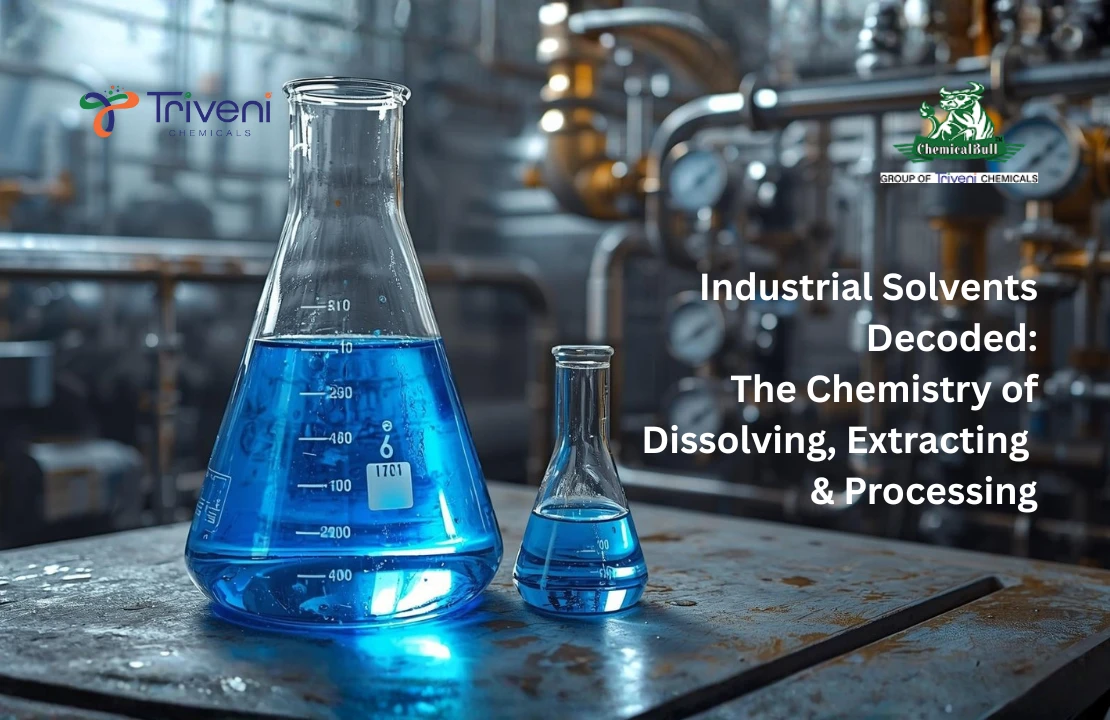
Industrial solvents are the backbone of modern manufacturing. From cleaning metal surfaces to extracting active ingredients and enabling complex chemical reactions, solvents play a silent yet critical role across industries. For B2B buyers and technical teams, understanding how solvents work and how to select the right one is essential for safe, efficient, and cost-effective production.
As a chemical manufacturing–focused organisation serving industrial clients, this blog explains what industrial solvents are, how their chemistry works, and how they are used across real-world manufacturing applications—in clear, practical language.
What Are Industrial Solvents?
Industrial solvents are chemicals used to dissolve, disperse, extract, clean, or carry other substances during manufacturing processes. Unlike laboratory solvents, industrial solvents are used in bulk quantities and must meet strict requirements for purity, consistency, performance, and safety.
Common industrial solvents include acetone, methanol, ethanol, toluene, isopropyl alcohol, and dichloromethane. Each solvent is selected based on the specific process requirement, material compatibility, and application conditions.
As an industrial chemicals manufacturer in India, Chemicalbull Pvt Ltd. supplies the global market with industry knowledge, application expertise, and quality control for industrial chemicals.
The Three Chemical Functions of Industrial Solvents
Before diving into solvent chemistry, it's essential to understand that solvents perform three distinct functions in manufacturing. Knowing which function you need determines which chemical properties matter most.
Dissolving vs Extracting vs Processing in Industrial Solvent Chemistry
In industrial manufacturing, solvents are not used for a single purpose. Their role changes depending on whether the goal is dissolving, extracting, or processing materials. Understanding this distinction helps industries choose the right solvent and optimise performance.
|
Aspect |
Dissolving |
Extracting |
Processing |
|
Purpose |
To uniformly dissolve a substance |
To selectively separate a target component |
To support or control a manufacturing step |
|
Solvent behaviour |
Creates a homogeneous solution |
Selectively dissolves desired compounds |
Acts as a reaction medium or carrier |
|
Common industries |
Coatings, inks, adhesives |
Pharmaceuticals, agrochemicals, food ingredients |
Chemicals, polymers, resins, specialty products |
|
Typical outcome |
Stable mixture |
Purified or concentrated material |
Controlled reaction, viscosity, or heat transfer |
|
Example use |
Dissolving resins in paints |
Extracting APIs from raw materials |
Supporting synthesis or formulation |
In simple terms, dissolving focuses on uniform mixing, extracting focuses on separation and purity, and processing focuses on enabling or improving industrial operations. This chemistry-driven understanding is central to effective solvent selection in manufacturing.
Understanding the Chemistry Behind Solvents
Polar vs Non-Polar Solvents
Polar solvents and non-polar solvents differ mainly in their molecular structure and how they interact with substances during industrial processes:
Polar Solvents
-
Have an uneven charge distribution within the molecule
-
Effectively dissolve polar and ionic substances
-
Possess a high dielectric constant
-
Show faster to moderate evaporation rates
-
Commonly used in cleaning, extraction, pharmaceutical processing, and coatings
Non-Polar Solvents
-
Have an even charge distribution within the molecule
-
Are effective in dissolving oils, greases, and hydrocarbons
-
Have a low dielectric constant
-
Generally evaporate at a moderate to slow rate
-
Widely used for degreasing, oil extraction, rubber processing, and polymer applications
In industrial practice, polar solvents such as acetone and alcohols are preferred for resin removal, extraction, and precision cleaning. Non-polar solvents like petroleum ether are commonly used for oil and grease removal during metal processing and raw material extraction.
Types of Industrial Solvents Used in Manufacturing
Organic vs Inorganic Solvents
|
Basis |
Organic Solvents |
Inorganic Solvents |
|
Chemical composition |
Carbon-based compounds |
Mineral or non-carbon-based compounds |
|
Availability |
Widely available |
Limited and specialised |
|
Application range |
Coatings, pharmaceuticals, polymers, agrochemicals |
Specialised reactions and processing |
|
Environmental impact |
Varies based on chemical structure |
Generally lower volatility |
|
Industrial preference |
Preferred for most formulations |
Used only where chemically required |
Organic solvents dominate industrial manufacturing due to their versatility and wide compatibility. Inorganic solvents are typically selected for niche applications where specific chemical stability or reactivity is required.
Industrial Uses of Solvents Across Sectors
Metal Degreasing & Surface Preparation
Solvents are widely used for degreasing metal surfaces and removing oils, lubricants, machine fluids, and industrial contaminants before coating, plating, welding, or assembly operations. Chemicals such as Acetone and Isopropyl Alcohol are commonly selected based on evaporation rate, cleaning efficiency, and operational safety requirements. Reliable solvent systems help manufacturers improve surface preparation quality and production consistency.
Paints, Coatings & Inks
Solvents play a crucial role in controlling viscosity, drying time, flow behaviour, and surface finish in paints, coatings, and ink formulations. Industrial solvents support resin dissolution, pigment dispersion, and coating uniformity for improved product durability and application performance. Their contribution to coating chemistry is closely linked to finish quality, adhesion, and long-term protection.
Chemical Processing & Intermediates
In chemical manufacturing, solvents act as reaction media, extraction agents, purification aids, and heat transfer components. Controlled solvent systems are essential for achieving stable reactions, improved yields, and high-purity chemical intermediates. Solvents such as Toluene, Methanol, and Ethyl Acetate are widely used in speciality chemical production and industrial synthesis operations.
Pharmaceuticals & Healthcare
Solvents play a critical role in the extraction, crystallisation, purification, and processing of active pharmaceutical ingredients (APIs). High-performance solvents help pharmaceutical manufacturers maintain product purity, reaction efficiency, and formulation consistency throughout production processes. Chemicals such as Dichloromethane, Methanol, and Isopropyl Alcohol are widely used in pharmaceutical synthesis, API extraction, and intermediate manufacturing applications.
Trusted Dichloromethane supplier networks support pharmaceutical and healthcare industries with high-purity solvent solutions for chemical synthesis, intermediate processing, and advanced drug manufacturing applications.
Water Treatment & Environmental Applications
How to Choose the Right Industrial Solvent
A practical solvent selection guide considers:
-
Solubility of the material being targeted
-
Requirements for Polarity
-
Boiling point and rate of evaporation
-
Material and equipment compatibility
-
Safety, toxicity, and handling requirements
-
Regulatory and environmental considerations
The choice of the correct solvent directly affects the production efficiency, safety, operational costs, and the final quality of the product.
Role of Solvents in Advanced Industrial Formulations
Modern industrial formulations typically include stabilisers, solvents, and catalysts, as well as functional ingredients. For instance:
-
Acetone is used as a fast-evaporating carrier solvent
-
Methanol supports extraction and synthesis processes
-
Toluene is used in coatings and resin systems
-
Isopropyl alcohol supports cleaning and pharmaceutical processing
These solvents operate within broader industrial chemical ecosystems that include solvents, esters, alcohol solvents, and carboxylic acids.
Why B2B Buyers Choose Reliable Solvent Manufacturers
To industrial purchasers, the consistency of products and dependability are more important than the brand name. Reputable industrial chemical distributors and manufacturers can provide:
-
Batch-to-batch consistency
-
Reliable bulk supply
-
Application-focused technical support
-
Industry-specific compliance and documentation
This strategy is more supportive of long-term manufacturing partnerships than sourcing decisions that are made in the short term.
Frequently Asked Questions (FAQs)
-
What are some industrial solvents commonly used in manufacturing?
Industrial solvents comprise acetone, toluene, ethanol, methanol, isopropyl alcohol, and dichloromethane. They are all chosen based on the specific requirements. -
What is the difference between a solute and a solvent?
A solute is the substance that gets dissolved, while a solvent is the substance that does the dissolving. In industrial processes, the solvent provides the medium for dissolution, reaction control, cleaning, or formulation. -
Is ethanol used as an industrial solvent?
Yes, ethanol can be employed in extraction, pharmaceutical coatings, and chemical processing because of its polarity as well as its relatively safe handling characteristics. -
What are the best solvents for grease removal in industries?
Non-polar or semi-polar solvents such as acetone, petroleum ether, and isopropyl alcohol are commonly used for grease and oil removal. -
Are industrial solvents hazardous?
Industrial solvents can be hazardous if not selected, handled, or stored properly. Factors such as flammability, toxicity, and environmental impact must be evaluated, which is why industries rely on experienced industrial solvent suppliers for safe usage guidance.
Conclusion
Industrial solvents are far more than simple liquids—they are strategic tools that influence manufacturing efficiency, product quality, and process safety. By understanding solvent chemistry and application requirements, B2B buyers can make informed sourcing decisions and build resilient supply chains.
For a broader perspective on how solvents fit within the wider chemical ecosystem, readers can also explore our detailed guide on understanding industrial chemicals, their selection, properties, and real-world manufacturing applications, which explains how different chemical classes are chosen for industrial performance and reliability.
As a trusted bulk industrial chemicals supplier, Chemicalbull - Group of Triveni Chemicals focuses on delivering application-ready solvents supported by technical expertise, consistent quality, and deep industry understanding.
Comment Section