Chemical Bull
1576
04-Feb-2026
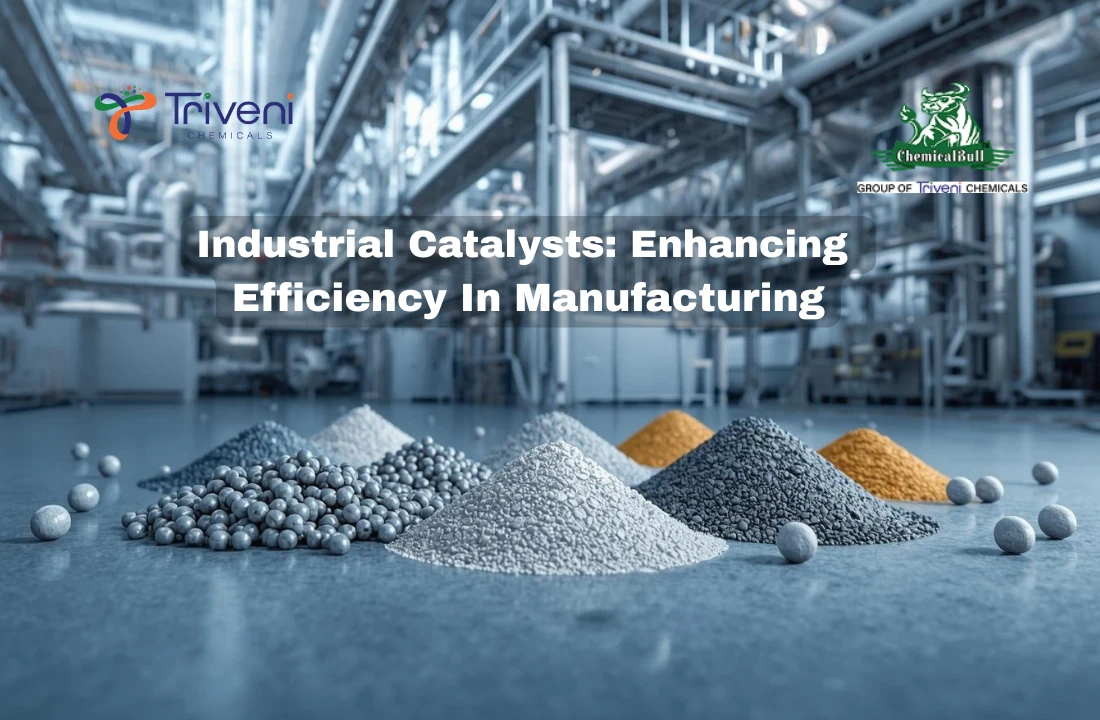
Industrial catalysts are the silent force behind modern manufacturing. Even when used in very small quantities, they make chemical reactions faster, safer, more economical, and more sustainable—without being consumed in the process.
From petroleum refining and pharmaceuticals to coatings, polymers, agrochemicals, and specialty chemicals, catalysts help industries produce more output using less energy and fewer raw materials.
For B2B manufacturers and processors, understanding how catalysts work, how they are selected, and where they are applied is critical for improving yield, reducing costs, and meeting today’s green manufacturing standards. As bulk industrial chemical distributors and suppliers, Chemicalbull Pvt. Ltd. supports industries by supplying high-purity catalysts and catalyst intermediates for large-scale industrial applications.
What Is a Catalyst in a Chemical Reaction?
A catalyst is a substance that increases the rate of a chemical reaction without being permanently consumed. It works by lowering the activation energy, allowing reactions to proceed faster at lower temperatures and pressures.
In simple terms, catalysts help ensure that:
-
Reactants convert into products faster
-
Energy consumption is reduced
-
Overall process efficiency improves
-
Equipment experiences less thermal and mechanical stress
This principle is widely applied across industrial catalysts used in chemical manufacturing, refining, pharmaceuticals, coatings, and polymer processing.
Why Are Catalysts Used in Small Amounts?
Catalysts are effective because they take part in the reaction mechanism rather than becoming part of the final product.
Key reasons include:
-
One catalyst molecule can activate thousands of reaction cycles
-
The catalyst regenerates itself after each cycle
-
Performance depends more on surface activity than quantity
-
Precise dosing prevents side reactions and material waste
This is why even small amounts of compounds such as Vanadium Pentoxide, Zinc Sulphide, or Cobalt Naphthenate can control reactions involving tonnes of raw materials.
How Do Industrial Catalysts Lower Activation Energy?
Catalysts provide an alternative reaction pathway that requires less energy to proceed.
Mechanism explained simply:
-
The catalyst interacts with reactant molecules
-
Existing chemical bonds are weakened
-
Intermediate states are stabilised
-
Products form more quickly
-
The catalyst exits the reaction unchanged
This explains the role of catalysts in speeding up chemical reactions across industrial processes.
With Catalysts vs Without Catalysts in Industrial Manufacturing
|
Parameter |
With Catalysts |
Without Catalysts |
|
Reaction speed |
Very fast |
Very slow |
|
Energy usage |
Low, supports sustainable chemistry |
High |
|
Operating temperature |
Moderate |
Extremely high |
|
Product yield |
High and consistent |
Low and variable |
|
Cost efficiency |
Optimised |
Expensive |
|
Environmental impact |
Supports green manufacturing |
High emissions |
What Are the Two Main Types of Industrial Catalysts?
Homogeneous Catalysts
-
Same phase as reactants (usually liquid)
-
High selectivity and uniform mixing
-
Easy reaction control, but difficult separation
Heterogeneous Catalysts
-
Different phase (solid catalyst with liquid or gas reactants)
-
Easy separation and reuse
-
Widely used in bulk industrial manufacturing
A quick comparison table of Homogeneous Catalysis vs Heterogeneous Catalysis is given below:
|
Feature |
Homogeneous Catalysis |
Heterogeneous Catalysis |
|
Phase |
Same as reactants |
Different |
|
Separation |
Difficult |
Easy |
|
Industrial scale |
Limited |
Very common |
|
Example use |
Fine chemicals |
Petroleum refining |
Common Industrial Catalysts & Applications
Industrial catalysts are selected based on reaction type, operating temperature, pressure, and end-use industry.
Common Catalyst examples used in manufacturing include:
-
Vanadium Pentoxide – oxidation reactions in sulfuric acid and polymer production
-
Zinc Sulphide – pigment chemistry and polymer stabilisation
-
Cobalt Naphthenate – curing and drying catalyst in coatings and resins
-
Nickel Sulfate Anhydrous – hydrogenation and electroplating processes
-
Molybdenum Trioxide – petroleum refining and desulfurisation
These materials are supplied through trusted industrial chemical distributors for industrial applications at scale.
To explore other commonly supplied catalyst-related chemical products, visit Chemicalbull’s Industrial Chemicals page, which also covers solvents, esters, and chemical intermediates used alongside catalysts.
Industrial Applications of Catalysts Across Sectors
Petroleum & Refining
Catalysts enable catalytic cracking, hydroprocessing, and reforming to convert crude oil into fuels and valuable intermediates.
Pharmaceuticals
Catalysts help transform raw chemicals into intermediates and APIs, supporting efficient and reliable drug manufacturing, as explained in Chemistry Behind Medicines: How Industrial Chemicals Transform into Life-Saving Drugs.
Paints, Coatings & Inks
Catalysts accelerate curing, improve gloss, and enhance coating durability.
Polymers & Plastics
Polymerisation catalysts control molecular weight, strength, and flexibility.
Specialty & Fine Chemicals
Used in dyes, agrochemicals, textile auxiliaries, and chemical intermediates, linking closely with The Color Chemistry of Textiles: Industrial Chemicals That Bring Fabrics to Life.
Role of Catalysts in Sustainable & Green Manufacturing
Catalysis plays a key role in sustainable chemistry by enabling:
-
Lower energy consumption
-
Reduced waste generation
-
Higher reaction efficiency
-
Better environmental compliance
Newer catalytic systems are helping industries reduce their environmental footprint while maintaining productivity.
From petroleum refining and pharmaceuticals to coatings, polymers, agrochemicals, and specialty chemicals, catalysts help industries produce more output using less energy and fewer raw materials. Their role is closely connected with broader topics such as Understanding Industrial Chemicals: Selection, Properties & Real-World Manufacturing Applications, where catalyst choice directly impacts process efficiency.
The Lifecycle of an Industrial Catalyst
-
Selection based on reaction chemistry
-
Formulation with solvents or carriers
-
Industrial deployment
-
Performance monitoring
-
Regeneration or recycling
Reliable sourcing from bulk chemical suppliers ensures consistent performance throughout this lifecycle.
Industrial Chemicals That Work Alongside Catalysts
In industrial processes, catalysts work alongside chemical intermediates, solvents, and esters to support reaction control, stability, and efficiency.
Relevant categories include:
-
Industrial Chemicals
-
Catalysts
-
Solvents
-
Esters
-
Chemical Intermediates
Why Industry Relies on Catalysis
Industries rely on catalysts to:
-
Make large-scale reactions practical
-
Improve product quality
-
Reduce production time
-
Lower energy and operating costs
-
Support sustainable manufacturing goals
FAQs on Industrial Catalysts
-
What is called a catalyst?
A catalyst is a substance that speeds up a chemical reaction without being consumed. -
What are 5 examples of catalysts?
Vanadium Pentoxide, Zinc Sulphide, Nickel catalysts, Cobalt compounds, and Palladium catalysts. -
What is catalyst used for?
Catalysts are used to accelerate reactions in refining, pharmaceuticals, polymers, and coatings. -
Why are catalysts important in industrial processes?
They improve efficiency, reduce energy use, increase yield, and support sustainability. -
What are the two main types of catalysts?
Homogeneous catalysts and heterogeneous catalysts.
Conclusion: Small Catalysts, Massive Impact on Industrial Manufacturing
Industrial catalysts prove that small amounts of chemicals can deliver massive industrial results. They enable faster reactions, higher efficiency, and lower energy consumption across multiple manufacturing sectors. Commonly supplied catalyst-related products by Chemicalbull Pvt. Ltd., including Vanadium Pentoxide, Zinc Sulphide, Cobalt Naphthenate, Nickel-based catalysts, and other industrial catalysts, support these processes at scale.
As a trusted supplier and distributor of industrial catalysts and related chemicals, Group of Triveni Chemicals – Chemicalbull helps manufacturers build efficient, reliable, and future-ready chemical processes. For enquiry, bulk supply, or technical sourcing support, connect with our team through the Contact Us page.


Comment Section