Chemical Bull
5453
20-Jun-2026
Polyethylene Glycol in Pharmaceutical Formulations: A Formulator's Guide
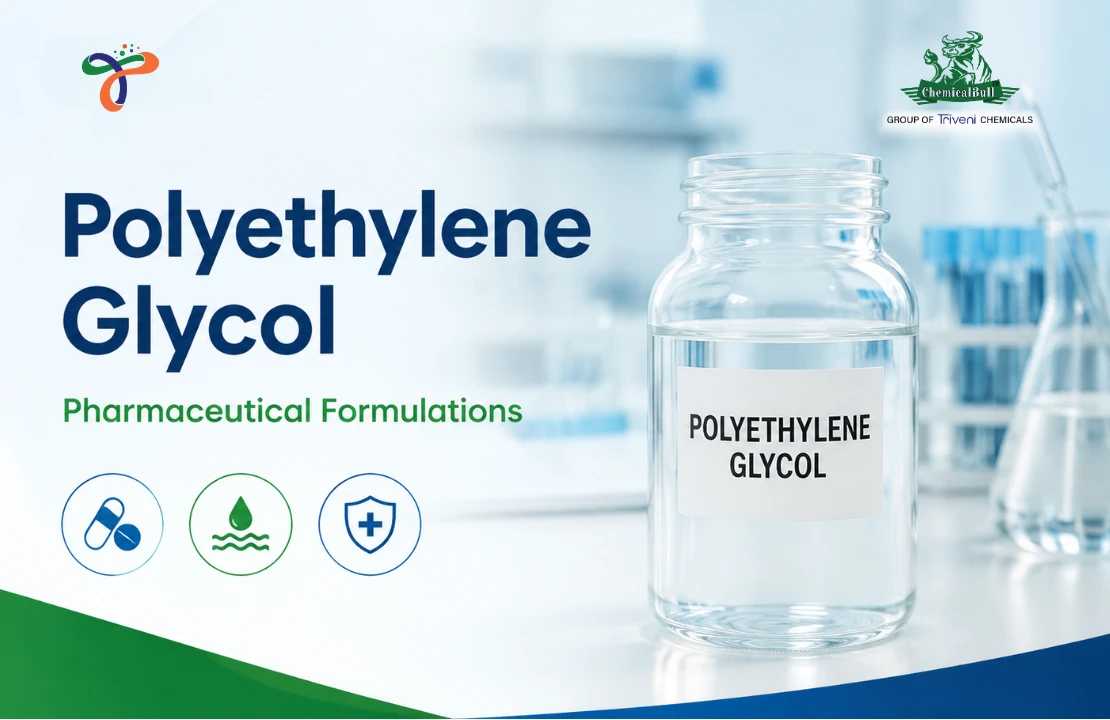
Polyethylene Glycol (PEG) is one of the most versatile and widely approved pharmaceutical excipients available today. Listed under USP-NF, BP, and EP pharmacopoeia standards, it is used across nearly every major dosage form — from oral tablets and softgel capsules to topical ointments, suppositories, injectables, and ophthalmic solutions.
What makes PEG exceptional as a pharma excipient is its tunability. By selecting the right molecular weight grade, formulators can precisely control viscosity, solubility enhancement, melting behaviour, and drug-release profile to meet exact formulation requirements.
This guide covers PEG grade selection, excipient functions across dosage forms, API compatibility, regulatory status, and how PEG compares with propylene glycol as a co-solvent in pharmaceutical systems. For PEG market trends and global demand data, refer to our dedicated guide on Polyethylene Glycol in pharma: key applications and emerging market trends.
PEG Grades and Physical Characteristics
The grade number indicates approximate average molecular weight (g/mol). As molecular weight increases, PEG transitions from a clear liquid to a hard waxy solid — and its pharma function shifts accordingly.
|
PEG Grade |
Physical State at 25°C |
Primary Pharmaceutical Use |
|
PEG 200 / 300 |
Clear liquid |
Solvent, injectable co-solvent |
|
PEG 400 |
Viscous liquid |
Solubilizer, softgel fill, ointment, ophthalmic |
|
PEG 600 |
Semi-liquid / paste |
Ointment bases, suppositories |
|
PEG 1000 / 1500 |
Soft to waxy solid |
Suppository bases, ointment structuring |
|
PEG 3350 / 4000 |
Solid flakes |
Tablet lubricant, binder, laxative API |
|
PEG 6000 / 8000 |
Hard waxy solid |
Film coating plasticizer, tablet formulations |
Key selection rule: Lower MW = better solvent capacity and water activity. Higher MW = better structural, matrix, and lubricant function.
PEG 400 Uses in Pharmaceutical Formulations
Among all grades, polyethylene glycol 400 (PEG 400) is the most widely used liquid PEG in pharma manufacturing. Its balanced molecular weight delivers a unique combination of water miscibility, API solubilization, low volatility, and multi-route acceptability.
Key functional properties of PEG 400:
- Fully miscible with water — serves as solvent, co-solvent, and carrier in aqueous systems
- Solubilizes poorly water-soluble APIs (BCS Class II and IV drugs)
- Accepted by FDA as a parenteral excipient at controlled concentrations
- Compatible with most pharmaceutical polymers, preservatives, and co-solvents
- Non-volatile — maintains formula consistency during manufacturing and storage
Primary pharmaceutical uses of PEG 400:
- Oral liquid formulations — co-solvent in solutions and elixirs for hydrophobic APIs
- Softgel capsule fill — one of the most common fill vehicles for lipophilic API delivery
- Topical and semi-solid bases — liquid component of official PEG ointment bases
- Injectable solutions — co-solvent vehicle for water-insoluble parenteral APIs (e.g., digoxin, diazepam)
- Ophthalmic solutions — lubricating and viscosity-modifying agent in artificial tear products
PEG in Key Pharmaceutical Dosage Forms
Tablet Formulations
PEG serves three distinct roles in tablet manufacturing:
Lubricant (PEG 4000, 6000, 8000):
High MW solid PEG grades reduce die-wall friction during compression. Unlike magnesium stearate, PEG lubricants are water-soluble and do not retard tablet dissolution — making them preferred in immediate-release formulations. Typical usage: 1%–5%.
Melt Binder (PEG 3350, 4000):
In hot-melt granulation, PEG melts, coats granules, and solidifies to improve compressibility and tablet hardness without solvents.
Film Coating Plasticizer (PEG 400, 6000):
Added to HPMC or PVA coating systems to reduce the polymer's glass transition temperature, making the film flexible and crack-resistant—typical usage: 1%–5% of coating formulation.
Ointments and Topical Formulations
The official USP PEG ointment base blends a liquid PEG grade (typically PEG 400 at 40–60%) with a solid PEG grade (PEG 3350 or PEG 4000 at 40–60%). The ratio is adjusted to achieve the target consistency and spreadability.
Compared to petrolatum-based ointments, PEG ointment bases are water-washable, non-staining, and compatible with aqueous wound secretions — making them widely used in dermatological antibiotics, antifungal creams, wound care products, and hemorrhoid preparations.
Suppositories
PEG suppository bases (typically PEG 1000 + PEG 4000 blends) dissolve in rectal fluid rather than melting at body temperature — unlike fatty acid bases such as cocoa butter. This makes them more stable across temperature variation during storage and preferred for warm-climate supply chains. The melting point is engineered by adjusting the solid-to-liquid PEG ratio.
Capsule Formulations
Softgel capsules:
PEG 400 is a primary fill vehicle for softgel products, used alone or blended with propylene glycol, glycerin, or polyoxyethylated castor oil to optimize API solubility and fill stability. PEG 400 offers broader chemical stability; propylene glycol provides stronger fluidity at lower temperatures — the two are often co-formulated for optimal performance.
Hard capsule melt-fill:
Solid-grade PEG (PEG 4000, 6000) is used as a melt-fill carrier in hard gelatin capsules, dispersing APIs as solid dispersions to improve dissolution of poorly soluble drugs.
Injectable Formulations
PEG 300 and PEG 400 are the grades accepted for parenteral use per the FDA Inactive Ingredient Database. They serve as co-solvents to keep insoluble APIs in solution and prevent precipitation upon dilution. Parenteral-grade PEG must pass strict residual impurity testing for ethylene oxide and 1,4-dioxane.
Beyond excipient use, high MW PEG (PEG 5000–40000) is used in PEGylation — covalent attachment of PEG chains to therapeutic proteins and biologics to extend half-life, reduce immunogenicity, and improve solubility (e.g., PEG-interferon alfa, PEGylated liposomal doxorubicin).
PEG 400 vs. Propylene Glycol in Pharma
Both PEG 400 and propylene glycol are water-miscible, low-toxicity co-solvents approved across multiple pharmaceutical routes. Here is how they compare:
|
Property |
PEG 400 |
Propylene Glycol |
|
Molecular Weight |
~400 g/mol |
~76 g/mol |
|
Viscosity at 25°C |
~90 cP |
~40 cP |
|
API Solubilizing Power |
High |
Good |
|
Antimicrobial Effect |
Minimal |
Yes (>15%) |
|
Parenteral Acceptance |
Yes (controlled) |
Yes (controlled) |
|
Best Used In |
Softgels, injectables, ointments |
Syrups, oral liquids, topical gels |
In practice, PEG 400 and propylene glycol are frequently blended as a co-solvent system to combine their solubilization strengths while optimizing viscosity and preservative contribution. Both are fully miscible and pharmacopoeia-accepted across oral, topical, and parenteral routes.
Regulatory Status:
|
Regulatory Body |
Standard |
|
US FDA |
GRAS; FDA Inactive Ingredient Database (multiple routes) |
|
USP-NF |
Monographs for PEG 200–8000 |
|
BP / EP |
Listed as Macrogol grades |
|
Japanese Pharmacopoeia |
Macrogol 400 and others listed |
When sourcing pharmaceutical-grade PEG, always request: USP/BP Certificate of Analysis (COA), residual ethylene oxide and 1,4-dioxane test results, heavy metals data, GMP manufacturing documentation, and Drug Master File (DMF) reference for regulated market supply.
Frequently Asked Questions
1. What is PEG used for in pharmaceutical tablets?
PEG serves as a water-soluble tablet lubricant (PEG 4000–8000), melt binder in granulation (PEG 3350–4000), and film coating plasticizer (PEG 400, 6000) — improving compression, dissolution, and coating flexibility.
2. Which PEG grade is used in pharmaceutical ointments?
PEG ointment bases blend PEG 400 (liquid, 40–60%) with PEG 3350 or PEG 4000 (solid, 40–60%) — the ratio is adjusted to control consistency and API release.
3. Is PEG 400 safe for injectable use?
Yes — PEG 400 is FDA-approved for parenteral use at controlled concentrations; parenteral-grade material must meet strict limits for residual ethylene oxide and 1,4-dioxane impurities.
4. What is the difference between PEG 400 and propylene glycol in pharma?
PEG 400 offers higher molecular weight, greater viscosity, and broader API compatibility; propylene glycol is lighter, more fluid, and adds inherent antimicrobial activity — both are frequently co-formulated.
5. What does USP grade mean for PEG?
USP-grade PEG meets pharmacopoeia monograph specifications for molecular weight, hydroxyl value, acid value, heavy metals, and residual impurity limits — mandatory for pharmaceutical manufacturing.
6. What is PEGylation in pharmaceuticals?
PEGylation is the covalent bonding of PEG chains to therapeutic proteins or biologics, extending drug half-life, reducing immune response, and improving solubility in the body.
7. Can PEG be used in suppositories?
Yes — PEG 1000 and PEG 4000 blends form suppository bases that dissolve in rectal fluid rather than melting, offering superior temperature stability over fatty acid bases.
Conclusion
Polyethylene Glycol is a precision pharmaceutical excipient — its value lies in the ability to select the exact grade needed for each dosage form function, from PEG 400 as a softgel fill and injectable co-solvent to high MW solid grades as tablet lubricants, ointment bases, and suppository vehicles.
For pharmaceutical-grade PEG across all molecular weight grades with USP/BP COA, GMP documentation, and DMF support, connect with ChemicalBull — a reliable polyethylene glycol manufacturer supplying pharma manufacturers and formulators across India and global export markets.
Comment Section