Chemical Bull
829
20-Jun-2026
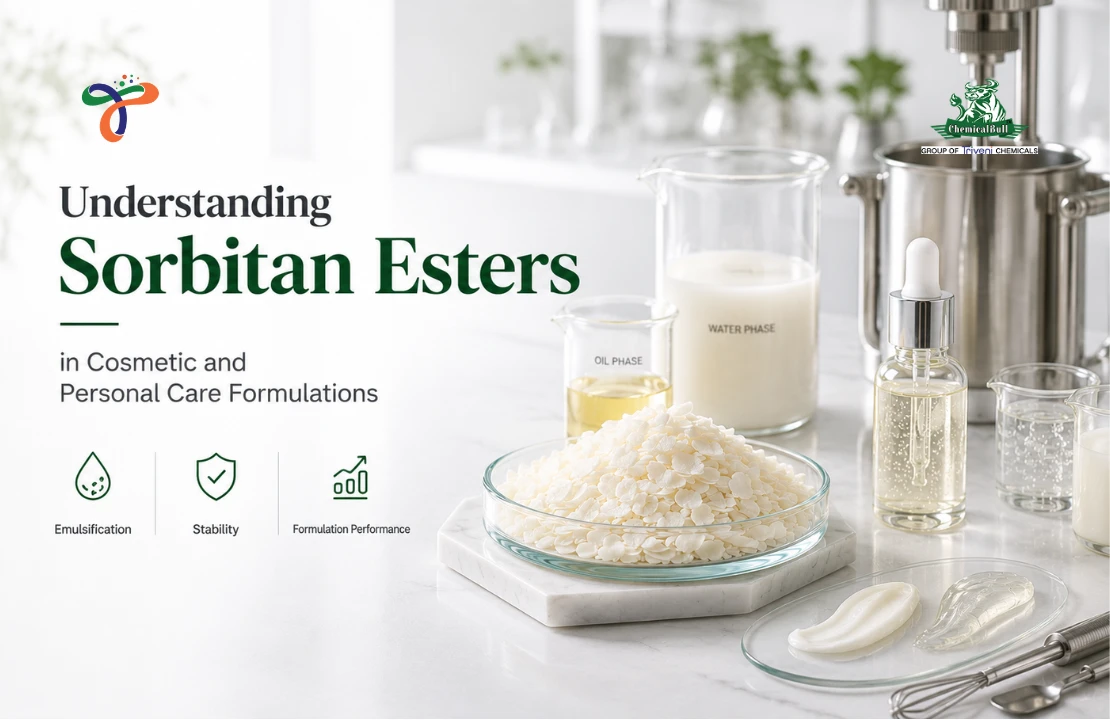
Introduction: Why Sorbitan Esters Matter in Modern Personal Care
A smooth cream, stable lotion, rich body butter, cleansing balm, sunscreen, or ointment needs more than oils and water. It needs the right ingredient system to hold the formula together, improve texture, and support long-term stability.
This is where sorbitan esters become important in cosmetic and personal care formulations. They are widely used as non-ionic emulsifiers, co-emulsifiers, dispersing agents, and texture-supporting ingredients in creams, lotions, balms, sunscreens, cleansing systems, and other personal care products.
For formulators, sorbitan esters are useful because they help manage oil-water interaction, improve spreadability, and support stable product appearance. They are also part of the growing interest in sustainable personal care ingredients, especially when grades are selected with proper supplier documentation and application suitability.
Quick Answer
Sorbitan esters are non-ionic emulsifiers used in cosmetic formulations to stabilize creams, lotions, balms, and sunscreens. They work by reducing oil-water separation using their fatty acid chain and sorbitan head group structure. Common types include Sorbitan Stearate, Sorbitan Oleate, and Sorbitan Tristearate, selected based on HLB value and product format.
What Are Sorbitan Esters and How Are They Used in Personal Care?
Sorbitan esters are fatty acid esters of sorbitan, a dehydrated derivative of sorbitol. They are formed when sorbitan reacts with fatty acids such as stearic acid, oleic acid, lauric acid, palmitic acid, or other fatty acid blends.
In cosmetic formulation, sorbitan esters are mainly used as non-ionic surfactants. This means they do not carry an electrical charge, which makes them compatible with many oils, waxes, emulsifiers, thickeners, actives, and preservatives.
They are commonly selected when a formulation needs:
-
Better oil-water compatibility
-
Improved emulsion stability
-
Smooth texture
-
Better spreadability
-
Support for waxy or oily phases
-
Controlled viscosity
-
Mild formulation behavior
In simple terms, sorbitan esters help oily and watery ingredients work together more effectively in personal care products.
What Is Sorbitan Ester Used For in Cosmetics?
Sorbitan ester is used in cosmetics and personal care products to support emulsification, dispersion, texture, and product stability. It helps combine ingredients that normally do not mix well, especially oils, waxes, butters, and water-based phases.
Common sorbitan esters applications in cosmetics include:
-
Stabilizing creams and lotions
-
Supporting water-in-oil emulsions
-
Working as co-emulsifiers in oil-in-water systems
-
Improving body butter and balm texture
-
Helping disperse oils and waxes
-
Improving product spreadability
-
Supporting sunscreen and ointment stability
-
Helping cleansing creams and cleansing balms maintain consistency
-
Improving sensory feel in skin care products
Sorbitan esters are not usually added for fragrance, color, or active performance. Their main value is formulation support.
Examples of Sorbitan Esters Used in Personal Care
Different sorbitan esters are selected for different product formats. Some are better for creams, while others are more suitable for oil-rich systems, balms, or cleansing products.
|
Example |
Span No. |
Common Use in Formulations |
Typical Product Fit |
|
Sorbitan Stearate |
Span 60 |
Co-emulsifier, texture modifier, stabilizer |
Creams, lotions, sunscreens, body butters |
|
Sorbitan Oleate |
Span 80 |
Lipophilic emulsifier and dispersing aid |
Cleansing balms, oils, W/O systems |
|
Sorbitan Laurate |
Span 20 |
Emulsifier and dispersion support |
Light creams, lotions, cleansing systems |
|
Sorbitan Palmitate |
Span 40 |
Body-building co-emulsifier |
Creams, ointments, structured emulsions |
|
Sorbitan Tristearate |
Span 65 |
Oil-phase structuring and fat compatibility |
Balms, sticks, wax-rich formulations |
|
Sorbitan Sesquioleate |
Span 83 |
W/O emulsifier support |
Cold creams, ointments, rich emulsions |
These examples of sorbitan esters show why the ingredient family is useful across many cosmetic formulation techniques.
Looking for a trusted Sorbitan Tristearate manufacturer in India? ChemicalBull connects you with verified bulk supply options backed by COA, TDS, and SDS.
How Sorbitan Esters Work in Cosmetic Formulations
In a cosmetic emulsion, oil and water naturally separate. Sorbitan esters help reduce this problem by positioning themselves at the boundary between oil and water.
Their fatty acid portion interacts with the oil phase, while the sorbitan part supports interaction near the polar phase. This helps reduce interfacial tension and improves the stability of the mixture.
In practical formulation work, sorbitan esters are often used with other emulsifiers. A low-HLB sorbitan ester may be paired with a higher-HLB emulsifier to create a more balanced emulsifier system.
This is common in:
-
Moisturizing creams
-
Sunscreens
-
Cleansing creams
-
Conditioners
-
Ointments
-
Body lotions
-
Balms and butters
HLB Value of Sorbitan Esters: Why It Decides Your Formula
HLB means hydrophilic-lipophilic balance. It helps formulators understand whether an emulsifier is more water-loving or oil-loving.
Sorbitan esters usually have low to medium HLB values, which means they are generally more oil-compatible. This makes them useful in water-in-oil systems and as co-emulsifiers in oil-in-water formulations.
|
HLB Behavior |
What It Means |
Formulation Use |
|
Lower HLB |
More oil-loving |
W/O emulsions, balms, rich creams |
|
Medium HLB |
Balanced support |
Co-emulsifier systems |
|
Higher HLB partner |
More water-loving |
Helps support O/W emulsions when blended |
The right HLB balance depends on the oil phase, wax content, water content, desired texture, and product type.
Are Sorbitan Esters Safe in Cosmetics?
Sorbitan esters are widely used in personal care products, but safety always depends on grade, concentration, final formula, application area, and regulatory requirements.
In general cosmetic formulation, they are used as functional excipients rather than active treatment ingredients. They help with emulsification, texture, and stability.
For the safety of cosmetic ingredients, formulators should check:
- Cosmetic grade suitability and supplier SDS
- Impurity profile and allergen statements
- Regional cosmetic regulations
- Finished product stability and skin compatibility testing
Frequently Asked Questions
-
What are sorbitan esters?
Sorbitan esters are non-ionic emulsifiers made from sorbitan and fatty acids, used in cosmetic creams, lotions, balms, and sunscreens to stabilize oil-water systems and improve texture.
-
What are the examples of sorbitan esters?
Common examples include Sorbitan Stearate (Span 60), Sorbitan Oleate (Span 80), Sorbitan Laurate (Span 20), Sorbitan Tristearate (Span 65), and Sorbitan Sesquioleate (Span 83), each with different HLB values and formulation uses. -
Is sorbitan ester safe for skin?
Yes, sorbitan esters are widely used in cosmetic formulations at approved levels. Always verify cosmetic grade suitability, SDS, and conduct finished product stability and skin compatibility testing. -
Who is the manufacturer of sorbitan esters in India?
India has multiple sorbitan esters manufacturers, exporters, and distributors serving cosmetic, pharma, and industrial sectors. ChemicalBull helps buyers source verified grades with COA, TDS, and SDS. -
Sorbitan esters vs polysorbates — what is the difference?
Sorbitan esters (Span series) are oil-loving with low HLB values, while polysorbates (Tween series) are water-loving with higher HLB values. They are often paired together to achieve balanced emulsification in creams and lotions. -
What is the HLB value of sorbitan esters in cosmetics?
Sorbitan esters have HLB values from 2.1 (Span 65 / Sorbitan Tristearate) to 8.6 (Span 20 / Sorbitan Laurate). Lower HLB suits W/O emulsions and balms; higher HLB suits O/W light creams and cleansing systems.
Conclusion
Sorbitan esters are important cosmetic formulation ingredients because they help stabilize emulsions, improve texture, support oil-phase compatibility, and enhance product consistency. Their structure, fatty acid type, HLB value, and grade quality all influence how they perform in creams, lotions, sunscreens, balms, ointments, and cleansing systems.
For cosmetic and personal care formulators, the best approach is to choose sorbitan esters based on the product format, oil phase, desired texture, stability target, and documentation requirements.
For sorbitan esters, samples, COA, TDS, SDS, and bulk sourcing support, connect with ChemicalBull to compare suitable grades for cosmetic and personal care formulations.

Comment Section