Chemical Bull
2229
24-Jun-2026
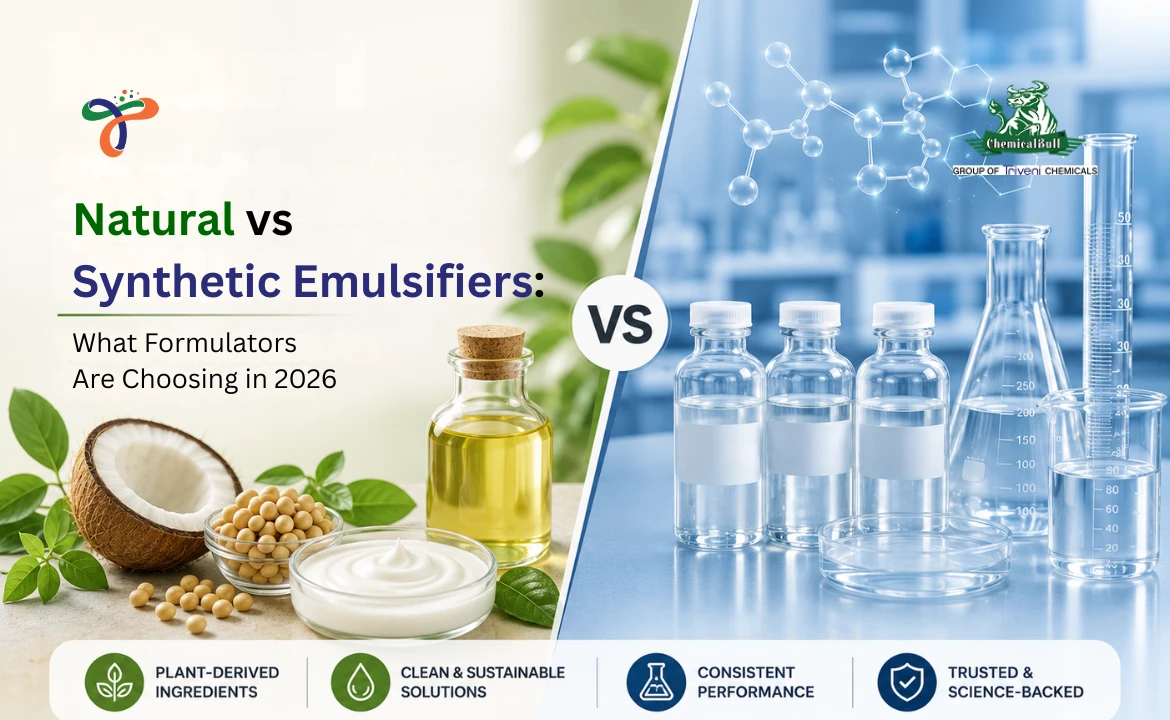
Natural vs Synthetic Emulsifiers: What Formulators Are Choosing in 2026
What Are Emulsifiers?
In 2026, emulsifier selection is no longer only about mixing oil and water. Formulators now look at label appeal, product stability, consumer trust, processing performance, cost, texture, and long-term shelf life before choosing the right ingredient system.
Natural emulsifiers are gaining attention in clean-label foods, premium skin care, plant-based products, ice cream, sauces, creams, lotions, and mild personal care products. At the same time, synthetic emulsifiers remain important because they offer consistent quality, strong stability, easier processing, and better control in large-scale production.
The best choice is not always natural or synthetic. A natural emulsifier may be better for a clean-label food or natural skin care cream, while a synthetic emulsifier may be better for a high-stability lotion, sunscreen, frozen dessert, packaged bakery product, or formula that needs stronger processing tolerance.
Quick Answer: Natural or Synthetic Emulsifiers?
Natural emulsifiers are generally obtained from plant, animal or naturally derived raw materials. They are often preferred when clean-label, natural-origin, vegan or consumer-friendly positioning is important.
Synthetic emulsifiers are manufactured or chemically modified to provide controlled composition, predictable performance and greater stability under demanding processing conditions.
What Is an Emulsifier and How Does It Work?
An emulsifier is a molecule containing one part that is attracted to water and another part that is attracted to oil.
When added to an oil-and-water formulation, emulsifier molecules position themselves at the boundary between the two phases. This helps reduce interfacial tension and prevents dispersed droplets from joining together too quickly.
Depending on the formulation, emulsifying agents may help improve:
- Physical stability
- Texture and mouthfeel
- Viscosity
- Spreadability
- Aeration
- Skin feel
- Product appearance
- Processing consistency
- Shelf-life performance
An emulsifier does not guarantee stability by itself. The oil phase, water phase, HLB requirement, droplet size, temperature, pH, mixing speed and storage conditions must also be considered.
What Are the Different Types of Emulsifiers?
There are different types of emulsifier, and each type is selected based on product format, source, charge, and emulsion behavior.
|
Type |
What It Means |
Common Product Use |
|
Natural emulsifiers |
Derived from natural or bio-based sources |
Clean-label food, natural skin care, balms, creams |
|
Synthetic emulsifiers |
Manufactured or chemically modified for controlled performance |
Packaged foods, cosmetics, pharma, industrial products |
|
Non-ionic emulsifiers |
Emulsifiers without electrical charge |
Mild creams, lotions, food emulsions |
|
Anionic emulsifiers |
Negatively charged emulsifiers |
Cleansers, foaming systems, selected emulsions |
|
Cationic emulsifiers |
Positively charged emulsifiers |
Hair conditioners and conditioning systems |
|
Oil-in-water emulsifiers |
Help disperse oil droplets in water |
Lotions, sauces, creams, milk drinks |
|
Water-in-oil emulsifiers |
Help disperse water droplets in oil |
Cold creams, barrier creams, butter-like spreads |
Natural Emulsifiers
Natural emulsifiers are chosen when brands want a cleaner ingredient label, natural-origin positioning, plant-based appeal, or a more familiar ingredient story. They are used in food, skin care, hair care, baby care, nutraceuticals, body care, and premium personal care products.
In food, lecithin is often used in chocolate, sauces, spreads, bakery systems, and plant-based products. In skin care, glyceryl stearate, lecithin, sucrose esters, and polyglyceryl esters are commonly selected for creams, lotions, moisturizers, cleansing balms, and body butters.
Natural emulsifiers are attractive because they support clean-label and natural-positioned products. However, they still need proper testing. A natural emulsifier can still fail if the oil phase, HLB balance, processing temperature, preservative system, or storage conditions are not suitable.
Examples of Natural Emulsifiers
Common examples include:
Synthetic Emulsifiers
Synthetic emulsifiers are selected when the formulation needs predictable performance, stronger stability, better processing control, and consistent batch quality.
They are commonly used in packaged foods, bakery products, ice cream, frozen desserts, creams, lotions, sunscreens, pharmaceuticals, and industrial formulations.
These ingredients are often chosen because they perform well under heat, shear, pH changes, long storage, transport stress, and high-volume manufacturing. Synthetic does not automatically mean unsafe or poor quality. The right question is whether the emulsifier is approved for the application, suitable for the product, and used at the correct level.
Examples of Synthetic Emulsifiers
Common synthetic or chemically modified emulsifiers include:
- Polysorbate 20
- Polysorbate 80
- Sorbitan monostearate
- PEG-100 stearate
- PEG-40 hydrogenated castor oil
- Sodium stearoyl lactylate
In food and bakery formulations, Sodium Stearoyl Lactylate is commonly used as an emulsifier and dough-conditioning ingredient to support dough strength, product softness, texture, processing consistency, and finished-product quality.
Natural vs Synthetic Emulsifiers: Key Difference
The main difference between natural and synthetic emulsifiers is not only the ingredient source. It is also about performance consistency, label perception, formulation flexibility, cost, and stability.
|
Factor |
Natural Emulsifiers |
Synthetic Emulsifiers |
|
Source |
Plant, animal, or bio-based origin |
Manufactured or chemically modified |
|
Label Appeal |
Strong for clean-label and natural-positioned products |
May be less preferred in natural-positioned products |
|
Performance Consistency |
Can vary by source and grade |
Usually more consistent |
|
Stability |
Good, but may need careful balancing |
Often stronger in demanding formulas |
|
Cost |
Can be higher |
Often more cost-effective |
|
Processing |
May need more formulation trials |
Easier to standardize |
|
Consumer Perception |
Often positive |
Depends on product category and ingredient name |
|
Best Fit |
Clean-label food, natural skin care, premium products |
High-stability foods, sunscreens, lotions, mass production |
Natural emulsifiers are often selected when the product story and ingredient label matter most. Synthetic emulsifiers are often selected when performance, repeatability, and cost control matter most.
Where Natural and Synthetic Emulsifiers Fit in 2026 Formulations
In 2026, formulators are choosing emulsifiers based on both product positioning and technical performance. Natural emulsifiers are preferred when a formula needs clean-label appeal, natural-origin positioning, or a more familiar ingredient story. This is common in natural emulsifiers in food, premium skin care creams, lotions, balms, plant-based foods, sauces, chocolate, clean-label ice cream, and mild personal care products.
Synthetic emulsifiers are still widely used when a product needs strong shelf stability, repeatable performance, cost control, and easier processing at scale. This is common in synthetic emulsifiers in food, packaged bakery products, frozen desserts, sunscreens, conditioners, lotions, and high-stability emulsions. For more application-specific information, explore our guide to bakery emulsifiers: types, uses and applications.
For oil and water systems, the selection depends on the emulsion type, oil phase, HLB requirement, processing temperature, and shelf-life target. Natural emulsifiers for oil and water can work well when the formulation is properly balanced, but synthetic or hybrid systems may perform better when the formula needs long storage stability, heat tolerance, or stronger processing control.
In agricultural formulations, emulsifier selection also depends on formulation type, dilution behaviour, stability and compatibility with active ingredients. Learn more in our guide to agrochemical emulsifiers: types, functions and applications.
In rinse-off personal-care systems, multifunctional ingredients such as PEG-7 Glyceryl Cocoate can support mildness, conditioning, refatting, foam quality, and improved after-wash feel in shampoos, face washes, and body washes.
|
Formulation Need |
Better Direction |
|
Clean-label food or premium positioning |
Natural emulsifier |
|
Strong shelf stability |
Synthetic or hybrid system |
|
Natural skin care texture |
Natural-origin emulsifier |
|
Large-scale food processing |
Synthetic or hybrid system |
|
Ice cream texture and melt control |
Natural or synthetic, depending on claim |
|
Oil and water stability |
Match emulsifier to HLB and oil phase |
|
Cost control |
Synthetic or optimized blend |
|
Natural-origin claim with performance |
Hybrid emulsifier system |
This is why many formulators now use a practical approach instead of choosing only by origin. They ask what the product must achieve first, then choose the emulsifier system that can deliver that result.
How to Choose the Right Emulsifying Agent
Before selecting an emulsifier, formulators should evaluate the complete system.
1. Identify the Emulsion Type
Determine whether the product is oil-in-water or water-in-oil.
2. Evaluate the Oil Phase
Consider the type and percentage of oils, waxes, fats, silicones or emollients.
3. Determine the HLB Requirement
The required hydrophilic-lipophilic balance can help narrow the selection of non-ionic emulsifiers.
4. Review Processing Conditions
Temperature, mixing speed, homogenisation, order of addition and cooling rate can affect the final emulsion.
5. Check pH and Ingredient Compatibility
Acids, salts, active ingredients, preservatives and fragrances may influence emulsifier performance.
6. Define the Required Shelf Life
A product intended for short-term refrigerated use may need a different system from a product expected to remain stable during extended storage and transport.
7. Confirm Regulatory Suitability
Use only emulsifier grades permitted for the intended food, cosmetic, pharmaceutical or industrial application.
8. Conduct Stability Testing
Evaluate the formulation under normal, elevated-temperature, freeze-thaw and centrifuge conditions where appropriate.
Natural, Synthetic, or Hybrid: Which Works Better?
Many modern formulations use a hybrid system. This means a natural-origin emulsifier may be combined with a synthetic or modified emulsifier to improve stability, texture, and processing performance.
A hybrid system is useful when the product needs both label appeal and technical reliability.
|
Product Goal |
Better Choice |
|
Clean-label appeal |
Natural emulsifier |
|
Maximum shelf stability |
Synthetic or hybrid system |
|
Premium skin care |
Natural-origin emulsifier system |
|
Large-scale food production |
Synthetic or hybrid system |
|
Vegan positioning |
Plant-based emulsifier |
|
Cost control |
Synthetic or optimized blend |
|
Sensitive skin positioning |
Mild natural-origin or non-ionic system |
|
High-performance sunscreen |
Hybrid emulsifier system |
This approach is practical because consumers may prefer natural ingredients, but the finished product still needs to pass real-world testing.
For formulators comparing emulsifier selection in cosmetic systems, read our detailed guide on solubilizers vs emulsifiers in cosmetic formulations, and connect with ChemicalBull for sourcing support from a reliable sorbitan monostearate distributor.
Selection Checklist for Formulators
Before choosing between natural and synthetic emulsifiers, formulators should check:
-
Product category
-
Natural or clean-label claim
-
Oil phase level
-
Water phase level
-
HLB requirement
-
Processing temperature
-
Texture target
-
pH range
-
Preservative compatibility
-
Shelf-life target
-
Regulatory status
-
Cost-in-use
-
Supplier documentation
A natural emulsifier may support the product story, but it must still pass stability testing. A synthetic emulsifier may give stronger technical performance, but it must match consumer expectations, regulatory requirements, and brand positioning.
Frequently Asked Questions
-
What is the difference between a natural and synthetic emulsifier?
A natural emulsifier is derived from natural or bio-based sources, while a synthetic emulsifier is manufactured or chemically modified for controlled performance. Natural emulsifiers are preferred for clean-label and natural-origin products, while synthetic emulsifiers are often chosen for stronger stability, cost control, and repeatable performance. -
What are examples of natural emulsifiers?
Examples of natural emulsifiers include lecithin, beeswax, candelilla wax, acacia gum, egg yolk, glyceryl stearate, sucrose esters, and polyglyceryl esters. The best choice depends on whether the product is food, skin care, ice cream, balm, cream, or oil-water emulsion. -
What are synthetic emulsifiers examples?
Synthetic emulsifiers examples include polysorbate 20, polysorbate 80, PEG-40 hydrogenated castor oil, DATEM, sodium stearoyl lactylate, mono- and diglycerides, ceteareth-20, and PEG-100 stearate. -
What is the best natural emulsifier?
The best natural emulsifier depends on the product. Lecithin is commonly used in chocolate and fat-based foods, acacia gum is useful in beverage emulsions, and glyceryl stearate or polyglyceryl esters are common in skin care creams and lotions. -
Are natural emulsifiers better than synthetic emulsifiers?
Natural emulsifiers are better when clean-label, natural-origin, or plant-based positioning matters. Synthetic emulsifiers are often better when the formula needs stronger stability, cost control, processing reliability, and repeatable performance. -
Can natural emulsifiers mix oil and water?
Yes. Natural emulsifiers can help mix oil and water, but the right option depends on the oil phase, water phase, HLB requirement, emulsion type, processing temperature, and stability target.
Conclusion
Natural and Synthetic emulsifiers both have important roles in modern formulation.
Natural and plant-based emulsifiers are suitable for products where clean-label, vegan or natural-origin positioning is important. Synthetic emulsifiers remain valuable where manufacturers need predictable quality, efficient processing and dependable shelf stability.
The most effective choice depends on the emulsion type, oil phase, HLB requirement, processing method, regulatory status, cost and final product claim. In many applications, a carefully designed hybrid emulsifier system offers the best balance between consumer appeal and technical performance.
For suitable natural and synthetic emulsifiers, food and cosmetic grades, technical documentation and bulk procurement support, contact Chemical Bull to discuss your formulation requirements.

Comment Section