Chemical Bull
19
09-Sep-2026
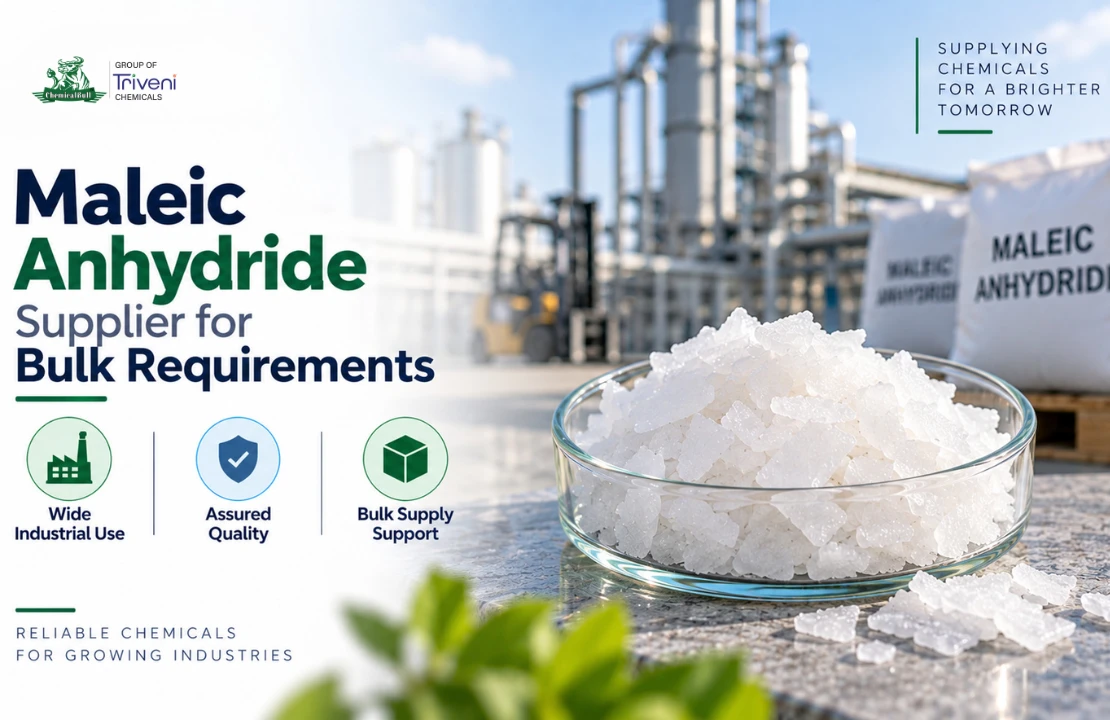
Maleic Anhydride Supplier for Bulk Requirements
Maleic Anhydride is an important reactive intermediate used in the production of unsaturated polyester resins, polymers, coatings, adhesives, agricultural chemicals, lubricant additives, and other specialty chemicals. Its reactive anhydride group allows it to participate in a range of chemical reactions, making it valuable across several industrial manufacturing processes.
In industrial applications, choosing the right maleic anhydride manufacturer can be important when consistent specifications, appropriate quality documentation, bulk availability, and reliable supply are required for ongoing production.
Quick Answer: What Is Maleic Anhydride Used For?
Maleic Anhydride is primarily used as a reactive intermediate in the manufacture of unsaturated polyester resins, alkyd resins, copolymers, coatings, adhesives, agricultural chemicals, lubricant additives, and specialty chemicals.
Its reactive anhydride group allows it to participate in different chemical reactions, making it useful for modifying polymers and producing downstream chemical intermediates.
The most important application areas include:
-
Unsaturated polyester resins
-
Polymer modification
-
Coatings and adhesives
-
Chemical intermediates
-
Agricultural chemical manufacturing
-
Lubricant and fuel additive production
-
Specialty chemical formulations
The appropriate grade and specification depend on the intended manufacturing process and downstream application.
What Is Maleic Anhydride?
Maleic Anhydride is the cyclic anhydride of maleic acid and belongs to the family of reactive organic anhydrides.
Its chemical formula is C₄H₂O₃, with a molecular weight of approximately 98.06 g/mol. It is commonly supplied as a white crystalline solid and is known for its strong chemical reactivity.
Maleic Anhydride readily reacts with water to form maleic acid and can participate in reactions such as esterification, polymerization, copolymerization, and addition reactions.
These characteristics make it more than simply an acidic chemical. In industrial manufacturing, Maleic Anhydride is primarily valuable because it can act as a reactive building block.
Basic Properties of Maleic Anhydride
|
Property |
General Information |
|
Chemical name |
Maleic Anhydride |
|
CAS Number |
108-31-6 |
|
Chemical formula |
C₄H₂O₃ |
|
Molecular weight |
98.06 g/mol |
|
Chemical family |
Organic acid anhydride |
|
Physical form |
White crystalline solid |
|
Appearance |
White to off-white crystalline material |
|
Melting point |
Approximately 52.8°C |
|
Water behavior |
Reacts with water to form maleic acid |
|
Main characteristic |
Highly reactive anhydride |
|
Major industrial role |
Chemical intermediate and polymer modifier |
How Is Maleic Anhydride Manufactured?
Maleic Anhydride is manufactured industrially through controlled catalytic oxidation processes. Modern large-scale production commonly uses n-butane as the feedstock, with catalytic oxidation producing Maleic Anhydride.
The manufacturing route requires careful control of reaction conditions because Maleic Anhydride is a reactive intermediate and the oxidation process can produce unwanted by-products if conditions are not properly controlled.
1. Feedstock Selection
Industrial production commonly starts with n-butane, which is converted through catalytic oxidation.
The selection and purity of the feedstock are important because impurities can influence catalyst performance, reaction efficiency, and product quality.
2. Catalytic Oxidation
The feedstock is reacted with oxygen in the presence of a suitable catalyst under controlled temperature and process conditions.
The oxidation converts the hydrocarbon feedstock into Maleic Anhydride.
Industrial manufacturers carefully control:
-
Feed composition
-
Oxygen concentration
-
Temperature
-
Pressure
-
Catalyst condition
-
Gas-flow rate
-
Reaction residence time
These parameters influence conversion, selectivity, energy consumption, and impurity formation.
3. Product Recovery
After the reaction stage, Maleic Anhydride is separated and recovered from the process stream.
Industrial recovery systems are designed to efficiently collect the product while minimizing losses and controlling unwanted reaction products.
4. Purification
The recovered material undergoes purification to achieve the required commercial specification.
Purification is important because the downstream application may require control over:
-
Assay
-
Color
-
Moisture
-
Acidity
-
Impurities
-
Solidification characteristics
5. Solidification and Packaging
Because Maleic Anhydride has a relatively low melting point, industrial handling requires appropriate temperature and storage control.
Depending on the supply format, it may be handled as solid material or in suitable molten systems.
Packaging is selected according to quantity, transportation requirements, storage conditions, and customer specifications.
Why Manufacturing Control Matters for Maleic Anhydride
Manufacturing control directly affects the consistency of Maleic Anhydride supplied to industrial customers.
For applications such as resin production, even relatively small variations in raw-material quality can influence processing behavior and finished-product performance.
A buyer evaluating a maleic anhydride manufacturer should therefore consider more than the quoted price. Product specification, batch consistency, quality documentation, packaging, production capability, and supply reliability are important parts of the procurement decision.
Major Industrial Applications of Maleic Anhydride
Maleic Anhydride is used across multiple industries because of its ability to react with alcohols, amines, polymers, olefins, and other chemical compounds.
1. Unsaturated Polyester Resins
One of the largest and most important applications of Maleic Anhydride is the production of unsaturated polyester resins (UPR).
Maleic Anhydride reacts with glycols and other components during polyester resin production to introduce unsaturation into the polymer backbone.
These resins are used in:
-
Fiberglass-reinforced plastics
-
Automotive components
-
Construction materials
-
Industrial equipment
-
Pipes and tanks
-
Marine applications
-
Composite materials
The performance of the resulting resin depends on the complete formulation, including the selected glycol, other acids or anhydrides, catalyst system, and processing conditions.
2. Alkyd Resins and Coatings
Maleic Anhydride can be incorporated into selected resin systems to modify polymer characteristics.
In coating and resin manufacturing, it may contribute to changes in:
-
Reactivity
-
Adhesion
-
Hardness
-
Flexibility
-
Chemical resistance
-
Compatibility
Its suitability depends on the resin chemistry and desired finished coating properties.
3. Polymer Modification
Maleic Anhydride is widely recognized for its role in polymer functionalization and modification.
It can be grafted onto certain polymers to introduce polar functional groups.
This approach can improve compatibility between otherwise different materials, particularly in polymer blends and composite systems.
Applications can include:
-
Polyolefin modification
-
Polymer blends
-
Compatibilizers
-
Composite materials
-
Adhesive systems
-
Functionalized polymers
4. Adhesives and Sealants
Maleic Anhydride derivatives and modified polymers can be used in adhesive and sealant technologies.
Its reactive functionality can contribute to improved interaction between polymer systems and different substrates.
Potential applications include:
-
Industrial adhesives
-
Hot-melt adhesive systems
-
Polymer-based bonding materials
-
Specialty sealants
-
Modified polymer formulations
5. Agricultural Chemicals
Maleic Anhydride is used as a chemical intermediate in selected agricultural chemical manufacturing processes.
Its reactive functional groups allow it to participate in the synthesis of downstream compounds used in agricultural applications.
However, the final agricultural product and its regulatory status determine the applicable manufacturing, handling, and quality requirements.
6. Lubricants and Fuel Additives
Maleic Anhydride is also used in the production of certain lubricant and fuel additive intermediates.
It can react with hydrocarbons, polymers, and other compounds to produce functionalized materials used in additive chemistry.
Potential applications include:
-
Lubricant additives
-
Dispersants
-
Deposit-control additives
-
Specialty fuel additives
-
Functionalized hydrocarbon products
The exact chemistry varies considerably between additive technologies.
7. Specialty Chemical Manufacturing
Maleic Anhydride serves as a starting material for numerous downstream chemicals.
Its derivatives can be used in:
-
Plasticizers
-
Copolymers
-
Resins
-
Surface-treatment chemicals
-
Chemical intermediates
-
Specialty formulations
This broad downstream chemistry is one reason Maleic Anhydride remains an important industrial raw material.
Maleic Anhydride in Resin and Polymer Manufacturing
The importance of Maleic Anhydride becomes particularly clear in polymer manufacturing.
Its reactive anhydride functionality allows it to interact with other molecules and introduce useful chemical functionality into polymer systems.
Why Polymer Manufacturers Use Maleic Anhydride
Maleic Anhydride may be selected when a manufacturer needs:
-
Reactive functional groups
-
Improved polymer compatibility
-
Modified surface properties
-
Better interaction between polymer phases
-
Reactive sites for further chemical modification
For example, Maleic Anhydride grafting is used to improve compatibility between certain non-polar polymers and more polar materials.
This makes it relevant to polymer blends, filled plastics, composites, and specialty modified polymers.
Maleic Anhydride and Unsaturated Polyester Resin: How Are They Connected?
Maleic Anhydride contributes unsaturation to polyester systems, which can subsequently participate in crosslinking reactions.
A simplified manufacturing concept is:
Maleic Anhydride + Glycol → Unsaturated Polyester Intermediate → Resin Formulation → Crosslinked Polyester
The actual industrial process is more complex and may involve additional acids, glycols, catalysts, inhibitors, solvents, and curing systems.
This chemistry makes Maleic Anhydride particularly important for manufacturers producing resin systems used in composite materials.
Technical Specifications Buyers Should Check
Before placing a bulk Maleic Anhydride order, procurement and technical teams should review the complete specification.
|
Specification |
Why It Matters |
|
Chemical identity |
Confirms the intended raw material |
|
CAS Number |
Helps identify the chemical substance |
|
Assay |
Indicates chemical purity |
|
Appearance |
Confirms physical conformity |
|
Color |
Important for appearance-sensitive applications |
|
Melting point |
Relevant to handling and processing |
|
Moisture |
Important because Maleic Anhydride reacts with water |
|
Acidity |
Useful for assessing chemical conformity |
|
Impurity profile |
Important for application-specific requirements |
|
Packaging |
Influences storage and transportation |
|
COA |
Provides batch-specific analytical information |
|
SDS |
Provides safety and handling information |
How to Choose a Maleic Anhydride Supplier for Bulk Requirements
A reliable bulk supplier should be evaluated on both technical and commercial factors.
1. Confirm the Required Grade
Define the application and establish the required purity, physical characteristics, and other specifications.
2. Check Batch Consistency
For continuous manufacturing, consistent raw-material quality can help maintain stable production conditions.
3. Review Documentation
Request the appropriate:
-
COA
-
SDS
-
Technical Data Sheet
-
Product specification
-
Batch information
-
Packaging details
4. Evaluate Bulk Supply Capability
Consider whether the supplier can support your:
-
Required quantity
-
Packaging format
-
Delivery schedule
-
Repeat-order requirements
-
Technical specifications
5. Consider Total Landed Cost
The purchase price is only one part of the total procurement cost.
Freight, packaging, handling, documentation, delivery location, and lead time can all influence the final landed cost.
Expert Insights: Maleic Anhydride Handling and Process Stability
Formulator's Note
One practical point that is sometimes overlooked during procurement is moisture exposure.
Maleic Anhydride reacts with water and can hydrolyze to maleic acid. For manufacturing processes where the anhydride functionality is important, unnecessary moisture exposure during storage, transfer, and handling can affect raw-material condition and process consistency.
For this reason, manufacturers should pay attention to:
-
Container integrity
-
Moisture exposure during transfer
-
Warehouse conditions
-
Opening and resealing practices
-
Material age and storage duration
-
Incoming quality checks
For resin and polymer applications, it is also useful to establish an internal raw-material specification and compare each incoming batch against that specification.
Packaging and Storage Considerations
Maleic Anhydride should be stored and handled according to the supplier's SDS and product-specific recommendations.
Important considerations include:
-
Keep material protected from moisture.
-
Keep containers properly closed.
-
Avoid unnecessary exposure to humid air.
-
Prevent contamination during transfer.
-
Use suitable packaging for the intended transportation method.
-
Maintain appropriate warehouse conditions.
-
Follow applicable workplace handling and safety procedures.
Because Maleic Anhydride is a reactive chemical, storage and handling practices should be established according to the specific product grade and applicable safety requirements.
Maleic Anhydride vs. Maleic Acid
Maleic Anhydride and Maleic Acid are closely related chemically, but they are not the same material.
|
Characteristic |
Maleic Anhydride |
Maleic Acid |
|
Chemical form |
Cyclic anhydride |
Dicarboxylic acid |
|
Formula |
C₄H₂O₃ |
C₄H₄O₄ |
|
CAS Number |
108-31-6 |
110-16-7 |
|
Physical form |
Crystalline solid |
Crystalline solid |
|
Water interaction |
Hydrolyzes to maleic acid |
Dissolves/reacts as an acid |
|
Main industrial role |
Reactive intermediate |
Acid/intermediate |
|
Polymer chemistry |
Highly reactive anhydride functionality |
Dicarboxylic acid functionality |
Maleic Anhydride Applications Across Major Industries
|
Industry |
Common Role / Application |
|
Resin Manufacturing |
Unsaturated polyester and modified resin production |
|
Plastics & Polymers |
Polymer modification and functionalization |
|
Coatings |
Resin and coating chemistry |
|
Adhesives |
Reactive polymer and adhesive systems |
|
Agriculture |
Chemical intermediate for selected products |
|
Lubricants |
Additive and dispersant chemistry |
|
Specialty Chemicals |
Chemical intermediates and derivatives |
|
Composite Materials |
Polyester resin systems |
|
Chemical Processing |
Reactive intermediate and synthesis |
The actual suitability of Maleic Anhydride depends on the chemistry, formulation, process conditions, and final-product requirements.
Frequently Asked Questions About Maleic Anhydride
-
What is Maleic Anhydride?
Maleic Anhydride is a reactive organic chemical and the anhydride of maleic acid. It is widely used as an industrial intermediate in resin, polymer, coating, adhesive, agricultural chemical, lubricant additive, and specialty chemical manufacturing. -
What is the CAS number of Maleic Anhydride?
The CAS number of Maleic Anhydride is 108-31-6. -
What is the chemical formula of Maleic Anhydride?
The chemical formula of Maleic Anhydride is C₄H₂O₃, and its molecular weight is approximately 98.06 g/mol. -
How is Maleic Anhydride manufactured?
Modern industrial Maleic Anhydride production commonly uses catalytic oxidation of n-butane. The resulting product is recovered, purified, tested, and prepared for commercial supply. -
Is Maleic Anhydride soluble in water?
Maleic Anhydride reacts with water and forms maleic acid. Therefore, moisture exposure should be controlled during storage and handling. -
What industries use Maleic Anhydride?
Major industries include resins, plastics, polymers, coatings, adhesives, composites, agriculture, lubricants, and specialty chemicals. -
What should buyers check before purchasing Maleic Anhydride?
Buyers should evaluate purity, appearance, moisture, color, melting characteristics, impurity profile, packaging, COA, SDS, quantity availability, and application-specific requirements. -
How do I select a Maleic Anhydride manufacturer?
Compare manufacturers or suppliers based on product specifications, batch consistency, documentation, manufacturing or sourcing capability, packaging, quantity availability, delivery performance, and ability to support recurring requirements.
Conclusion
Maleic Anhydride is a versatile reactive intermediate with major applications in unsaturated polyester resins, polymers, coatings, adhesives, agricultural chemicals, lubricant additives, and specialty chemical manufacturing.
For bulk procurement, selecting the right material involves more than comparing prices. Purity, moisture, physical characteristics, documentation, packaging, batch consistency, quantity, and delivery requirements should all be considered.
For businesses sourcing Maleic Anhydride in commercial quantities, ChemicalBull can support discussions around specifications, bulk requirements, packaging, documentation, and application needs.

Comment Section