Chemical Bull
26
09-Sep-2026
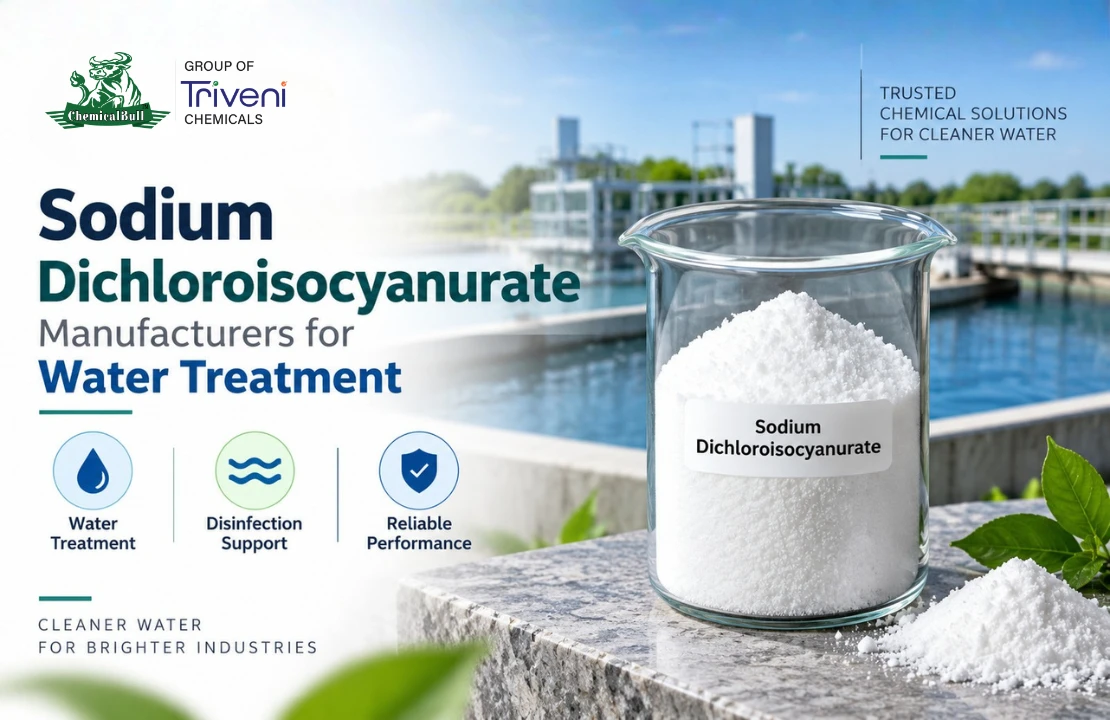
Sodium Dichloroisocyanurate Manufacturers for Water Treatment
Sodium Dichloroisocyanurate, commonly abbreviated as SDIC or NaDCC, is a widely used chlorine-releasing compound valued for its stability, ease of handling, and effective disinfection performance across drinking water treatment, swimming pool sanitation, and wastewater applications. Unlike liquid chlorine or chlorine gas, SDIC is supplied as a stable solid, making it easier and safer to store, transport, and dose accurately.
Because dosing accuracy and disinfection performance depend on consistent available chlorine content, working with an established sodium dichloroisocyanurate supplier helps water treatment operators and industrial buyers maintain reliable, consistent disinfection results.
Chemical Identity & Properties
|
Property |
Detail |
|
CAS Number |
2893-78-9 (anhydrous); 51580-86-0 (dihydrate) |
|
Chemical Formula |
C₃Cl₂N₃NaO₃ |
|
Appearance |
White crystalline powder, granules, or tablets |
|
Available Chlorine Content |
Typically 55% to 60% |
|
Solubility |
Highly soluble in water |
|
Common Forms |
Powder, granules, tablets |
What Is Sodium Dichloroisocyanurate?
SDIC belongs to a class of chemicals known as chlorinated isocyanurates, which release hypochlorous acid when dissolved in water, the same active disinfecting agent produced by other chlorine-based sanitizers. Its stable, solid form lets it be kept for a longer time without a significant loss of chlorine. This is the main benefit over sodium hypochlorite liquid, which is more easily degraded as time passes and with temperature changes.
Applications of SDIC in Water Treatment
- Drinking Water Disinfection: Used in municipal and point-of-use water treatment systems to inactivate bacteria, viruses, and other pathogens.
- Swimming Pool and Spa Sanitation: Widely used to maintain disinfection levels in public and residential pools due to its stability and ease of dosing.
- Emergency and Portable Water Treatment: Formulated into tablets for emergency water purification, disaster relief, and portable water treatment applications.
- Wastewater Treatment: Applied in certain wastewater disinfection processes before discharge or reuse.
- Aquaculture Water Management: Used to manage water quality and control pathogens in fish farming and aquaculture operations.
- Industrial Water Systems: Applied in cooling towers and other industrial water systems requiring microbial control.
Comparing SDIC to Other Chlorine-Based Disinfectants
Water treatment operators evaluating disinfectant options often compare SDIC to calcium hypochlorite and liquid sodium hypochlorite, since all three release chlorine for disinfection but differ in handling and performance characteristics:
|
Disinfectant |
Form |
Key Characteristic |
|
Sodium Dichloroisocyanurate (SDIC) |
Solid (powder, granules, tablets) |
Stable storage, precise dosing, moderate cost |
|
Calcium Hypochlorite |
Solid (granules, tablets) |
High available chlorine, but adds calcium hardness to treated water |
|
Sodium Hypochlorite (Liquid Bleach) |
Liquid |
Lower cost per unit, but degrades faster and requires careful storage |
SDIC is often selected over calcium hypochlorite in applications where added water hardness is undesirable, and over liquid sodium hypochlorite where storage stability and precise dosing are priorities. The decision to make is contingent on the water treatment process, the dosing equipment, as well as water chemistry issues in a particular location.
Dosing and Application Considerations
Because SDIC releases available chlorine at a defined concentration, proper dosing calculations are essential for both effective disinfection and regulatory compliance:
- Determine target chlorine residual: Water treatment applications typically specify a target free or combined chlorine residual that dosing rates need to achieve.
- Account for water demand: Organic matter, ammonia, and other contaminants in the source water consume chlorine before a residual is established, so initial demand must be factored into dosing calculations.
- Use calibrated dosing equipment: Tablet feeders, dry chemical feeders, or manual dosing methods should be calibrated to deliver consistent, accurate amounts based on flow rate or pool volume.
- Monitor residual levels regularly: Regular testing confirms that dosing rates are maintaining the intended disinfection level over time, since water demand can fluctuate with usage and environmental conditions.
- Adjust for temperature and pH: Disinfection efficiency can vary with water temperature and pH, so operators should account for these factors when fine-tuning dosing rates.
Manufacturing Quality Considerations for Bulk Buyers
Not all SDIC products are manufactured to the same consistency, and bulk buyers, particularly municipal water treatment operators and large-scale pool service companies, should evaluate a few manufacturing-level quality factors:
- Consistent available chlorine assay: Request historical batch data showing the manufacturer's track record for maintaining consistent available chlorine percentage across production runs.
- Impurity and by-product control: Confirm the manufacturer's process minimizes unwanted by-products that could affect water quality or disinfection performance.
- Dissolution rate consistency: For tablet and granule forms, consistent dissolution behavior affects how evenly the product disperses and doses in a treatment system.
- Manufacturing scale and reliability: A manufacturer with dedicated production capacity for chlorinated isocyanurates is generally better positioned to maintain consistent quality than one producing it as a secondary product line.
Why SDIC Is Preferred for Certain Water Treatment Applications
|
Factor |
Advantage |
|
Stability |
Maintains available chlorine content over longer storage periods compared to liquid chlorine |
|
Ease of Dosing |
Solid tablet and granule forms allow for more precise, consistent dosing |
|
Handling Safety |
Reduced handling risk compared to chlorine gas or concentrated liquid hypochlorite |
|
Versatility |
Available in multiple forms (powder, granules, tablets) suited to different application methods |
|
Transport Convenience |
Solid form simplifies storage and transport logistics compared to bulk liquid chlorine |
What to Look for in an SDIC Manufacturer
- Available Chlorine Content Consistency: Confirm the manufacturer can consistently deliver the specified available chlorine percentage across batches, since this directly affects dosing accuracy.
- Batch Documentation: Request a Certificate of Analysis (CoA) for each batch, along with a current Safety Data Sheet (SDS).
- Form and Particle Size: Confirm whether the manufacturer can supply the specific form (powder, granules, or tablets) and particle size your dosing equipment requires.
- Regulatory Compliance: For drinking water applications, confirm the material meets relevant regulatory standards for potable water treatment use in your region.
- Packaging Options: Water treatment operators typically require a range of packaging formats, from smaller retail-size containers to bulk industrial packaging for large treatment facilities.
Handling and Safety Considerations
SDIC is a strong oxidizer and should be handled with standard chemical safety precautions. It should never be mixed directly with acids, ammonia, or other chlorine-incompatible chemicals, as this can release hazardous chlorine gas. Storage areas should be kept dry, cool, and separated from incompatible materials, since SDIC can decompose and release chlorine gas if exposed to moisture, heat, or contamination. Buyers should request a current Safety Data Sheet from their supplier and follow appropriate workplace safety guidelines for storage and handling.
Frequently Asked Questions
-
What is Sodium Dichloroisocyanurate used for?
It is primarily used as a disinfectant in drinking water treatment, swimming pool sanitation, emergency water purification, wastewater treatment, and industrial water systems. -
How is SDIC different from liquid chlorine?
SDIC is a stable solid that maintains its available chlorine content over longer storage periods, while liquid chlorine (sodium hypochlorite) degrades more quickly, especially with heat and light exposure. -
What forms does SDIC come in?
It is commonly available as a powder, granules, or compressed tablets, with the form selected based on the specific dosing system or application. -
Is SDIC safe to use for drinking water treatment?
When used according to appropriate dosing guidelines and regulatory standards, SDIC is a widely accepted method for drinking water disinfection, including in emergency and portable water treatment applications. -
What safety precautions are needed when handling SDIC?
It should be stored in a cool, dry place away from acids and other incompatible chemicals, since improper mixing can release hazardous chlorine gas. -
What should I check before ordering SDIC in bulk?
Confirm the available chlorine content, request batch-specific documentation, and verify the form and packaging match your dosing and handling requirements.
Conclusion
Sodium Dichloroisocyanurate remains a preferred disinfection solution across drinking water, pool sanitation, and industrial water treatment applications due to its stability, dosing precision, and handling convenience. Selecting a manufacturer who can consistently deliver the right available chlorine content, form, and documentation helps water treatment operators maintain reliable, effective disinfection.
Comment Section