Chemical Bull
762
08-Sep-2026
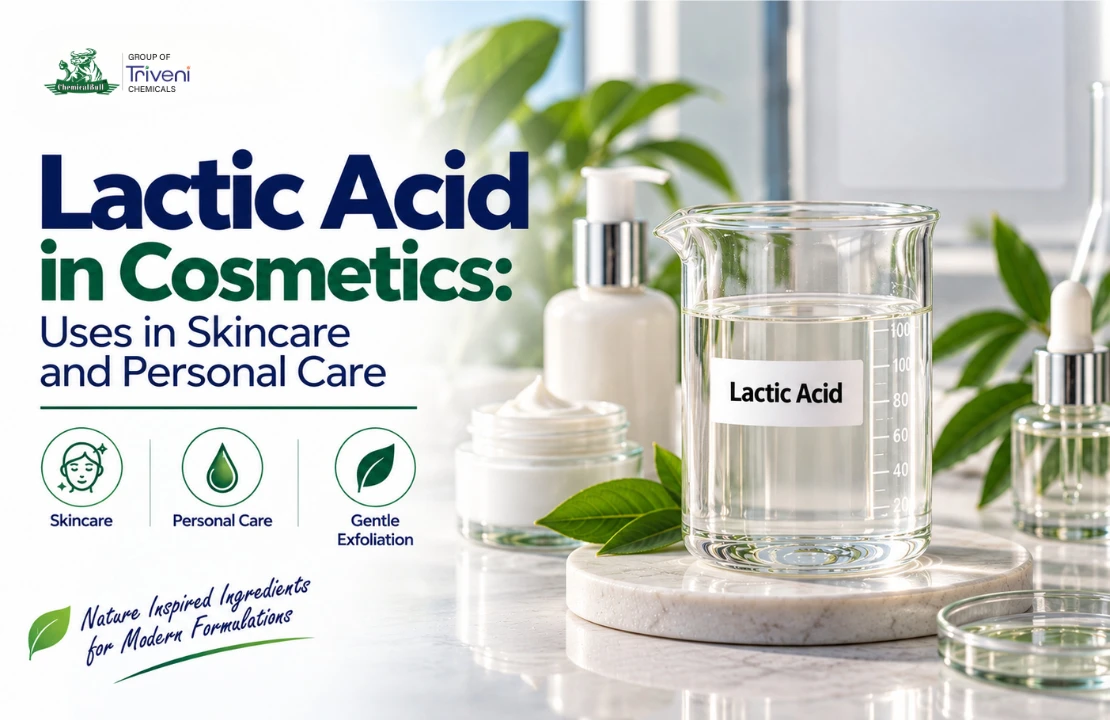
Lactic Acid in Cosmetics: Uses in Skincare and Personal Care
Quick Answer: What Is Lactic Acid Used for in Cosmetics?
Lactic acid is an alpha hydroxy acid (AHA) widely used in cosmetics and personal care products for exfoliation, skin-smoothing, and pH adjustment. In skincare formulations, it helps promote the shedding of surface skin cells, which can improve the appearance of skin texture and tone. Lactic acid is also used in products designed around moisture-related benefits and can be incorporated into serums, creams, lotions, cleansers, masks, and other personal care formulations.
For cosmetic manufacturers and formulators, the performance of lactic acid depends on more than the amount added. Concentration, final pH, buffering capacity, the other ingredients in the formula, and intended exposure all influence the behavior of an AHA formulation. FDA specifically notes that the extent of AHA exfoliation depends on the type and concentration of the acid, product pH, and other ingredients.
For bulk sourcing and formulation requirements, buyers can explore ChemicalBull's Lactic Acid manufacturer information for product and commercial supply details.
What Is Lactic Acid?
Lactic acid is an organic acid belonging to the alpha hydroxy acid (AHA) family. It contains both a hydroxyl group and a carboxylic acid group, giving it properties that make it useful in cosmetic formulation.
Lactic acid is one of the most recognized AHAs used in skincare. FDA identifies lactic acid and glycolic acid among the most common AHAs found in cosmetic products.
In cosmetics, lactic acid can perform several functions depending on the formulation. Its best-known role is as an exfoliating ingredient, but it can also contribute to pH adjustment and formulations intended to provide a combination of exfoliating and moisture-oriented characteristics.
The final cosmetic product—not the raw material alone—determines the actual performance, sensory profile, safety, and stability of the formulation.
Lactic Acid at a Glance
|
Property |
Description |
|
Ingredient |
Lactic Acid |
|
Chemical class |
Alpha Hydroxy Acid (AHA) |
|
Primary cosmetic role |
Exfoliation |
|
Other formulation role |
pH adjustment |
|
Common application areas |
Skin care and personal care |
|
Common product types |
Serums, creams, lotions, cleansers, masks, peels |
|
Key formulation variables |
Concentration, pH, buffering, compatibility |
|
Important safety consideration |
Potential increase in UV sensitivity |
|
Commercial consideration |
Grade, concentration, purity, specification, documentation |
How Does Lactic Acid Work on the Skin?
Lactic acid works primarily through chemical exfoliation.
Unlike physical exfoliants that rely on particles or friction, an AHA-based formulation helps promote the shedding of surface skin cells through chemical action. FDA describes AHA-containing products as causing exfoliation, with the degree of exfoliation influenced by the AHA type and concentration, product pH, and other ingredients.
This makes lactic acid useful in cosmetic products intended to improve the appearance of:
-
Rough skin texture
-
Dull-looking skin
-
Uneven-looking skin
-
Accumulated surface cells
-
Fine surface lines
-
Dry or rough-feeling areas
The effect should not be interpreted as simply "more acid equals better results." A well-designed formulation balances exfoliating performance with tolerability, stability, intended use, and the product's regulatory positioning.
Lactic Acid Uses in Cosmetics
1. Exfoliating Skincare Formulations
The most established cosmetic use of lactic acid is as an AHA exfoliant.
It can be incorporated into formulations designed to remove or loosen accumulated surface skin cells and produce smoother-looking skin.
Common applications include:
-
Facial exfoliating serums
-
Creams
-
Lotions
-
Toners
-
Masks
-
Body-care products
-
Exfoliating treatments
-
Professional-use formulations
The actual exfoliation achieved depends on the finished formulation rather than the raw ingredient percentage alone.
2. Skin-Smoothing Products
Lactic acid is frequently used in products designed to improve the appearance and feel of rough or uneven skin.
By promoting surface exfoliation, it can help create a smoother skin surface.
This makes it relevant to both facial and body-care formulations, particularly products positioned around:
-
Skin smoothing
-
Texture refinement
-
Surface renewal
-
Dullness reduction
-
Rough-skin care
3. Products for More Even-Looking Skin
Lactic acid is often included in skincare products intended to improve the appearance of uneven skin tone.
Exfoliation can help remove accumulated surface cells that contribute to a dull or uneven appearance.
However, formulators and marketers should distinguish between cosmetic appearance claims and therapeutic claims.
FDA notes that products marketed for purposes such as treating acne or lightening discolorations may fall under drug regulations depending on their intended claims and use.
Therefore, product claims should be developed alongside regulatory review rather than simply copying popular skincare terminology.
4. Moisture-Focused Skincare
Lactic acid is particularly interesting to cosmetic formulators because its role is not limited to exfoliation.
Lactic acid is associated with humectant properties and is therefore relevant to formulations designed around both exfoliation and moisture-related characteristics.
This can be useful when developing products for skin that is both:
-
Rough or uneven in texture
-
In need of a moisture-supporting formulation
The moisturizing performance of the finished product still depends on the complete ingredient system. Lactic acid should not be treated as a substitute for a complete humectant, emollient, or barrier-support system.
5. Facial Serums
Lactic acid is commonly suited to serum formulations because serums can be developed around a controlled concentration, targeted pH, and relatively lightweight sensory profile.
Formulators developing a lactic acid serum may evaluate:
-
Lactic acid concentration
-
Final pH
-
Buffer system
-
Solvent system
-
Preservative compatibility
-
Viscosity
-
Packaging
-
Stability
-
Compatibility with other actives
The final pH should always be measured in the finished formula rather than estimated from the raw-material addition.
6. Creams and Lotions
Creams and lotions provide another common delivery system for lactic acid.
These formulations can be designed for facial or body applications and may combine exfoliation with emollient and moisturizing ingredients.
Important development variables include:
-
Emulsion stability
-
Final pH
-
Polymer compatibility
-
Preservative system
-
Fragrance compatibility
-
Viscosity
-
Packaging compatibility
A change in pH can affect several other components of an emulsion, so pH adjustment should be considered as part of the overall formulation process.
7. Facial Cleansers
Lactic acid can also be incorporated into cleansing products.
Because cleansers are generally rinsed from the skin, their exposure profile differs from leave-on serums and creams.
When developing an AHA cleanser, formulators should evaluate:
-
Contact time
-
Final pH
-
Acid concentration
-
Surfactant system
-
Skin feel
-
Product stability
-
Consumer directions
The presence of lactic acid alone does not determine the final exfoliating performance of a cleanser.
8. Body-Care Products
Lactic acid is also relevant to body-care formulations, especially products intended for rough or uneven-feeling skin.
Applications may include:
-
Body lotions
-
Body creams
-
Foot-care products
-
Hand creams
-
Smoothing lotions
-
Exfoliating body treatments
Body formulations may require a different balance of exfoliation, moisturization, sensory properties, and application frequency compared with facial products.
Lactic Acid in Personal Care: Common Applications
|
Product Category |
Potential Role of Lactic Acid |
|
Facial serums |
AHA exfoliation |
|
Facial creams |
Exfoliation and formulation support |
|
Body lotions |
Skin-smoothing applications |
|
Cleansers |
AHA-based cleansing concepts |
|
Masks |
Controlled exfoliating applications |
|
Toners |
AHA exfoliation and pH-related formulation |
|
Foot care |
Smoothing rough-feeling skin |
|
Hand care |
Texture-focused formulations |
|
Professional treatments |
Controlled AHA applications |
Benefits of Lactic Acid in Skincare Formulations
What Are the Main Benefits of Lactic Acid?
From a cosmetic formulation perspective, lactic acid is valued because it can provide several functions within one ingredient system.
Exfoliation
It helps promote the shedding of surface skin cells, making it useful for products targeting smoother-looking skin.
Texture Improvement
Regular use of appropriately formulated AHA products can help improve the appearance of rough or uneven skin texture.
Appearance of Dullness
Surface exfoliation can help create a brighter, more refreshed-looking appearance by removing accumulated surface cells.
Moisture-Oriented Formulation
Lactic acid is associated with humectant behavior, making it relevant to formulations where exfoliation and moisture-related properties are both desirable.
pH Adjustment
AHAs can also be used for pH adjustment in cosmetic formulations. FDA specifically lists pH adjustment among the cosmetic uses of AHAs.
Lactic Acid vs. Glycolic Acid vs. Salicylic Acid
Lactic acid is only one of several acids used in modern skincare. Comparing these ingredients helps formulators and product developers select the most appropriate acid for a particular formulation concept.
|
Feature |
Lactic Acid |
Glycolic Acid |
Salicylic Acid |
|
Acid category |
AHA |
AHA |
BHA |
|
Primary cosmetic role |
Exfoliation |
Exfoliation |
Exfoliation and pore-focused applications |
|
Water compatibility |
High |
High |
Lower than AHAs |
|
Common positioning |
Smoothing and exfoliation |
Strong AHA exfoliation |
Pore and blemish-focused products |
|
Common product formats |
Serums, creams, lotions |
Serums, creams, peels |
Cleansers, toners, treatments |
|
Key formulation concern |
pH and concentration |
pH and concentration |
Solubility and pH |
|
Typical formulation focus |
Surface exfoliation with moisture-oriented positioning |
More intensive AHA exfoliation |
Oil-soluble exfoliation |
Which Is Gentler: Lactic Acid or Glycolic Acid?
It is too simplistic to say that one acid is always gentler.
Molecular structure, concentration, pH, formulation, exposure time, buffering, application frequency, and the user's skin characteristics all influence tolerability.
Lactic acid is often positioned as a more gradual AHA option in skincare, but a finished product's formulation—not the ingredient name alone—determines its actual user experience.
Lactic Acid Formulation: Why pH Matters
One of the most important technical considerations when formulating with lactic acid is final product pH.
FDA states that the extent of exfoliation produced by an AHA depends on its type and concentration, pH, and other ingredients in the product.
This means two products containing the same nominal percentage of lactic acid can behave differently.
Factors That Influence AHA Performance
-
Lactic acid concentration
-
Final formulation pH
-
Buffering capacity
-
Other acids
-
Neutralizing agents
-
Solvent system
-
Other active ingredients
-
Contact time
-
Application frequency
-
Finished-product format
This is why formulators should evaluate the complete formulation rather than selecting a raw material based only on concentration.
Expert Insight: Formulator's Note
Why the Final pH Is More Important Than the Acid Percentage Alone
A common mistake in AHA formulation is to compare products only by the percentage of lactic acid.
That approach is incomplete.
For example, a formula containing a particular amount of lactic acid may behave differently depending on its buffering system and final pH. The same raw-material addition can therefore produce a different finished-product profile in two different formulations.
A practical formulation approach is to establish the desired product characteristics first, then optimize:
-
Acid concentration
-
Target pH
-
Buffer system
-
Supporting ingredients
-
Sensory profile
-
Stability
-
Packaging
-
Consumer-use instructions
This is one reason experienced formulators evaluate the finished product, rather than treating the raw-material percentage as the only performance variable.
Best Practices for Lactic Acid Stability
1. Monitor Finished-Product pH
Measure pH after production and during stability studies.
A change in pH over time can indicate interactions between ingredients or changes in the formulation system.
2. Monitor Viscosity
Changes in viscosity may indicate interactions involving polymers, emulsifiers, or other pH-sensitive components.
3. Check Color and Appearance
Look for:
-
Color changes
-
Precipitation
-
Crystallization
-
Phase separation
-
Sedimentation
-
Unexpected haze
4. Evaluate Odor
Unexpected odor changes can indicate degradation, raw-material interactions, preservation issues, or packaging-related effects.
5. Test Packaging Compatibility
The product should be evaluated in its intended commercial package.
A formulation that performs well in a laboratory container may behave differently after long-term contact with its final packaging.
6. Conduct Stability Testing
Raw-material specifications do not establish finished-product stability.
Finished formulations should be evaluated using the manufacturer's appropriate stability protocols, including relevant temperature, storage, packaging, and time conditions.
Lactic Acid Compatibility With Other Cosmetic Ingredients
Lactic acid can be formulated with many cosmetic ingredients, but compatibility should be evaluated at the finished-formula level.
Particular attention may be required when combining lactic acid with:
-
Other AHAs
-
BHAs
-
pH-sensitive preservatives
-
Carbomers
-
Other acrylic polymers
-
Peptides
-
Botanical extracts
-
Fragrance materials
-
Mineral salts
-
Sensitive emulsifiers
-
Other active ingredients
The presence of these ingredients does not automatically mean incompatibility. The correct approach is to assess the specific formulation through laboratory development and stability testing.
Can Lactic Acid Be Used With Other Acids?
Yes, formulations can contain more than one acid, but combining exfoliating acids requires careful formulation development.
The formulator should consider the:
-
Total acid load
-
Final pH
-
Buffering system
-
Intended exposure
-
Skin tolerability
-
Stability
-
Product claims
-
Regulatory requirements
Combining acids simply to increase the number of "actives" is not necessarily a better formulation strategy.
The objective should be to create a stable product with a clearly defined performance and use profile.
Lactic Acid and Sensitive Skin
Lactic acid is often marketed as a relatively gentle AHA, but no AHA should automatically be assumed to be non-irritating.
The potential for irritation depends on factors such as:
-
Concentration
-
pH
-
Frequency of use
-
Contact time
-
Formulation
-
Skin condition
-
Combination with other exfoliating ingredients
Scientific reviews of AHAs note that adverse effects can include irritation, redness, burning, and other reactions, particularly with stronger formulations.
Therefore, cosmetic manufacturers should avoid making absolute claims such as "lactic acid is safe for every skin type."
Does Lactic Acid Increase Sun Sensitivity?
Yes. AHA-containing topical products can increase skin sensitivity to ultraviolet radiation.
FDA states that topical AHA use can increase sensitivity to UV radiation and recommends sun-protection measures when using these products.
FDA's guidance also recommends appropriate sun-sensitivity labeling for applicable AHA-containing cosmetic products.
This is particularly important when developing consumer-facing skincare products.
Manufacturers should ensure that product directions and warnings are appropriate for the formulation, intended use, and target market.
Lactic Acid Concentration and Cosmetic Safety
Concentration should never be considered independently of pH and formulation.
For U.S. cosmetic products, FDA cites the Cosmetic Ingredient Review Expert Panel's conclusion that glycolic and lactic acid are considered safe for consumer cosmetic use when:
-
AHA concentration is 10% or less
-
Final formulation pH is 3.5 or greater
-
The formulation is designed to avoid increased sun sensitivity, or directions instruct consumers to use daily sun protection
These conditions come from the cited CIR safety conclusion and should not be interpreted as a universal formulation recipe or a guarantee that every product at those values is safe. Finished-product safety depends on the complete formulation, exposure, labeling, and intended use.
Professional-use and higher-strength peel formulations require separate consideration and should not be treated as equivalent to ordinary consumer skincare products.
Lactic Acid for Acne, Pigmentation, and Anti-Aging Claims
Lactic acid is frequently discussed online in connection with acne, hyperpigmentation, wrinkles, and other skin concerns.
There is an important distinction between cosmetic improvement of appearance and therapeutic treatment claims.
AHAs have been studied for applications involving skin texture, photoaging, pigmentation, and other dermatological concerns.
However, a cosmetic manufacturer should not automatically convert these research findings into drug claims.
FDA specifically notes that products intended to treat acne or alter the structure or function of the body may be regulated as drugs rather than cosmetics.
For commercial products, claims should therefore be reviewed against the applicable regulatory requirements in the target market.
Lactic Acid in Cosmetic Manufacturing
For manufacturers, the raw material is only one component of a successful skincare product.
A commercial formulation may require evaluation of:
Raw-Material Quality
-
Concentration
-
Purity
-
Appearance
-
Grade
-
Impurity profile
-
Batch consistency
Technical Documentation
Depending on the application, buyers may require:
-
Certificate of Analysis (CoA)
-
Safety Data Sheet (SDS)
-
Product specification
-
Batch information
-
Regulatory documentation
-
Origin information
Supply Consistency
Consistent raw-material quality is important for commercial manufacturing because variation can affect:
-
Finished-product pH
-
Processing
-
Stability
-
Sensory characteristics
-
Product specifications
-
Batch-to-batch consistency
How to Select Lactic Acid for Cosmetic Formulation
A cosmetic manufacturer should consider more than price when selecting a lactic acid supplier.
1. Confirm the Required Grade
The required grade should match the intended application.
Cosmetic, food, pharmaceutical, and technical grades should not automatically be assumed to be interchangeable.
2. Check the Specification
Review the supplier's current technical specification and CoA requirements.
3. Review Documentation
Ensure that the documentation supports the intended manufacturing and regulatory requirements.
4. Evaluate Batch Consistency
For long-term commercial production, consistency can be more important than the lowest initial purchase price.
5. Consider Packaging
Packaging should be suitable for transportation, storage, handling, and the intended shelf life.
Lactic Acid in Cosmetics: Technical Summary
|
Parameter |
Why It Matters |
|
Lactic acid concentration |
Influences formulation strength and performance |
|
Final pH |
Influences AHA behavior and compatibility |
|
Buffer capacity |
Controls resistance to pH changes |
|
Exposure time |
Influences consumer exposure |
|
Product format |
Changes application characteristics |
|
Other acids |
Can change total formulation acidity |
|
Preservative system |
May be pH-dependent |
|
Polymer system |
May respond to pH changes |
|
Packaging |
Can affect long-term product compatibility |
|
Stability |
Confirms finished-product performance |
|
Labeling |
Supports appropriate consumer use |
|
Claims |
Determines cosmetic vs. potential drug positioning |
Lactic Acid vs. Other AHAs
Lactic acid belongs to a broader family of alpha hydroxy acids.
|
AHA |
General Cosmetic Positioning |
|
Lactic Acid |
Exfoliation, smoothing, moisture-oriented formulations |
|
Glycolic Acid |
Exfoliation and texture-focused products |
|
Mandelic Acid |
AHA exfoliation with slower penetration characteristics |
|
Malic Acid |
AHA used in selected cosmetic formulations |
|
Citric Acid |
Acidification, pH adjustment, and selected exfoliating applications |
|
Tartaric Acid |
Used in selected cosmetic formulations |
Why Lactic Acid Is Important to the Personal Care Industry
The continued use of AHAs in skincare reflects the industry's demand for multifunctional cosmetic ingredients.
Lactic acid is particularly useful because it can contribute to several formulation objectives:
-
Chemical exfoliation
-
Skin-smoothing positioning
-
Texture-focused skincare
-
Moisture-oriented formulations
-
pH adjustment
-
Facial care
-
Body care
-
Professional skincare
A single ingredient therefore has relevance across multiple product categories.
Recent scientific literature continues to examine AHA mechanisms, cosmetic applications, efficacy, safety, and formulation strategies, reinforcing the importance of evaluating these ingredients from both dermatological and formulation perspectives.
Frequently Asked Questions
-
What is lactic acid used for in cosmetics?
Lactic acid is primarily used as an AHA exfoliant. It helps promote the shedding of surface skin cells and is used in products designed to improve the appearance of skin texture and tone. It can also contribute to pH adjustment in cosmetic formulations. -
Is lactic acid an AHA?
Yes. Lactic acid is an alpha hydroxy acid (AHA). FDA identifies lactic acid and glycolic acid among the most common AHAs used in cosmetic products. -
Is lactic acid good for dry skin?
Lactic acid can be useful in formulations designed for dry or rough-feeling skin because it provides exfoliating functionality and is associated with moisture-related properties. However, the suitability of a finished product depends on the complete formulation. -
What skincare products contain lactic acid?
Lactic acid can be incorporated into serums, creams, lotions, cleansers, masks, toners, body-care products, exfoliating treatments, and professional-use formulations. -
Is lactic acid better than glycolic acid?
Neither is universally better. Both are AHAs, but their formulation characteristics and intended applications can differ. Product concentration, pH, formulation, exposure, and consumer tolerability should be considered when selecting between them. -
Can lactic acid be used with glycolic acid?
It can be included in formulations with other acids, but the total acid system, final pH, buffering, stability, intended exposure, and tolerability should be evaluated carefully. -
Does lactic acid increase sun sensitivity?
Yes. FDA states that topical AHA use can increase sensitivity to UV radiation and recommends sun-protection measures when using AHA products. -
What pH is suitable for lactic acid skincare?
There is no single universal pH suitable for every lactic acid cosmetic. The appropriate pH depends on the finished formulation and intended use. FDA cites the CIR safety conclusion for consumer products containing glycolic or lactic acid at concentrations of 10% or less with a final pH of 3.5 or greater, along with conditions concerning sun protection. -
Can lactic acid be used in body lotions?
Yes. Lactic acid can be incorporated into body lotions and creams designed around exfoliation and skin-smoothing applications. -
Is lactic acid suitable for cosmetic manufacturing?
Yes, provided the selected raw material meets the manufacturer's required grade and specification and the finished product is properly formulated, tested, labeled, and compliant with applicable regulations.
Conclusion
Lactic acid has become an important ingredient in modern cosmetics and personal care because it combines the functionality of an AHA exfoliant with useful formulation characteristics. Its applications range from facial serums and creams to body lotions, cleansers, masks, toners, and professional skincare formulations.
For formulators, the most important lesson is that lactic acid concentration alone does not define the performance of a cosmetic product. Final pH, buffering capacity, formulation composition, exposure conditions, stability, and intended use all need to be considered.
Scientific and regulatory sources also make clear that AHA products require responsible formulation and labeling because stronger exfoliation can increase the potential for irritation and AHAs can increase sensitivity to ultraviolet radiation.
For cosmetic manufacturers and personal-care companies, selecting a consistent raw-material supply is therefore an important part of formulation development. Buyers should evaluate product specifications, documentation, batch consistency, packaging, and technical requirements before commercial procurement.
For bulk lactic acid requirements, manufacturers can review ChemicalBull product information and request a quotation or technical documentation based on their required grade, specification, and quantity.


Comment Section