Chemical Bull
34
08-Sep-2026
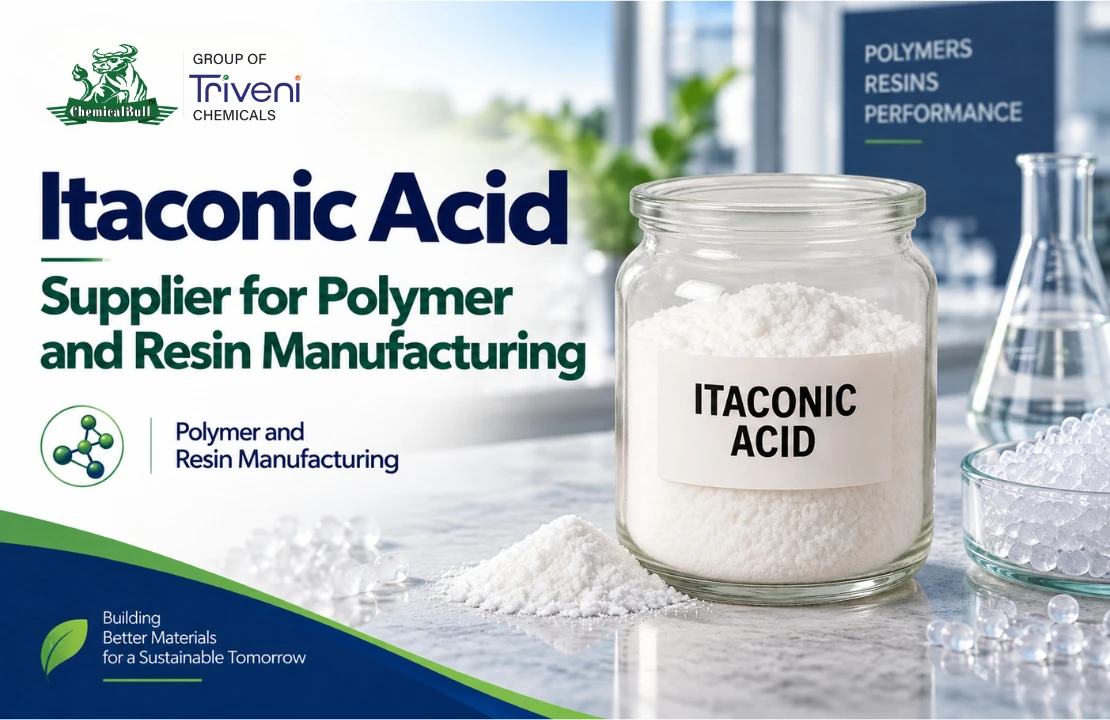
Itaconic Acid Supplier for Polymer and Resin Manufacturing
Itaconic Acid is a versatile unsaturated dicarboxylic acid that has become an important comonomer in polymer and resin manufacturing, valued for its ability to improve adhesion, flexibility, and water resistance in finished polymer products. From acrylic latex systems to unsaturated polyester resins, this bio-based building block plays a functional role across several specialty polymer applications.
Because consistent purity directly affects polymerization behavior, working with an established itaconic acid distributor helps manufacturers source material with the batch-to-batch reliability their formulations require.
Chemical Identity & Properties
|
Property |
Detail |
|
CAS Number |
97-65-4 |
|
Chemical Formula |
C₅H₆O₄ |
|
Molar Mass |
130.10 g/mol |
|
Appearance |
White crystalline powder |
|
Solubility |
Soluble in water, ethanol, and acetone |
|
Common Grades |
Technical grade, polymer grade (99%+) |
What Is Itaconic Acid?
Itaconic Acid is a naturally occurring unsaturated dicarboxylic acid, commercially produced through fermentation of carbohydrate feedstocks using specific fungal strains. Its molecular structure includes both a carboxylic acid group and a reactive double bond, which allows it to participate in polymerization reactions as a comonomer alongside more common monomers like acrylic acid, styrene, or vinyl acetate.
Role of Itaconic Acid in Polymer and Resin Manufacturing
- Improved Adhesion: The additional carboxylic acid group enhances polymer adhesion to various substrates, making it valuable in coatings and adhesive formulations.
- Enhanced Water Resistance: Copolymers incorporating Itaconic Acid often show improved water resistance compared to formulations without it.
- Crosslinking Capability: Its reactive functional groups support crosslinking reactions, contributing to improved mechanical strength in finished polymer films.
- Flexibility Modification: Helps fine-tune the flexibility and glass transition temperature of copolymer systems.
- Compatibility with Bio-Based Formulations: As a fermentation-derived material, it fits into polymer systems where partial bio-based content is a formulation goal.
Applications in Polymer and Resin Manufacturing
- Acrylic and Styrene-Butadiene Latex: Used as a comonomer in latex systems for paints, coatings, and adhesives, improving pigment binding and film adhesion.
- Unsaturated Polyester Resins: Incorporated into polyester resin formulations to modify flexibility and improve chemical resistance.
- Superabsorbent Polymers: Used in select superabsorbent polymer formulations, contributing to improved water absorption characteristics.
- Textile Binders: Functions as a comonomer in binder systems used for nonwoven textile and fabric finishing applications.
- Detergent Polymers: Used in the production of polymers for detergent formulations, where its carboxylic acid functionality supports performance in water-conditioning applications.
- Ion-Exchange Resins: Applied in specialty resin systems requiring specific ion-exchange or chelation properties.
Why Itaconic Acid Is Gaining Traction in Polymer Formulation
|
Factor |
Why It Matters |
|
Bio-based origin |
Produced via fermentation, supporting formulations targeting renewable content |
|
Dual functionality |
Combines a reactive double bond with a carboxylic acid group for versatile polymer chemistry |
|
Performance enhancement |
Improves adhesion, flexibility, and water resistance compared to base polymer systems alone |
|
Regulatory alignment |
Fits well with formulations moving toward reduced-petrochemical content |
How Itaconic Acid Compares to Other Comonomers
Formulators evaluating comonomer options often compare Itaconic Acid to alternatives like acrylic acid or maleic anhydride, since all three offer carboxylic acid functionality for polymer modification:
|
Comonomer |
Key Characteristic |
Common Trade-off |
|
Itaconic Acid |
Dual functionality with reactive double bond, bio-based origin |
Higher cost than some petrochemical alternatives |
|
Acrylic Acid |
Widely available, well-established performance data |
Petrochemical-derived, less suited to bio-based formulation goals |
|
Maleic Anhydride |
Strong reactivity, cost-effective |
Requires hydrolysis before use in aqueous systems |
Choosing between these options typically comes down to formulation goals, whether that's cost optimization, specific performance characteristics, or a shift toward renewable content, rather than a single comonomer being universally superior.
Typical Dosage Considerations in Formulation
While exact usage levels depend heavily on the specific polymer system and target performance characteristics, Itaconic Acid is generally incorporated at relatively low levels, often in the range of 1% to 5% of total monomer content, when used as a performance-modifying comonomer rather than a primary structural component. At these levels, it can meaningfully improve adhesion and water resistance without significantly altering the overall cost structure or processing behavior of the base polymer system. Formulators introducing Itaconic Acid into an existing system for the first time typically run small-scale trials to identify the optimal inclusion level for their specific application before scaling to full production batches.
Packaging and Storage Considerations
Itaconic Acid is typically supplied as a dry crystalline powder, commonly packaged in multi-wall paper bags or fiber drums to protect against moisture absorption during storage and transport. Since the material is hygroscopic to some degree, storage in a cool, dry environment with tightly sealed packaging helps maintain consistent flow properties and prevents caking, which could otherwise complicate accurate dosing during formulation. Buyers placing bulk orders should confirm packaging formats align with their material handling systems, particularly for automated dosing setups where consistent powder flow matters for accurate batch-to-batch formulation.
What to Look for in an Itaconic Acid Supplier
- Purity and Grade Consistency: Confirm the supplier can consistently provide the purity grade (typically 99%+ for polymer-grade applications) your formulation requires.
- Batch Documentation: Request a Certificate of Analysis (CoA) specific to each shipped batch, along with a current Safety Data Sheet (SDS).
- Particle Size and Form: Depending on your process, confirm whether the crystalline powder's particle size distribution matches your handling and dissolution requirements.
- Supply Consistency: Since Itaconic Acid production is concentrated among a limited number of fermentation-based manufacturers globally, confirm your supplier's ability to maintain consistent supply for ongoing production needs.
- Technical Support: A supplier familiar with polymer formulation can offer useful guidance on optimal usage levels and compatibility with your specific comonomer system.
Frequently Asked Questions
-
What is Itaconic Acid used for in polymer manufacturing?
It is used as a comonomer in acrylic and styrene-butadiene latex systems, unsaturated polyester resins, superabsorbent polymers, textile binders, and specialty ion-exchange resins. -
Is Itaconic Acid a bio-based material?
Yes, it is commercially produced through fermentation of carbohydrate feedstocks, making it a renewable alternative to some petrochemical-derived monomers. -
How does Itaconic Acid improve polymer performance?
Its dual functionality, a reactive double bond combined with a carboxylic acid group, improves adhesion, water resistance, and crosslinking capability in finished polymer films. -
What purity grade is needed for polymer applications?
Polymer-grade applications typically require 99%+ purity, though buyers should confirm exact specifications against their specific formulation requirements. -
What documentation should I request from an Itaconic Acid supplier?
At minimum, request a Certificate of Analysis and Safety Data Sheet for each batch to confirm purity and composition before use in your formulation. -
Can Itaconic Acid replace other monomers entirely?
It is typically used as a comonomer alongside other monomers rather than as a complete replacement, since its role is to modify and enhance specific polymer properties.
Conclusion
Itaconic Acid's unique combination of reactivity and bio-based origin makes it a valuable comonomer across acrylic latex, polyester resin, and specialty polymer applications. Selecting a supplier who can provide consistent purity, proper documentation, and reliable supply helps manufacturers maintain performance and consistency across their polymer and resin production.
Comment Section