Chemical Bull
3604
24-Oct-2025
Perfume Oils
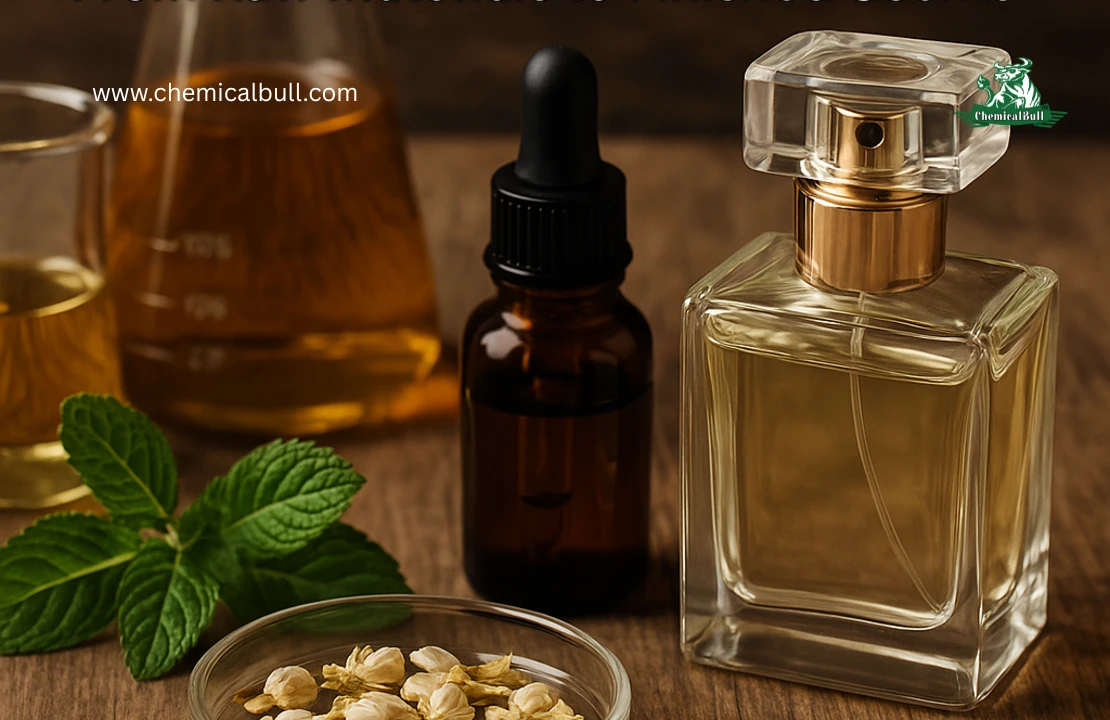
In the global fragrance business, one drop of essence can mean a trip of thousands of miles, from a flower field in India to the outside of a fancy perfume bottle in Paris. The journey changes through a complex fragrance supply chain that connects farmers, extractors, chemists, manufacturers, and distributors.
This supply chain is more than just a process at Chemical Bull Pvt. Ltd.; it's an art. The company is proud of how well it combines science and sourcing precision to meet the needs of customers all over the world in Aroma Chemicals, Essential Oils, and Solvents.
1. The Origins: The Place Where Every Scent Starts
Nature is where fragrance creation starts. Some examples of Essential Oils are Lavender Oil, Eucalyptus Oil, Lemongrass Oil, and Peppermint Oil. The flower, leaves, and roots give these oils their smell. They are either steam-distilled or cold-pressed.
Essential oils are the most critical part of perfumery because everyone values what is real and natural, and that is what they offer.
Aroma chemicals like Linalool, Citronellol, Geraniol, and Benzyl Acetate let us recreate and improve the smell of rare, expensive, or commercially less viable fragrances in a natural aroma.
For perfumers who need stability, scalability, and cost-effectiveness—essential for making and selling wholesale fragrance oil—a mix of natural extracts and synthetic aroma compounds works.
2. The Science and Art of Blending
We can see chemistry and creativity come together in the blending process. Perfume makers use the Top, Middle, and Base Notes to make a fragrance that is balanced. Each note has its own personality and lasts for a long time.
• Top notes are the first thing you smell. They are the lighter, more volatile scents that go away quickly and make a fragrance smell fresh and new. Limonene and Ethyl Acetate are often used to create top notes that capture that fleeting moment, that first whiff of scent.
• When the top notes fade away, the heart (middle) notes become the body of the scent. They add balance and depth with Phenylethyl Alcohol, Coumarin, and/or Geraniol. Most of the time, middle notes are floral, herbaceous, or spicy.
• Base notes are the heavier molecules and last longer on our skin, like Vanillin, Iso E Super, and Musk Ketone.
To make perfume oil for the whole industry, you need to be sure that each batch is the same when you blend. We make sure that every scent stays true to its profile at every level of production at Chemical Bull Pvt. Ltd. We do this by using analytical quality control methods and making sure that the blending is always the same.
3. Mass production and packaging: keeping the scent intact
You have the mixture, and now you need to make it stable. Stabilization is the point in time when all the molecules are in sync and have reached their final stage of development. You usually use a solvent like Diethyl Phthalate (DIP), Isopropyl Myristate (IPM), or Dipropylene Glycol (DPG) to make the concentration more even and to make it easier to dissolve.
How to Keep the Fragrance Oil Pure:
• The reactors are made of stainless steel and lined with high-density polyethylene (HDPE) containers.
• The filling will happen in airtight drums to keep out oxygen, which is your worst enemy!
• Routine sensory checks and chromatographic tests are done to double-check the scent and make sure it hasn't changed.
These steps make sure that all of the distribution's carriers keep the wholesale fragrance oils safe.
4. Global Distribution and Chemicals bull's reach around the world
Chemical Bull Pvt. Ltd. has a global network that serves more than 50+ countries and spans several continents. When a product is ready to ship, fragrance oils and raw materials travel through this network. The company makes sure that Aroma Chemicals, Essential Oils, and Solvents get to customers on time and in accordance with the law, from India's manufacturing hubs to markets in Europe, North America, the Middle East, and the Asia-Pacific.
Some of the logistical strengths are:
• Regional warehousing makes delivery times shorter.
• Documentation that meets customs requirements makes it easy to ship goods across borders.
• Flexibility in Ordering lets both small manufacturers and big industrial buyers get the materials they need.
This supply chain is safe, reliable, and can grow with your business if you need bulk fragrance ingredients or perfume oil wholesale.
5. Problems in the market and changing trends
The fragrance business is changing after being stable for the last ten years:
• Changes in Raw Materials: Natural materials, like rose or patchouli, change because of the seasons.
• Supply Chain Variability: Problems with transportation and rules can cause prices to go up.
• What Customers Want: The industry is moving toward products that are environmentally friendly, easy to track, and not tested on animals.
Because of these changes, suppliers will put a lot of money into bio-technology aroma synthesis (like bio-based Vanillin), AI prediction of formulations, and "smart" logistics to meet demand better.
6. Choosing the Right Wholesale Partner
When buying fragrance oil in bulk, it's crucial to find a supplier who can give you both technical knowledge and dependability around the world.
A good supplier should have:
• A wide range of Essential Oils that stay the same, like Lemongrass, Eucalyptus, and Rose oil.
• A strong Aroma Chemical Portfolio, like Linalool, Citral, Benzyl Alcohol, and Coumarin.
• Solvents and carriers that can be used for more than one thing, like DIP, DPG, and IPM.
• Better global logistics and transparent sourcing
Chemical Bull Pvt. Ltd. meets all of these requirements, giving B2B fragrance chemical manufacturers and re-sellers access to high-quality, scalable raw materials for any perfumery use.
7. The Future of the Fragrance Supply Chain
Sustainability and technology are what will shape the next chapter in fragrance sourcing:
• Blockchain tracking makes sure that the ingredients are clear.
• AI formulation speeds up the process of developing new products.
• Bio-derived aroma molecules and greener solvents make the environment more responsible.
Chemicalbull Pvt. Ltd. is still coming up with new ideas as it evolves. This helps businesses combine creativity, science, and commerce into one sweet success story.
Frequently Asked Questions:
Q1: What are the main things that go into making wholesale perfume oil?
The main components of wholesale perfume oils are:
- Aroma Chemicals: Synthetic compounds like Linalool, Coumarin, and Vanillin, which provide specific scent profiles and enhance fragrance complexity.
- Essential Oils: Natural plant-derived oils such as Lavender, Lemon, or Eucalyptus, contributing authentic and distinct aromas.
- Solvents: Substances like Diethyl Phthalate (DEP) or Dipropylene Glycol (DPG), used to dilute and stabilize the fragrance, ensuring a longer-lasting scent and consistent application.
These components are blended in precise ratios to achieve the desired fragrance profile, stability, and longevity for bulk production.
Q2: What makes fragrance oils and essential oils different?
- Essential Oils: These are purely natural, extracted directly from plants (e.g., flowers, leaves, or roots) through methods like steam distillation or cold pressing. They carry the authentic scent and therapeutic properties of the source plant but can vary in consistency due to natural factors like harvest conditions.
- Fragrance Oils: These are blends of synthetic aroma chemicals and sometimes natural essential oils, designed to replicate specific scents or create unique fragrance profiles. They are more consistent, cost-effective, and versatile, allowing for a broader range of scents that may not be achievable with essential oils alone.
Both can be used in perfume oil production, with essential oils providing natural authenticity and fragrance oils offering consistency and affordability.
Q3: How can quality and consistency be ensured in bulk perfume oil production?
To ensure quality and consistency in large-scale perfume oil production:
- Quality Raw Materials: Source pure, standardized aroma chemicals, essential oils, and solvents.
- Standardized Formulation: Use precise recipes and test batches for consistent scent and stability.
- Controlled Production: Maintain strict manufacturing conditions to prevent contamination.
- Quality Testing: Regularly test for scent longevity and safety.
- Reliable Supply Chain: Ensure timely delivery of materials to support large-scale production.
Continue Exploring the Fragrance Journey
The story of perfume oils is only one chapter in the evolving fragrance supply chain.
Discover how raw materials, science, and global logistics come together in the complete process of fragrance creation.
👉 Read the full story: The Fragrance Supply Chain — From Raw Materials to Finished Perfume
Comment Section