Chemical Bull
1385
25-May-2026
Introduction
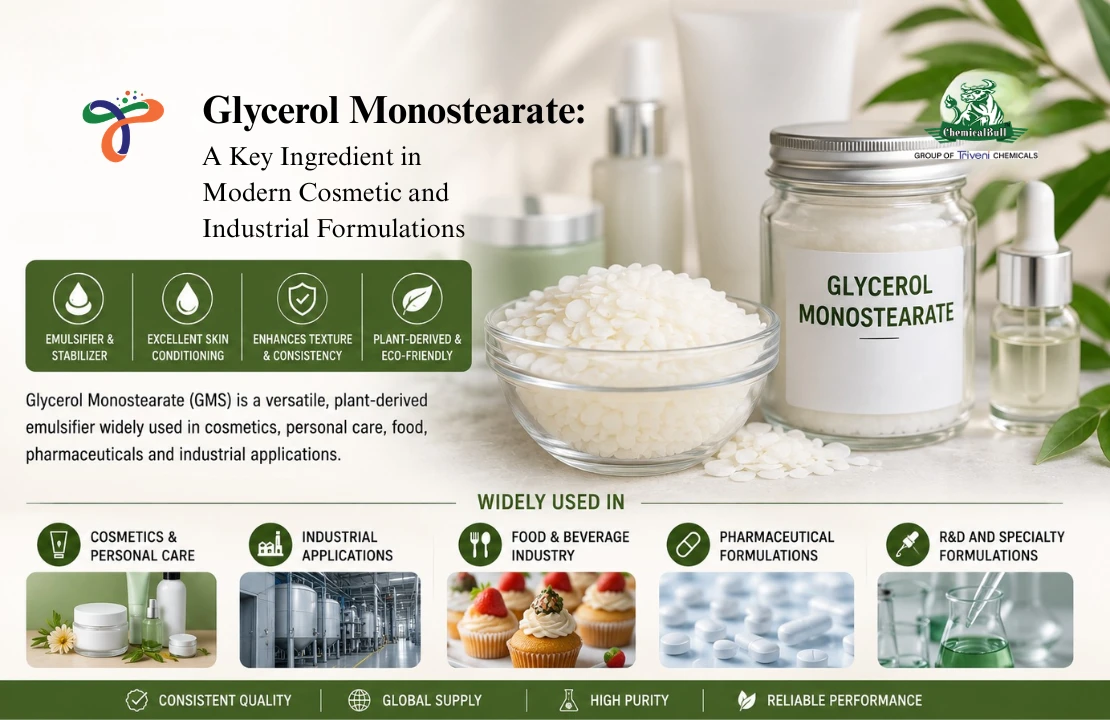
Glycerol Monostearate (GMS), also known as Glyceryl Monostearate, is one of the most widely used emulsifiers in cosmetic, pharmaceutical, food, and industrial formulations. Known for its excellent emulsifying, stabilising, and thickening properties, GMS helps manufacturers create products with improved texture, consistency, and long-term stability.
From moisturising creams and lotions to pharmaceutical preparations and industrial emulsions, Glycerol Monostearate plays an important role in modern formulation technology. Its multifunctional nature makes it a preferred ingredient for manufacturers seeking reliable performance across various applications.
Manufacturers looking for a reliable Glycerol Monostearate supplier for cosmetic, pharmaceutical, food, or industrial applications can review our product specifications and bulk supply options.
What is Glycerol Monostearate?
Glycerol Monostearate is a non-ionic emulsifier produced by the reaction of glycerol and stearic acid. It is commonly available as white flakes, powder, or beads and is widely used to stabilise oil and water mixtures.
Because it contains both hydrophilic and lipophilic properties, GMS helps create stable emulsions while improving product texture and consistency.
GMS Full Form in Chemistry
The full form of GMS in chemistry is Glycerol Monostearate (also known as Glyceryl Monostearate). It is a fatty acid ester widely used as an emulsifier, stabiliser, and texture-enhancing ingredient in cosmetic, pharmaceutical, food, and industrial formulations.
Glycerol Monostearate Structure and Properties
Glycerol Monostearate is formed by combining glycerol with stearic acid. Its unique molecular structure allows it to interact with both water and oil phases, making it an effective emulsifier.
Is Glycerol Monostearate an Emulsifier?
Yes. Glycerol Monostearate is primarily used as a non-ionic emulsifier.
An emulsifier helps combine oil and water phases into a stable mixture. Without emulsifiers, many creams, lotions, and industrial emulsions would separate during storage.
Because of its excellent emulsification properties, GMS is widely used in:
- Cosmetic creams
- Lotions
- Sunscreens
- Hair conditioners
- Pharmaceutical creams
- Industrial emulsions
Glycerol Monostearate Uses
Glycerol Monostearate has applications across multiple industries because it provides emulsification, viscosity control, stabilisation, and texture enhancement.
Cosmetic and Personal Care Products
GMS is widely used in:
- Face creams
- Body lotions
- Moisturisers
- Sunscreens
- Body butters
- Cleansing creams
- Hair conditioners
Its ability to create smooth, stable formulations makes it one of the most commonly used cosmetic emulsifiers.
Pharmaceutical Applications
In pharmaceutical manufacturing, GMS is used as:
- Emulsifier
- Stabiliser
- Lubricant
- Excipient
It is commonly found in creams, ointments, topical products, and certain tablet formulations.
Food Applications
Food-grade GMS is used as an emulsifier and texture-improving agent in selected food products where formulation consistency and stability are important.
Industrial Applications
Industrial manufacturers use GMS in:
- Specialty emulsions
- Plastic processing
- Lubricant formulations
- Surface treatment systems
- Industrial chemical formulations
Glycerol Monostearate Uses in Cosmetics
One of the most important applications of GMS is in cosmetic manufacturing.
Emulsion Stability
GMS helps prevent oil and water separation, ensuring creams and lotions remain stable throughout their shelf life.
Texture Enhancement
Cosmetic products require smooth and luxurious textures. GMS helps improve creaminess, spreadability, and overall sensory performance.
Viscosity Control
It contributes to the desired thickness and consistency of cosmetic formulations, making products easier to apply and more appealing to consumers.
Improved Product Performance
By improving formulation stability and texture, GMS helps cosmetic manufacturers create premium-quality products with enhanced consumer appeal.
Benefits of Glycerol Monostearate
The popularity of GMS is largely due to its multifunctional benefits.
Key Benefits
- Excellent emulsifying properties
- Improved formulation stability
- Enhanced product texture
- Better viscosity control
- Improved spreadability
- Broad ingredient compatibility
- Suitable for cosmetic, pharmaceutical, food, and industrial applications
Because one ingredient can perform several formulation functions, manufacturers often use GMS to simplify formulations and improve efficiency.
Why Manufacturers Prefer GMS
Manufacturers choose Glycerol Monostearate because it offers:
- Reliable emulsion stability
- Consistent formulation performance
- Compatibility with various oils, waxes, and surfactants
- Cost-effective multifunctionality
- Improved product quality and shelf life
Its versatility makes it a valuable ingredient in both consumer and industrial products.
Looking for reliable bulk supply?
For large-scale manufacturing, product quality and consistency are essential. When sourcing GMS, buyers should consider:
- Product quality standards
- Technical documentation availability
- Consistent batch quality
- Packaging options
- Supply reliability
- Bulk supply capability
Reliable sourcing helps manufacturers maintain formulation consistency and production efficiency. Chemical Bull supplies high-quality Glycerol Monostearate for cosmetic, pharmaceutical, food, and industrial applications. We provide consistent quality, technical documentation, and reliable bulk supply support for manufacturers and formulators.
Frequently Asked Questions
-
What is Glycerol Monostearate used for?
Glycerol Monostearate is used as an emulsifier, stabiliser, and thickening agent in cosmetics, pharmaceuticals, food products, and industrial formulations. -
What is the full form of GMS in chemistry?
GMS stands for Glycerol Monostearate, also known as Glyceryl Monostearate. -
Is Glycerol Monostearate an emulsifier?
Yes. GMS is a non-ionic emulsifier used to stabilise oil-and-water formulations. -
What are the uses of Glycerol Monostearate in cosmetics?
It is used in creams, lotions, moisturisers, sunscreens, conditioners, and other cosmetic products to improve stability, texture, and consistency. -
What are the benefits of Glycerol Monostearate?
Benefits include improved emulsification, enhanced texture, better viscosity control, increased stability, and broad formulation compatibility. -
Which industries use Glycerol Monostearate?
Cosmetic, personal care, pharmaceutical, food, and industrial manufacturing industries commonly use GMS.
Conclusion
Glycerol Monostearate (GMS) is a versatile emulsifier and stabilising agent that plays an important role in cosmetic, pharmaceutical, food, and industrial formulations. Its ability to improve emulsion stability, texture, consistency, and overall product performance has made it one of the most widely used multifunctional ingredients in modern manufacturing.
As demand for high-performance formulations continues to grow, Glycerol Monostearate will remain an essential ingredient for manufacturers seeking stable, efficient, and high-quality products.

Comment Section