Chemical Bull
4690
20-Nov-2025
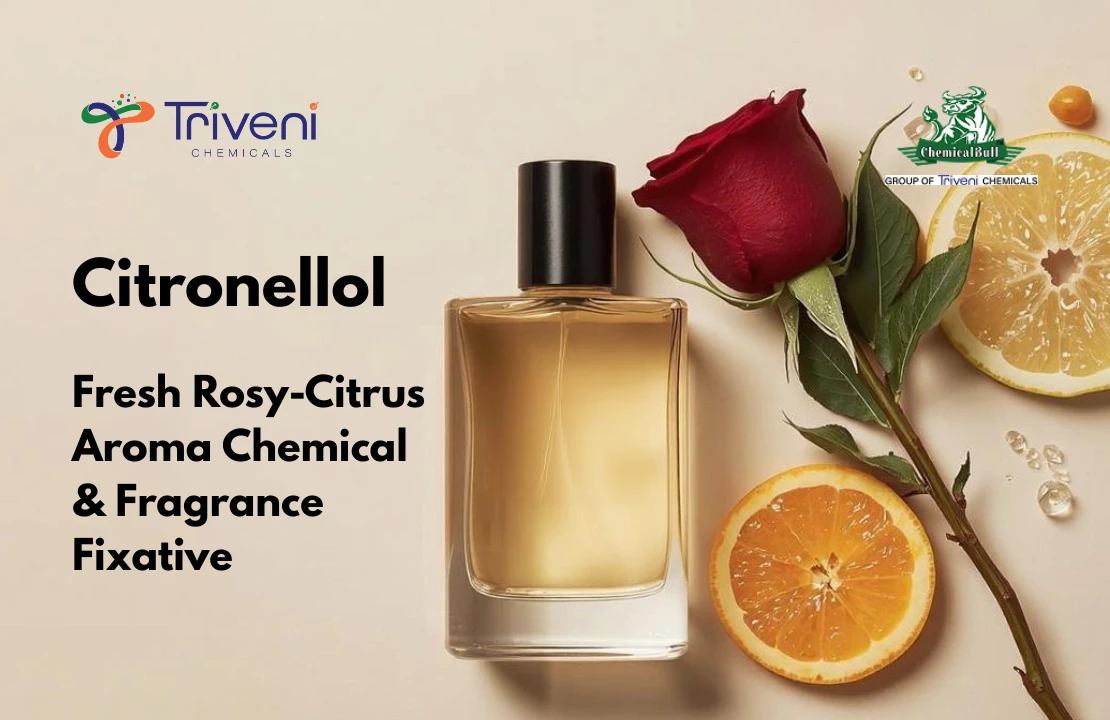
Citronellol plays an important role in fragrance, cosmetics, personal care and home care formulations. Manufacturers value this ingredient for its fresh rosy–citrus aroma, excellent blending behavior and reliable performance as a fragrance fixative in fine perfumes.
As a trusted chemical trading company representing itself as a chemical Supplier and Distributor, Triveni Chemicals supplies high-purity Citronellol to B2B clients across India and global markets.
This blog explains Citronellol from a technical, manufacturing and perfumery viewpoint to help formulators and fragrance buyers understand its aroma profile, industry uses and formulation benefits.
What is Citronellol?
Citronellol is an acyclic monoterpenoid alcohol widely used in perfumery, cosmetics and home fragrance manufacturing.
The Citronellol formula is C₁₀H₂₀O, and its IUPAC name is 3,7-Dimethyloct-6-en-1-ol.
Industries use Citronellol to create:
- Fresh floral accords
- Rose and geranium-based perfumes
- Citrus-floral blends
- Personal care fragrances
- Home fragrance products
Citronellol appears as a clear, colourless liquid with a soft floral and mild citrus character. Because it resembles components found in geranium oil, many formulators describe it as a geranium-like fragrance ingredient suitable for modern perfumery.
Citronellol in Nature
Citronellol naturally occurs in several aroma-rich plants. Manufacturers often ask about the citronellol plant sources, and the ingredient mainly comes from:
- Rose oil
- Geranium oil
- Citronella oil
- Lemongrass
- Neroli
- Lavender Oil
These essential oils contribute to Citronellol’s sweet, fresh and rosy aroma, making it one of the most widely used floral ingredients across the global perfume ingredient chemical market.
Natural vs Synthetic Citronellol – Complete Guide for Perfumery
Manufacturers use both natural and synthetic Citronellol depending on cost, performance and label requirements.
|
Feature |
Natural Citronellol |
Synthetic Citronellol |
|
Source |
Extracted from essential oils (rose, geranium, citronella) |
Produced through chemical synthesis |
|
Aroma |
Slightly complex, natural floral–citrus tone |
Very consistent rosy–citrus aroma |
|
Cost |
Higher due to limited natural supply |
More economical for bulk production |
|
Stability |
Can vary based on seasonal crops |
Highly stable and uniform |
|
Usage |
Natural perfumes, clean-label products |
Fine fragrance, cosmetics, home care & industrial use |
Isomers of Citronellol: R-Citronellol & S-Citronellol
Citronellol exists in two major optical isomers, and each one contributes differently to a fragrance.
R-Citronellol
R-Citronellol naturally occurs in rose and geranium oils. It offers a softer, rounder and more realistic rosy aroma, which makes it highly preferred in fine fragrances and high-end floral compositions. It also enhances natural floral character and blends smoothly with rose-based formulas.
S-Citronellol
S-Citronellol commonly appears in citronella-derived extracts. It carries a slightly sharper citrus tone compared to the R-isomer. Perfumers and manufacturers use it in soaps, detergents, home fragrances and functional products where a bright citrus–floral profile works well.
What Does Citronellol Smell Like?
Citronellol delivers a fresh rosy–citrus aroma with a soft floral sweetness and a mild lemon-like freshness. Perfumers describe its scent as rosy, smooth, slightly sweet, bright and uplifting.
This profile makes Citronellol a valuable middle note perfumery ingredient, helping bridge citrus top notes and woody or musky base notes. Its balanced floral character works perfectly in modern fragrances for fine perfumery, personal care and home fragrance products.
Benefits of Citronellol for B2B Formulators
-
Enhances Floral Accords
Citronellol strengthens rose, geranium and citrus-based floral blends. It improves roundness, adds natural freshness and helps build premium floral structures. -
Acts as a Fragrance Fixative
Manufacturers use Citronellol as a fragrance fixative to support top notes and extend overall fragrance performance, especially in body care and fabric care products. -
Suitable for Cosmetics
Citronellol works well in creams, lotions, shampoos, conditioners, deodorants and personal care products due to its mildness and compatibility. -
Versatile Applications
It performs consistently across fine fragrance, skin care, hair care, fabric care, air care and home fragrance formulations. -
Cost-Effective Alternative
Citronellol provides floral impact similar to rose oil and geranium oil but at a much more economical cost, making it ideal for large-scale manufacturing.
Industrial and Commercial Uses of Citronellol
-
Perfumery & Fine Fragrance Manufacturing
Brands use Citronellol to build rose, citrus–floral, herbal and green fragrance compositions. Its stability and balanced floral tone make it ideal for Citronellol for Fine Fragrance Formulation, especially in modern floral perfumes. -
Cosmetics and Personal Care
Citronellol appears in creams, serums, sunscreens, lotions, shampoos, conditioners and deodorants. Its performance in citronellol in cosmetics makes it suitable for daily-use personal care products. -
Home Fragrance & Household Care
Citronellol performs well in room sprays, incense sticks, candles, diffusers, detergents and fabric perfumes. Its clean floral note enhances consumer acceptance in home care products. -
Insect Repellent Products
Citronellol shows natural repellent properties and supports Citronellol insect repellent formulations, mosquito oils, coils and outdoor body sprays.
How to Use Citronellol in Perfume
Formulators primarily use Citronellol (CAS No. 106-22-9) as a reliable middle note.
Recommended usage levels
- Fine fragrances: 1% – 8%
- Floral accords: 5% – 20%
- Cosmetics: 0.1% – 0.5%
- Soaps & detergents: 0.5% – 2%
Citronellol blends well with:
Geraniol, Linalool, Nerol, Lavender, Citronellal, Rose oil.
If you want to understand similar fragrance ingredients, explore our detailed blogs on Citronellal and Linalool, which are widely used in perfumery and personal care formulations.
Citronellol vs Citronella – Clear Comparison
|
Feature |
Citronellol |
Citronella Oil |
|
Type |
Aroma chemical |
Essential oil |
|
Aroma |
Rosy, floral, citrus-fresh |
Sharp, lemon-grass |
|
Usage |
Perfumes, cosmetics, home care |
Repellents, outdoor oils |
|
Odour Strength |
Soft |
Strong |
|
Nature |
Acyclic monoterpenoid alcohol |
Natural oil blend |
This comparison helps formulators understand the distinction between Citronellol vs Citronella Oil, which are often confused due to similar names.
The Secret Behind Sustainable & High-Impact Fine Fragrance Formulation
Citronellol has become a preferred material for perfumers designing long-lasting and modern floral fragrances. Its clean rosy-green character brings elegance to both luxury and mass-market fragrances.
Why Perfumers Rely on Citronellol in Fine Fragrance Creation
Citronellol provides natural rosy brightness, strengthens floral heart notes, softens stronger ingredients like geraniol and lifts essential oils to achieve a premium finishing effect.
Citronellol as a Sustainable Ingredient
Citronellol supports clean fragrance trends due to its botanical origins, biodegradable profile and compatibility with natural essential oils. It helps formulators reduce the need for heavy synthetic boosters while maintaining performance.
Top 5 Frequently Asked Questions (FAQ) for citronellol
1. Is citronellol safe for skin?
Yes. It is safe when used according to citronellol IFRA standards for cosmetics and personal care.
2. What is another name for citronellol?
Citronellol is also known as dihydrogeraniol.
3. What is citronellol used for?
It is used in perfumes, cosmetics, hair care, household fragrances and insect repellent formulations.
4. What is the difference between Citronellol and Geraniol?
Citronellol smells more rosy-citrus and soft, while Geraniol is sweeter and more intense. Citronellol works mainly in middle notes; Geraniol lifts top–middle floral notes.
5. Is citronellol an allergen?
Yes. Citronellol is a listed fragrance allergen, and manufacturers must declare it on product labels when it exceeds regulatory limits.
Conclusion
Citronellol is a versatile and high-value fresh rosy–citrus aroma chemical used across fine fragrance, cosmetics, home fragrance and repellent formulations. Its compatibility, stability, blending behaviour and cost-effectiveness make it essential for modern fragrance development.
Triveni Chemicals, as a trusted chemical trading company, supplies and distributes high-purity Citronellol for B2B clients. We support manufacturers with consistent quality, bulk availability and reliable technical guidance for large-scale fragrance and cosmetic formulation.



Comment Section