Chemical Bull
152
07-Sep-2026
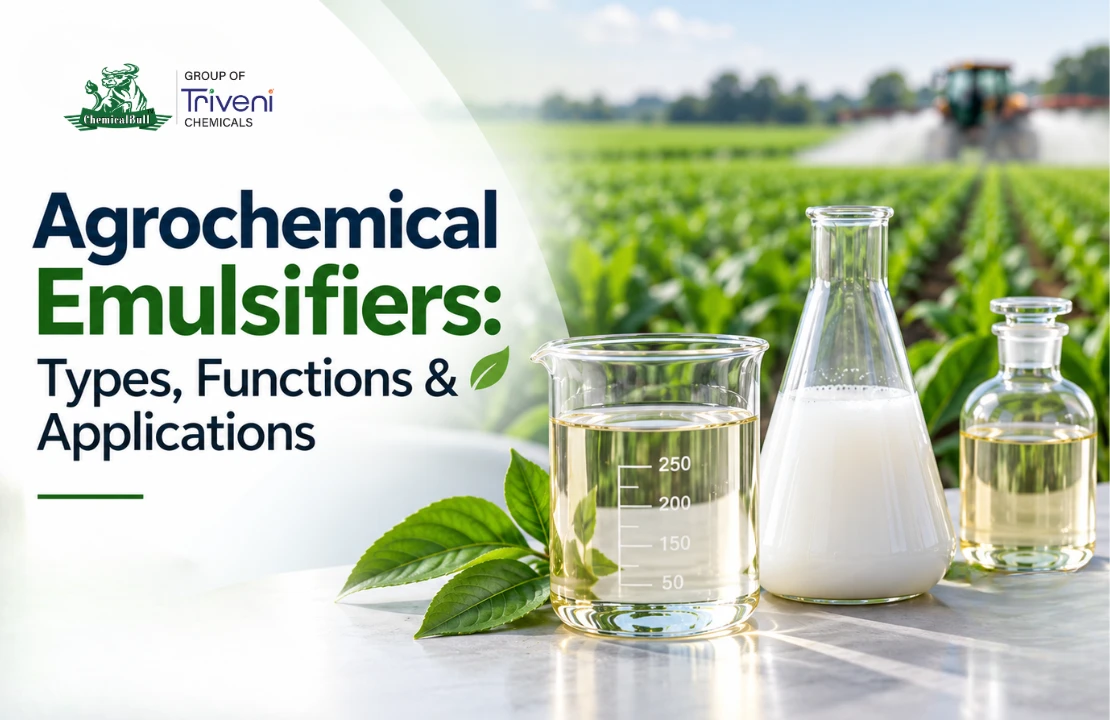
Agrochemical emulsifiers are important formulation ingredients used where oil-based active ingredients, solvents or carriers need to mix effectively with water. They help create stable emulsions, improve dilution behaviour and support the consistent performance of crop-protection formulations.
For pesticide, herbicide, insecticide, fungicide and agricultural adjuvant manufacturers, the right emulsifier system can influence formulation stability, processing, storage and spray preparation.
Manufacturers sourcing agrochemicals commonly evaluate different surfactant families according to the active ingredient, formulation type, solvent system, required Hydrophilic-Lipophilic Balance (HLB) and end-use requirements.
Among the important groups are sorbitan esters, polysorbates, alcohol ethoxylates, amine ethoxylates and castor oil ethoxylates. Buyers comparing these formulation ingredients can also explore the wider agrochemical emulsifiers range.
What Are Agrochemical Emulsifiers?
Agrochemical emulsifiers are surface-active ingredients that help two normally incompatible phases, particularly oil and water, remain distributed together.
Many crop-protection active ingredients have limited compatibility with water. However, agricultural formulations are often diluted with water before spraying.
The emulsifier works at the oil-water interface and helps the concentrate form a more uniform emulsion after dilution.
They are particularly relevant in:
-
Emulsifiable Concentrates (EC)
-
Emulsion in Water (EW)
-
Suspo-Emulsions (SE)
-
Microemulsions (ME)
-
Oil Dispersions (OD)
-
agricultural spray adjuvants
Emulsifiers are therefore an important part of the wider group of agrochemical raw materials and intermediates used by manufacturers.
Why Are Emulsifiers Used in Agrochemical Formulations?
Emulsion Formation
The main role of an emulsifier is to reduce interfacial tension between oil and water so the two phases can form a more stable emulsion.
This becomes especially important when an oil-based concentrate must disperse rapidly after it is added to water.
Formulation Stability
A suitable emulsifier system helps reduce problems such as creaming, coalescence and phase separation during storage and after dilution.
Dilution Performance
Agrochemical concentrates should disperse consistently when mixed with water. Formulators therefore evaluate how quickly the emulsion forms, how uniform it remains and whether separation occurs after dilution.
Wetting and Surface Coverage
Certain surfactants also provide wetting properties that can help the diluted formulation spread more effectively across treated surfaces.
Dispersion and Solubilization
Depending on the surfactant structure, an emulsifier may also support dispersion or solubilization of formulation ingredients.
Types of Agrochemical Emulsifiers
Agrochemical emulsifiers can broadly be divided into anionic, nonionic and blended emulsifier systems.
Anionic Emulsifiers
Anionic emulsifiers carry a negative charge in solution. Calcium alkylbenzene sulfonates and related surfactants are commonly associated with selected pesticide and EC formulation systems.
They may be combined with nonionic surfactants to achieve the required balance between oil compatibility, water compatibility and emulsion stability.
Nonionic Emulsifiers
Nonionic emulsifiers do not carry an electrical charge and are widely used across agrochemical formulation systems.
Important nonionic groups include:
-
Sorbitan Esters
-
Polysorbates
-
Alcohol Ethoxylates
-
Amine Ethoxylates
-
Castor Oil Ethoxylates
-
Hydrogenated Castor Oil Ethoxylates
These are particularly relevant for manufacturers looking for emulsification, wetting, solubilization and formulation-support properties.
1. Sorbitan Esters for Agrochemical Formulations
Sorbitan esters are nonionic surfactants with relatively strong affinity toward oil. They can function as emulsifiers or co-emulsifiers in formulations containing oil, organic solvents or other hydrophobic components.
Important products include:
|
Product |
Typical Formulation Role |
|
Emulsification and wetting support |
|
|
Co-emulsification and stabilization |
|
|
Emulsifier and stabilizer |
|
|
Oil-compatible emulsifier |
|
|
Specialty emulsion stabilization |
|
|
Oil-rich formulation and co-emulsifier systems |
Sorbitan Monooleate
Sorbitan Monooleate is a lipophilic nonionic emulsifier that can be considered when stronger interaction with the oil phase is required.
It may be used alone in selected systems or combined with more hydrophilic surfactants to achieve a suitable HLB balance.
Sorbitan Trioleate
Sorbitan Trioleate has strong oil affinity and can be evaluated for selected pesticide formulations, oil dispersions and agricultural emulsifier systems.
Its suitability depends on the active ingredient, carrier oil, solvent phase and complete surfactant package.
Other Sorbitan Esters
Sorbitan Monolaurate, Sorbitan Monopalmitate, Sorbitan Monostearate and Sorbitan Tristearate provide different oil-water characteristics.
Formulators normally choose among these products according to formulation requirements rather than treating all sorbitan esters as interchangeable.
2. Polysorbates Used as Emulsifiers
Polysorbates are ethoxylated derivatives of sorbitan esters. Compared with many sorbitan esters, they have greater affinity toward water and can support oil-in-water emulsification, solubilization and stabilization.
Important products include:
|
Product |
Typical Formulation Role |
|
Emulsification and solubilization |
|
|
Emulsification and stabilization |
|
|
Nonionic oil-in-water emulsification |
|
|
Specialty emulsion systems |
|
|
Emulsification, wetting and solubilization |
|
|
Specialty surfactant applications |
|
|
Oil-rich and specialty formulation support |
Polysorbate 60
Polysorbate 60 is a nonionic emulsifier that can support oil-in-water emulsion formation and stability in selected formulations.
Its effectiveness depends on the complete formulation rather than the surfactant alone.
Polysorbate 80
Polysorbate 80 provides emulsification, wetting and solubilization properties and may be considered for selected agricultural and crop-protection formulations.
Polysorbates can also be paired with sorbitan esters when formulators need to balance oil affinity with water compatibility.
For example:
Sorbitan Ester + Polysorbate
This allows the formulation developer to fine-tune HLB and emulsion behaviour instead of relying on a single surfactant.
For a detailed comparison of grades, functions and formulation roles, see our guide on Polysorbates Used in Agrochemical Formulations.
3. Ethoxylated Surfactants for Agrochemicals
Ethoxylated surfactants are one of the most commercially important surfactant groups used in agricultural formulation development.
Their properties can be adjusted through the starting material and degree of ethoxylation, giving formulators access to different HLB values, water compatibility and wetting behaviour.
Alcohol and Related Ethoxylates
Alcohol ethoxylates are nonionic surfactants used where emulsification and wetting properties are required.
Important products include:
Different ethoxylation levels allow formulators to choose products with the required balance between oil affinity and water compatibility.
Alkylphenol Ethoxylates
Other ethoxylated surfactants include:
These materials are known for surface-active, wetting and emulsification properties. However, their regulatory acceptance can vary by market, so agrochemical manufacturers should verify suitability for the intended destination and end use.
Amine Ethoxylates
Amine ethoxylates are particularly relevant to herbicide formulations and agricultural adjuvant systems.
Important products include:
Depending on the grade and formulation, these surfactants can support wetting, emulsification and other surface-active functions.
Their exact suitability should be checked according to the active ingredient, formulation design and regulatory requirements.
Castor Oil Ethoxylates
Castor Oil Ethoxylate is an important nonionic surfactant used across agrochemical formulation systems.
Depending on grade and EO level, it can support:
-
emulsification
-
wetting
-
solubilization
-
formulation stability
-
adjuvant systems
It is particularly relevant to manufacturers working with EC, EW and agricultural adjuvant formulations.
Hydrogenated Castor Oil Ethoxylates provide another option where formulators require nonionic emulsification and solubilization properties with different hydrophilic characteristics.
Learn how different ethoxylated surfactant families support emulsification, wetting and formulation performance in our guide to ethoxylated surfactants for agrochemical formulations.
Agrochemical Emulsifiers by Formulation Type
The formulation type has a major influence on surfactant selection.
|
Formulation |
Main Requirement |
Relevant Surfactant Families |
|
EC – Emulsifiable Concentrate |
Rapid emulsion formation after water dilution |
Alcohol ethoxylates, castor oil ethoxylates, sorbitan derivatives and blends |
|
EW – Emulsion in Water |
Oil-droplet stabilization in water |
Polysorbates and other hydrophilic nonionic surfactants |
|
SE – Suspo-Emulsion |
Stability of emulsified droplets and suspended solids |
Emulsifiers with wetting and dispersing agents |
|
OD – Oil Dispersion |
Wetting and dispersion in an oil system |
Oil-compatible surfactants and selected ethoxylates |
|
ME – Microemulsion |
Fine oil-water system |
Balanced surfactant and co-surfactant packages |
|
Adjuvants |
Wetting, spreading and compatibility |
Alcohol, castor oil and selected amine ethoxylates |
Emulsifiers for EC Formulations
EC formulations are among the most relevant applications for agrochemical emulsifiers.
In an EC, the active ingredient is generally dissolved in an organic solvent together with an emulsifier package. When the formulation is added to water, the surfactant system should help create a stable and uniform emulsion.
Manufacturers typically evaluate:
-
active ingredient
-
solvent compatibility
-
required HLB
-
water hardness
-
emulsion formation
-
dilution stability
-
storage conditions
-
formulation temperature
Because these factors vary between formulations, blends of multiple surfactants are often evaluated.
EC systems are widely used across different pesticide and insecticide formulations, making emulsifier selection an important part of crop-protection formulation development.
How Does HLB Help in Emulsifier Selection?
Hydrophilic-Lipophilic Balance, or HLB, describes the relative affinity of a surfactant toward water and oil.
Lower-HLB surfactants generally have stronger oil affinity, while higher-HLB surfactants generally interact more strongly with water.
This explains why formulators may combine different surfactant families.
Examples include:
Sorbitan Ester + Polysorbate
Sorbitan Ester + Alcohol Ethoxylate
Castor Oil Ethoxylate + Another Nonionic Surfactant
The objective is not simply to use more emulsifier. It is to obtain an appropriate surfactant balance for the active ingredient and formulation system.
How to Select an Agrochemical Emulsifier
Agrochemical manufacturers should evaluate several factors before choosing a surfactant.
Formulation Type
EC, EW, SE, OD and ME systems have different emulsification requirements.
Active Ingredient
Solubility, concentration and polarity can influence surfactant selection.
Oil or Solvent Phase
The emulsifier must be compatible with the carrier phase used in the formulation.
Required HLB
HLB helps formulators shortlist products with suitable oil-water characteristics.
Water Hardness
Mineral content in dilution water may influence emulsification behaviour.
Dilution Stability
The formulation should be evaluated at intended dilution ratios and water conditions.
Storage Stability
Temperature and storage time can affect separation, viscosity and overall formulation behaviour.
Regulatory Suitability
The selected surfactant should be suitable for the intended market and agricultural end use.
Why Are Emulsifier Blends Common in Agrochemicals?
One surfactant does not always provide the required balance of oil compatibility, water compatibility and wetting.
This is why agrochemical formulators frequently test blends.
A more lipophilic emulsifier can support the oil phase, while a more hydrophilic surfactant supports dispersion into water.
The formulation developer can then adjust the ratio until the required emulsion stability and dilution performance are achieved.
Agrochemical Emulsifiers for Bulk Industrial Formulations
Agrochemical manufacturers, pesticide formulators, herbicide producers, crop-protection companies and agricultural adjuvant manufacturers may require surfactants in regular commercial quantities.
ChemicalBull supports B2B sourcing enquiries for Sorbitan Esters, Polysorbates, Alcohol Ethoxylates, Amine Ethoxylates, Castor Oil Ethoxylates and Hydrogenated Castor Oil Ethoxylates.
Manufacturers can share:
-
required product
-
formulation type
-
active ingredient
-
required quantity
-
preferred packaging
-
destination
-
monthly or annual requirement
Buyers evaluating a wider range of formulation ingredients can also read the complete guide to agricultural chemical solutions.
Looking for an emulsifier for an EC, EW, SE, OD or agricultural adjuvant formulation? Share your formulation type, required product and bulk quantity with ChemicalBull to discuss suitable supply options.
Frequently Asked Questions
1. What are the main types of emulsifiers used in agrochemicals?
Common groups include anionic emulsifiers, sorbitan esters, polysorbates, alcohol ethoxylates, amine ethoxylates and castor-oil-based ethoxylates.
2. How do I select an emulsifier blend for an EC formulation?
Selection depends on the active ingredient, solvent, required HLB, dilution stability, water quality and desired emulsion behaviour. Formulators often evaluate a blend of surfactants rather than relying on one emulsifier.
3. Which emulsifiers are used in agrochemical formulations?
Examples include Sorbitan Monooleate, Sorbitan Trioleate, Polysorbate 60, Polysorbate 80, Lauryl Alcohol Ethoxylate, Castor Oil Ethoxylate and selected amine ethoxylates.
4. Why are emulsifier blends used in agrochemicals?
Blends allow formulators to combine different oil-water affinities and surface-active properties to achieve the required emulsification and formulation stability.
5. What information should buyers provide for bulk agrochemical emulsifier enquiries?
Buyers should ideally share the required product or function, active ingredient, formulation type, quantity, packaging preference and delivery destination.
Conclusion
Agrochemical emulsifiers play an important role in formulations where oil-based ingredients need to interact effectively with water.
Sorbitan esters, polysorbates and ethoxylated surfactants give formulators different options for controlling emulsification, wetting, solubilization and formulation stability across EC, EW, SE, OD, ME and agricultural adjuvant systems.
For manufacturers, the best emulsifier is determined by the complete formulation rather than by product name alone. Evaluating the active ingredient, solvent system, HLB, dilution behaviour and regulatory requirements helps identify a suitable surfactant or emulsifier blend for commercial production.
For bulk requirements, manufacturers can explore ChemicalBull's range of agrochemical emulsifiers and share their formulation requirements to identify suitable products for sourcing.
Comment Section