Chemical Bull
30
19-Sep-2026
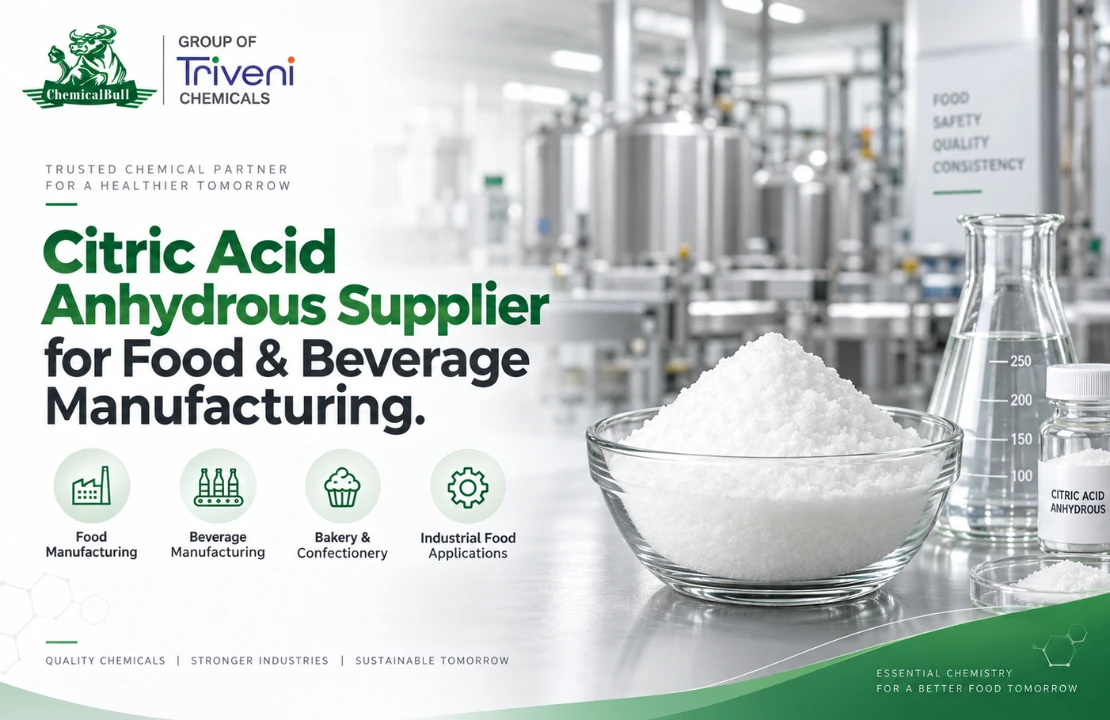
Citric Acid Anhydrous Supplier for Food & Beverage Manufacturing
Citric Acid Anhydrous is one of the most widely used food acidulants in the world, valued for its clean sour taste, strong buffering capacity, and reliable performance across beverages, confectionery, and processed foods. Its anhydrous (water-free) form is specifically preferred in applications where moisture sensitivity or precise dry-blend formulation matters.
Because purity and consistency directly affect taste, shelf stability, and formulation performance, working with an established citric acid anhydrous manufacturer helps food and beverage manufacturers maintain reliable results across production batches. Chemical Bull supplies Citric Acid Anhydrous in bulk quantities at competitive pricing for food and beverage manufacturers.
Chemical Identity & Properties
|
Property |
Detail |
|
CAS Number |
77-92-9 |
|
Chemical Formula |
C₆H₈O₇ |
|
Molar Mass |
192.12 g/mol |
|
Appearance |
White crystalline powder or granules |
|
Solubility |
Highly soluble in water |
|
Common Grades |
Food grade, USP/FCC grade |
What Is Citric Acid Anhydrous?
Citric Acid Anhydrous is the water-free form of citric acid, it is a naturally occurring weak organic acid originally derived from citrus fruits and now commercially produced primarily through fermentation. Unlike the monohydrate form, which contains a bound water molecule, the anhydrous form is preferred where moisture control is critical, such as in dry powder mixes, tablet formulations, and applications requiring a longer shelf life without caking.
Uses of Citric Acid Anhydrous in Food and Beverage Manufacturing
-
Beverage Acidulant:
Provides the characteristic tart flavor in carbonated soft drinks, juices, and flavored waters while also acting as a preservative by lowering pH. -
Confectionery:
Used in candies, gummies, and sour-flavored sweets to provide sharp acidity and flavor balance. -
Dry Powder Mixes:
Preferred over the monohydrate form in drink mixes, gelatin desserts, and instant beverage powders where moisture-free blending is essential. -
Dairy Products:
Used in select processed cheese and dairy formulations as a pH adjuster and emulsifying salt component. -
Baked Goods:
Functions as a leavening acid component and flavor enhancer in certain baking applications. -
Preserves and Jams:
Helps set pectin properly and extends shelf life by controlling pH in fruit preserves and jellies. -
Flavor Enhancement:
Used broadly to balance sweetness and enhance fruit flavor notes across a wide range of processed foods.
Why Citric Acid Anhydrous Is Preferred Over the Monohydrate Form
|
Factor |
Anhydrous Form |
Monohydrate Form |
|
Moisture Content |
Water-free |
Contains bound water |
|
Best Suited For |
Dry powder mixes, tablets, moisture-sensitive blends |
Liquid formulations, applications where moisture isn't a concern |
|
Shelf Stability in Dry Blends |
Reduces caking risk in powder formulations |
Can contribute to caking in dry mixes over time |
|
Storage Considerations |
Requires protection from humidity to remain free-flowing |
Generally more tolerant of ambient humidity |
Functional Roles of Citric Acid Anhydrous in Formulations
- Acidulant: Provides tartness and balances sweetness across beverages and confectionery.
- pH Buffer: Helps maintain stable pH levels, which is important for both flavor consistency and microbial stability.
- Preservative Support: Lowering pH helps inhibit the growth of certain spoilage organisms, extending product shelf life.
- Chelating Agent: Binds trace metal ions that could otherwise cause off-flavors or discoloration in food and beverage products.
- Flavor Enhancer: Sharpens and balances fruit flavors, making it a common addition even in products where acidity isn't the primary sensory goal.
What to Look for in a Citric Acid Anhydrous Supplier
-
Food-Grade Certification:
Confirm the material meets applicable food safety standards, such as FCC or USP specifications, for your target market. -
Batch Documentation:
Request a Certificate of Analysis (CoA) and Safety Data Sheet (SDS) for each batch, confirming purity and composition. -
Particle Size Consistency:
For dry-blend applications, confirm the particle size distribution matches your formulation's dosing and mixing requirements. -
Moisture Content Control:
Since the anhydrous form's key advantage is its water-free state, confirm the supplier's packaging protects against moisture absorption during storage and transport. -
Supply Consistency:
Citric Acid Anhydrous is a high-volume ingredient for many manufacturers, so confirm the supplier can reliably support your ongoing bulk production needs.
Handling and Storage Considerations
Citric Acid Anhydrous should be stored in tightly sealed containers in a cool, dry environment, since exposure to humidity can cause the crystalline powder to absorb moisture, leading to caking and reduced flowability in automated dosing systems. While it's a mild, food-safe acid, standard handling precautions such as dust control and eye protection are recommended when handling bulk quantities, along with reviewing the current Safety Data Sheet.
Manufacturing Process Overview
Commercial Citric Acid is produced almost entirely through microbial fermentation today, typically using strains of Aspergillus niger mold fed on a sugar-based substrate such as molasses or glucose syrup. The fermentation process converts sugars into citric acid, which is then extracted, purified, and crystallized. To produce the anhydrous form specifically, the crystallization process is carried out under controlled temperature conditions (generally above 36.5°C) that favor the water-free crystal structure, as opposed to the lower-temperature crystallization that produces the monohydrate form. This temperature-controlled step is what allows manufacturers to offer both forms from essentially the same production process, depending on downstream application needs.
Common Buyer Mistakes to Avoid
-
Assuming Anhydrous and Monohydrate Are Interchangeable:
While chemically similar, substituting one form for the other without adjusting formulation ratios can affect moisture balance and dry-mix performance. -
Overlooking Particle Size Requirements:
Using a granulation size not suited to your mixing or dosing equipment can lead to inconsistent blending, especially in automated powder handling systems. -
Skipping Moisture-Protective Packaging Checks:
Since the anhydrous form's main advantage is its water-free state, receiving material in packaging that doesn't adequately protect against humidity undermines that benefit. -
Not Requesting Batch-Specific Documentation:
Relying on a generic product sheet instead of a batch-specific CoA limits your ability to verify that what actually arrives matches your specification.
Frequently Asked Questions
-
What is Citric Acid Anhydrous used for?
It is used as an acidulant, pH buffer, flavor enhancer, and preservative support across beverages, confectionery, dry powder mixes, dairy products, and baked goods. -
What's the difference between Citric Acid Anhydrous and Citric Acid Monohydrate?
The anhydrous form is water-free and preferred for dry powder blends and moisture-sensitive applications, while the monohydrate form contains bound water and is commonly used in liquid formulations. -
Is Citric Acid Anhydrous naturally derived?
Citric acid was originally derived from citrus fruits, though most commercial supply today is produced through fermentation processes using specific mold strains. -
What grade of Citric Acid Anhydrous is needed for food applications?
Food and beverage applications typically require food-grade material meeting FCC or USP specifications, depending on the target market's regulatory requirements. -
How should Citric Acid Anhydrous be stored?
It should be stored in the tightly seal in the containers in a cool, dry environment to prevent moisture absorption, which can cause caking and affect dosing accuracy. -
What documentation should I request from a Citric Acid Anhydrous supplier?
At minimum, request a Certificate of Analysis and Safety Data Sheet for each batch to confirm purity, grade, and appropriate handling information.
Conclusion
Citric Acid Anhydrous remains a foundational ingredient across food and beverage manufacturing, valued for its clean acidity, buffering capacity, and suitability for moisture-sensitive dry blends. Selecting a supplier who can provide consistent food-grade purity, proper documentation, and reliable bulk supply helps manufacturers maintain quality and consistency across their production runs.

Comment Section