Chemical Bull
252
05-Sep-2026
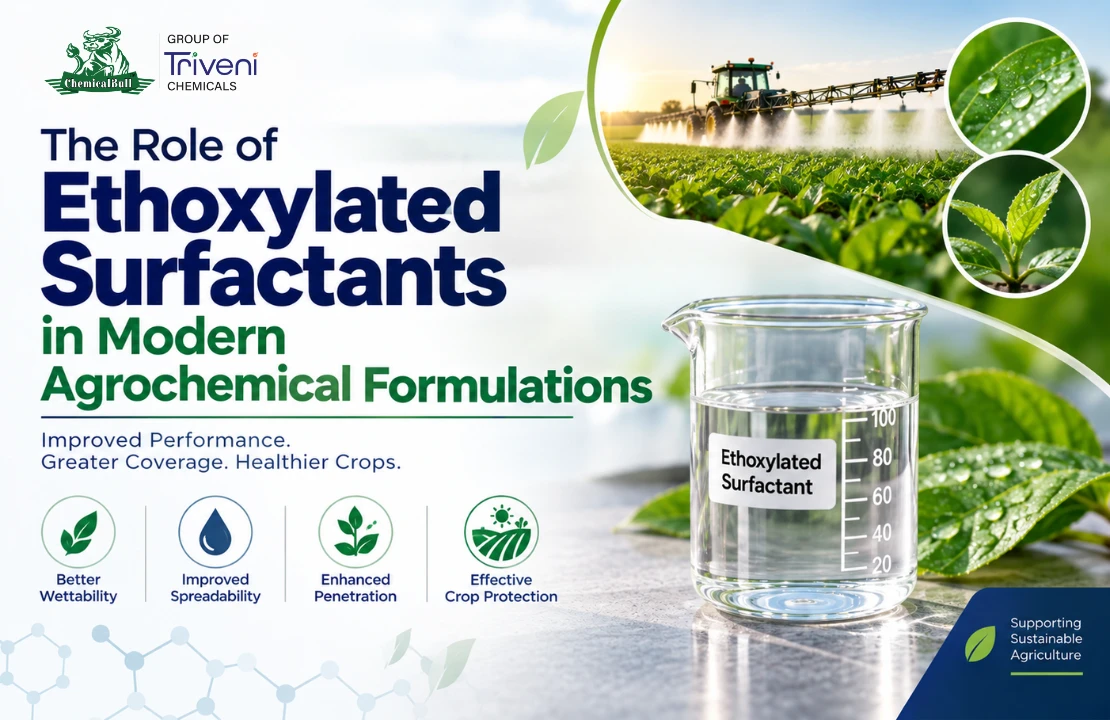
Ethoxylated Surfactants for Agrochemical Formulations
Ethoxylated surfactants play a foundational role in agrochemical formulation, helping active ingredients mix, spread, and perform consistently once applied in the field. Choosing the right type, whether an alcohol, amine, or oil-based ethoxylate, directly affects how well a herbicide, insecticide, or fungicide formulation performs on the crop surface.
Chemical Bull supplies a wide range of ethoxylated surfactants for agrochemical formulations in bulk quantities at competitive pricing, supporting formulators across India with consistent grade quality and documentation.
1. What Are Ethoxylated Surfactants?
Ethoxylated surfactants are non-ionic compounds produced by reacting a hydrophobic base material, such as a fatty alcohol, amine, or natural oil, with ethylene oxide. This reaction adds hydrophilic ethylene oxide units to the molecule, creating a surfactant with both water-loving and oil-loving properties. In agrochemical formulations, this dual nature is what allows the surfactant to help active ingredients interact effectively with both the spray solution and the target plant surface.
2. Role of Ethoxylated Surfactants in Agrochemical Formulations
|
Function |
How It Helps in the Field |
|
Wetting |
Reduces surface tension so spray droplets contact leaf surfaces more evenly instead of beading up |
|
Spreading |
Helps the spray solution spread across the leaf surface for more uniform coverage |
|
Emulsification |
Stabilizes oil-in-water or water-in-oil systems, keeping active ingredients evenly distributed |
|
Dispersion |
Keeps solid particles in suspension concentrates evenly distributed rather than settling |
|
Solubilization |
Helps poorly water-soluble active ingredients dissolve or disperse into the formulation |
|
Improving Formulation Stability |
Supports shelf-life and consistency by preventing phase separation or particle settling over time |
3. Types of Ethoxylated Surfactants Used in Agrochemicals
A. Alcohol Ethoxylates
- Lauryl Alcohol Ethoxylate: A widely used nonionic surfactant offering strong wetting and emulsifying performance across a range of EO grades.
- C16-18 Alcohols Ethoxylated: Derived from longer-chain fatty alcohols, offering stable emulsification suited to oil-heavy formulations.
- Oleyl Cetyl Alcohol Ethoxylate-5: A blended alcohol ethoxylate used for its balanced HLB in emulsifiable concentrate systems.
- PEG Isotridecyl Ether: Used as a wetting and dispersing agent in select agrochemical adjuvant systems.
- PEG Decyl Ether: A shorter-chain alcohol ethoxylate valued for fast wetting action in aqueous formulations.
B. Amine Ethoxylates
- Tallow Amine Ethoxylate: One of the most established surfactants in herbicide formulation, known for enhancing herbicide uptake through leaf surfaces.
- Oleylamine Ethoxylated: Offers strong wetting and penetration properties, often used in combination with other adjuvant components.
- Coco Alkyl Amine Ethoxylates: Derived from coconut-based fatty amines, used for their biodegradability and consistent surfactant performance.
C. Oil-Based Ethoxylates
- Castor Oil Ethoxylate: A versatile emulsifier and wetting agent widely used in pesticide and herbicide spray formulations, often blended with alcohol ethoxylates for optimized performance.
- Hydrogenated Castor Oil Ethoxylates: Offer improved oxidative stability compared to standard castor oil ethoxylates, useful in formulations requiring longer shelf stability.
4. Applications in Agrochemical Formulations
- Herbicides: Ethoxylated surfactants improve leaf wetting and help active ingredients penetrate the leaf cuticle for better absorption.
- Insecticides: Support even dispersion of active ingredients in spray tank mixes, improving contact coverage on target pests.
- Fungicides: Help fungicide actives spread evenly across plant surfaces, improving disease control coverage.
- Pesticides (General): Function as core wetting and emulsifying agents across broad-spectrum pesticide formulations.
- Adjuvants: Used as standalone or blended tank-mix adjuvants to enhance the performance of a separately applied active ingredient.
- Emulsifiable Concentrates (EC): Ethoxylated surfactants stabilize the oil-in-water emulsion formed when an EC formulation is diluted in the spray tank.
- Suspension Concentrates (SC): Support particle dispersion and prevent settling of solid active ingredients suspended in the formulation.
For a broader view of how different surfactant families are used across EC, EW, SE, OD, ME and other crop-protection systems, read our guide on agrochemical emulsifiers: types, functions and applications.
5. How to Select an Ethoxylated Surfactant
- Match HLB value to your formulation type: Lower HLB surfactants generally suit water-in-oil systems, while higher HLB grades work better in water-continuous formulations like SCs.
- Consider the active ingredient's compatibility: Some actives perform better with alcohol ethoxylates, while others respond better to amine or oil-based types.
- Evaluate biodegradability requirements: Coco-based amine ethoxylates and certain alcohol ethoxylates are often preferred where biodegradability is a formulation priority.
- Check regulatory acceptance: Confirm the surfactant is acceptable for use in your target formulation type and export market, since some regions have specific restrictions on certain ethoxylate classes.
- Request compatibility testing: Before committing to bulk volumes, test the surfactant in a small-batch formulation to confirm emulsion stability and performance with your specific active ingredient.
- Confirm supply consistency: Since formulation performance depends on consistent EO grade and purity, work with a supplier who can maintain batch-to-batch consistency across repeat orders.
6. Ethoxylated Surfactant Supplier in India
- Domestic Manufacturing Base: India's chemical manufacturing hubs, including Gujarat's industrial corridor, support strong domestic availability of alcohol, amine, and oil-based ethoxylates for agrochemical formulators.
- Documentation for Formulators: A reliable supplier provides batch-specific Certificates of Analysis, Safety Data Sheets, and EO grade specifications needed for consistent formulation work.
- Bulk and Trial Order Support: Formulators developing new products benefit from suppliers who can support smaller trial quantities alongside full bulk production volumes.
- Blending and Technical Guidance: Many agrochemical formulators use combinations of alcohol, amine, and oil-based ethoxylates, so a supplier who understands these blending relationships adds practical value beyond just supplying raw material.
Frequently Asked Questions
-
What are ethoxylated surfactants used for in agrochemicals?
They are used as wetting, spreading, emulsifying, and dispersing agents that help active ingredients mix into spray solutions and perform consistently once applied to plant surfaces. -
What's the difference between alcohol, amine, and oil-based ethoxylates?
Alcohol ethoxylates are derived from fatty alcohols and offer broad wetting performance, amine ethoxylates are known for enhancing herbicide uptake, and oil-based ethoxylates like Castor Oil Ethoxylate provide strong emulsification for oil-heavy formulations. -
How do I choose the right ethoxylated surfactant for my formulation?
Match the surfactant's HLB value to your formulation type, confirm compatibility with your active ingredient, and run small-batch testing before committing to bulk volumes. -
Are ethoxylated surfactants used in both EC and SC formulations?
Yes, they stabilize the oil-in-water emulsion in emulsifiable concentrates and help keep solid particles suspended and evenly dispersed in suspension concentrates. -
Does Chemical Bull supply ethoxylated surfactants for agrochemical use?
Yes, Chemical Bull supplies a range of alcohol, amine, and oil-based ethoxylated surfactants for agrochemical formulations in bulk quantities at competitive pricing.
Conclusion
Selecting the right ethoxylated surfactant, whether an alcohol, amine, or oil-based type, comes down to matching its properties to your specific formulation and active ingredient. Chemical Bull supplies a broad range of ethoxylated surfactants for agrochemical formulators across India, supporting consistent quality and documentation for both trial and bulk production needs.
Comment Section