Chemical Bull
45
16-Sep-2026
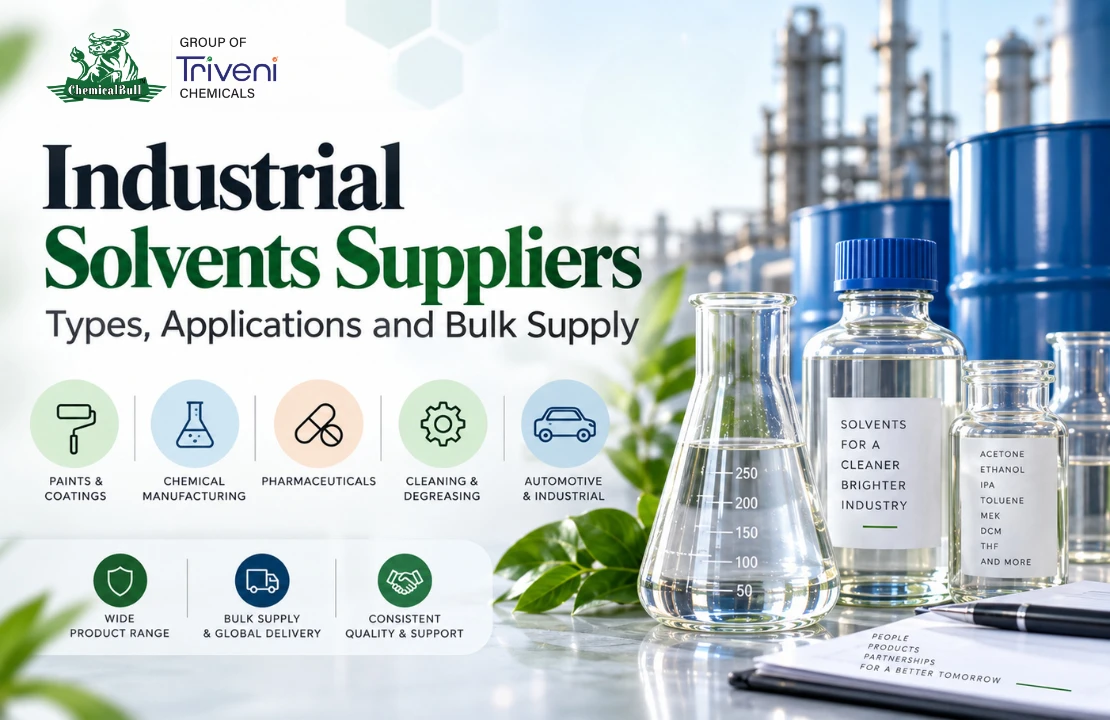
Industrial Solvents Suppliers | Types, Applications & Bulk Supply
Industrial solvents form the backbone of countless manufacturing processes, from paints and coatings to cleaning formulations, printing inks, and chemical synthesis. Choosing the right solvent type, whether a glycol ether or a chlorinated solvent, directly affects evaporation rate, solvency power, and compatibility with the rest of a formulation.
Chemical Bull supplies a wide range of industrial solvents in bulk quantities at competitive pricing, and working with a supplier who carries relevant industrial chemical products across multiple solvent categories helps manufacturers source everything they need from a single, reliable source.
Types of Industrial Solvents We Supply
Glycol Ether Solvents
Glycol ether solvents are valued for their strong solvency, water miscibility, and controlled evaporation rates, making them useful across coatings, cleaning, and printing applications.
- 2-Ethoxyethanol: Also known as Ethyl Cellosolve, used as a solvent in coatings, inks, and cleaning formulations.
- Ethylene Glycol Monobutyl Ether: Known as Butyl Cellosolve, widely used in paints, coatings, and industrial cleaning products.
- Diethylene Glycol Monobutyl Ether: Also called Butyl Carbitol, valued for its slower evaporation rate in coalescing and coating applications.
- Carbitol (Diethylene Glycol Monoethyl Ether): Used as a solvent in printing inks, lacquers, and cleaning formulations.
- 2-(2-Methoxyethoxy)ethanol: Also known as Methyl Carbitol, used in select industrial and specialty solvent applications.
- Triethylene Glycol Monomethyl Ether: Used as a high-boiling solvent in specialty coating and processing applications.
Chlorinated Solvents
- Dichloromethane: A powerful, fast-evaporating solvent used in paint stripping, degreasing, and select chemical processing applications.
Understanding Evaporation Rate and Why It Matters
One of the most important factors in solvent selection is evaporation rate, since it directly affects how a formulation behaves during application and drying. Solvents are generally grouped into fast, medium, and slow evaporating categories, and understanding where a given solvent falls helps formulators predict how it will perform:
-
Fast-evaporating solvents:
Dry quickly, which can be useful for rapid-turnaround processes but may cause issues like poor leveling or surface defects if the formulation isn't balanced correctly. -
Medium-evaporating solvents:
Offer a balance between workable open time and reasonable drying speed, making them common choices in general-purpose coatings and inks. -
Slow-evaporating solvents:
Extend open time, which helps with leveling, flow, and film formation, particularly in coatings that need to self-level before curing.
Many formulations blend solvents with different evaporation rates to achieve a specific drying profile that a single solvent couldn't provide on its own.
Glycol Ethers vs. Chlorinated Solvents: Key Differences
Formulators choosing between glycol ether solvents and chlorinated solvents like Dichloromethane should understand a few fundamental differences in how these solvent families perform:
|
Factor |
Glycol Ether Solvents |
Chlorinated Solvents |
|
Water Miscibility |
Generally miscible with water |
Typically not water-miscible |
|
Solvency Power |
Moderate to strong, depending on grade |
Very strong, effective on a wide range of resins and coatings |
|
Evaporation Rate |
Ranges from moderate to slow |
Generally very fast |
|
Common Use Case |
Coatings, inks, cleaning formulations |
Paint stripping, degreasing, specialty extraction |
|
Handling Considerations |
Standard industrial solvent precautions |
Requires stricter ventilation and exposure controls |
Neither category is universally "better," since the right choice depends entirely on the specific formulation requirements, regulatory considerations, and the balance between solvency power and handling complexity a manufacturer is willing to manage.
Sourcing Considerations for Bulk Solvent Buyers
Manufacturers purchasing industrial solvents at scale should factor in a few additional considerations beyond basic price comparisons:
-
Consolidated Sourcing:
Working with a supplier who carries multiple solvent categories reduces the administrative overhead of managing separate vendor relationships for each raw material. -
Storage Infrastructure Compatibility:
Confirm that your existing tank, drum, or IBC storage setup is compatible with the specific solvent grades you're sourcing, since some solvents require specific container materials or ventilation. -
Regulatory Documentation for Export:
If your finished products are destined for international markets, confirm your supplier can provide documentation supporting relevant regulatory requirements in your target country. -
Volume-Based Pricing Tiers:
Discuss pricing structures for different order volumes, since bulk solvent purchasing often follows tiered pricing based on drum, tote, or tanker-level quantities.
Applications of Industrial Solvents
-
Paints and Coatings:
Solvents like Ethylene Glycol Monobutyl Ether and Butyl Carbitol are used to control drying time, viscosity, and film formation in coating formulations. -
Printing Inks:
Carbitol and related glycol ether solvents help control ink drying speed and pigment dispersion in flexographic and gravure printing. -
Industrial Cleaning:
Glycol ethers and Dichloromethane are used in degreasing, parts cleaning, and paint stripping formulations across manufacturing facilities. -
Chemical Processing:
Several of these solvents serve as reaction media or extraction solvents in downstream chemical synthesis. -
Textile Processing:
Certain glycol ether solvents are used in dye and finishing formulations to support even penetration and processing consistency. -
Adhesives and Sealants:
Controlled evaporation rate solvents help manage open time and cure behavior in adhesive formulations.
How to Choose the Right Industrial Solvent
|
Factor |
Why It Matters |
|
Evaporation Rate |
Determines drying time in coatings, inks, and adhesives |
|
Water Miscibility |
Affects compatibility with water-based formulation systems |
|
Solvency Power |
Determines effectiveness at dissolving resins, oils, or residues |
|
Flash Point |
Impacts storage, handling, and transport classification |
|
Regulatory Status |
Some solvents carry specific handling or emissions requirements depending on the application and region |
|
Odor Profile |
Relevant for workplace environment and finished product characteristics |
What to Look for in an Industrial Solvent Supplier
-
Purity and Consistency:
Confirm the supplier can consistently deliver the purity grade your process requires across repeat batches. -
Batch Documentation:
Request a Certificate of Analysis (CoA) and Safety Data Sheet (SDS) for each solvent grade. -
Bulk Packaging Options:
Confirm the supplier can support drum, tote, or bulk tanker packaging suited to your production volume. -
Broad Product Range:
A supplier carrying multiple solvent categories, glycol ethers, chlorinated solvents, and related specialty chemicals, simplifies sourcing across different formulation needs. -
Reliable Lead Times:
Since solvent-dependent manufacturing often runs on continuous schedules, confirm the supplier's track record for on-time bulk delivery.
Handling and Safety Considerations
Industrial solvents vary in flammability, volatility, and toxicity, so handling precautions should always be confirmed against the current Safety Data Sheet for each specific product. General precautions include adequate ventilation, appropriate personal protective equipment, and storage away from heat sources and incompatible materials. Chlorinated solvents like Dichloromethane require particular attention to ventilation and exposure limits, while glycol ether solvents generally require standard industrial handling practices, though specifics vary by grade and concentration.
Frequently Asked Questions
-
What are the main types of industrial solvents?
Common categories include glycol ether solvents, chlorinated solvents, and various specialty solvents, each suited to different applications based on evaporation rate, solvency power, and compatibility. -
What is Dichloromethane commonly used for?
It is used as a fast-evaporating solvent in paint stripping, degreasing, and select chemical processing applications due to its strong solvency power. -
Why are glycol ethers popular in coatings and inks?
Glycol ethers offer a good balance of solvency, water miscibility, and controlled evaporation rates, making them useful for managing drying time and film formation. -
Does Chemical Bull supply industrial solvents in bulk?
Yes, Chemical Bull supplies a range of industrial solvents, including glycol ethers and chlorinated solvents, in bulk quantities at competitive pricing. -
What documentation should I request from a solvent supplier?
At minimum, request a Certificate of Analysis and Safety Data Sheet for each solvent grade to confirm purity and appropriate handling information. -
How do I choose the right solvent for my formulation?
Consider evaporation rate, water miscibility, solvency power, flash point, and regulatory requirements relevant to your specific application and target market.
Conclusion
Selecting the right industrial solvent, whether a glycol ether or a chlorinated solvent, comes down to matching evaporation rate, solvency, and safety characteristics to your specific process. Chemical Bull supplies a broad range of industrial solvents in bulk quantities at competitive pricing, helping manufacturers source consistent, well-documented raw materials across their formulation needs.


Comment Section