Chemical Bull
14
19-Nov-2026
A cake or biscuit can meet its weight, colour and texture specifications but still disappoint if the flavour differs from the approved product. For food factories, maintaining that familiar taste requires control over both raw materials and production methods.
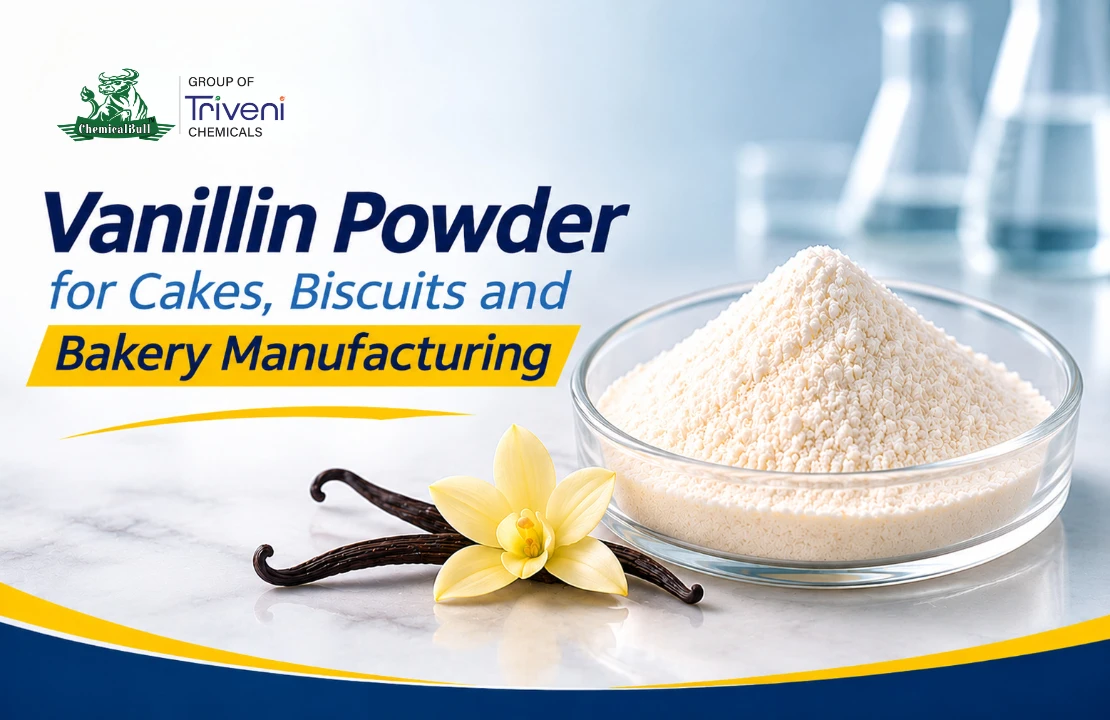
Food-grade vanillin powder is a flavouring chemical used to provide a characteristic vanilla note in cakes, biscuits, cookies, fillings and bakery premixes. Manufacturers select it according to the desired flavour, incorporation method and performance in the finished product. Commercial vanillin producers document its use across these bakery applications.
For specifications, samples and bulk pricing, contact Chemical Bull with your bakery application, required quantity and delivery location.
What Is Vanillin Powder?
Vanillin is a defined aroma chemical with CAS number 121-33-5 and molecular formula C₈H₈O₃. It is typically supplied as white to slightly yellow crystals or crystalline powder with a sweet, creamy, vanilla odour.
For bakery procurement, distinguish between the chemical ingredient and a finished flavour preparation:
- Vanillin powder: A specific flavouring substance supplied against a defined specification.
- Vanilla flavour powder: May contain vanillin, other flavouring substances and carriers.
- Vanilla extract: An extract with a different composition and sensory profile.
These materials should not be substituted at equal weights without reviewing their concentration and formulation behaviour. Confirm exactly what the existing recipe uses before comparing products or prices.
Why Bakery Manufacturers Use Vanillin
Vanillin helps manufacturers build a recognisable vanilla profile. It can be the main flavour in a plain cake or part of a broader flavour system in biscuits, cookies and fillings.
Its value in production comes from matching the ingredient to three requirements.
Flavour consistency: An approved grade and controlled addition method help factories reproduce the intended sensory profile.
Manufacturing suitability: The material must be weighed accurately and distributed throughout the batch.
Purchasing consistency: Each delivery should meet the agreed specification and match the approved reference.
Powder characteristics also matter. Producer literature distinguishes grades developed for dry mixing, dissolution and flowability, showing why physical form should be considered alongside assay. These are grade-specific properties rather than guarantees for every vanillin powder.
Applications in Commercial Bakery Products
Different bakery products require separate evaluations because their recipes, processing conditions and flavour expectations differ.
|
Bakery product |
Intended flavour contribution |
What manufacturers should evaluate |
|
Cakes and muffins |
Vanilla character in the baked crumb |
Batter distribution and flavour after cooling |
|
Biscuits and cookies |
Vanilla note within the baked flavour profile |
Dough uniformity and post-bake intensity |
|
Wafer and sandwich fillings |
Creamy vanilla character |
Incorporation and balance with the wafer or biscuit |
|
Bakery premixes |
Flavour component in a dry ingredient system |
Blend uniformity, segregation and storage |
|
Icings and toppings |
Vanilla note in the finishing layer |
Dissolution or dispersion and finished texture |
Vanillin and vanillin-based preparations have established applications in bakery products. The selected material still requires approval in the actual recipe and process.
Cakes and Muffins
For cake production, assess flavour after baking and cooling. The aroma of the batter alone does not establish how the packed cake will taste.
Run trials using the intended mixing sequence, deposit weight and oven conditions. Compare the cooled cake against an approved reference, then repeat the assessment during storage.
For filled or iced cakes, evaluate the complete product. The sponge, filling and topping may each contribute flavour, so their combined effect should determine the final balance.
Biscuits and Cookies
The required vanilla profile can differ between a plain sweet biscuit, a cocoa cookie and a sandwich biscuit.
Keep the recipe and processing conditions consistent when comparing samples. This makes it easier to identify whether a difference comes from the ingredient, its addition level or the production process.
Check multiple samples from each batch. Uneven flavour may indicate a distribution problem that increasing the dosage will not resolve.
Fillings and Premixes
A filling added after baking follows a different processing route from dough that passes through an oven. Approve its flavour separately, then assess it with the biscuit, wafer or cake.
For premixes, evaluate uniformity after blending, packing and handling. Test the finished premix using the preparation instructions intended for the customer.
How to Incorporate Vanillin into Bakery Formulations
The incorporation method should reflect the ingredient grade, recipe and available equipment.
Dry Blending
Where suitable, prepare a controlled preblend with a compatible dry ingredient already present in the recipe. This can help distribute a small addition through a larger production batch.
Confirm the preblend ratio, mixing time and addition sequence through trials. Particle size can influence dry mixing, while flowability can affect automatic dosing. Supplier literature identifies specialised grades for these requirements, so ask for information about the offered material.
Check weighing accuracy and blend uniformity before increasing production scale.
Incorporation Through a Liquid Phase
Vanillin is only slightly soluble in water. Adding a concentrated quantity to a small volume of cold water may therefore leave undissolved material.
If the process uses a liquid preblend, confirm a suitable food-compatible carrier and preparation method with the technical supplier. Examine the preparation for undissolved particles or crystallisation before use.
Account for the carrier in the recipe and confirm that it meets the factory’s ingredient requirements.
Selecting the Addition Level
There is no single dosage suitable for every cake, biscuit or filling.
The required level depends on the ingredient concentration, complete recipe, processing conditions and target flavour. Use supplier guidance as a starting point, then establish the approved quantity through controlled trials.
Record the addition level in a clearly defined unit, such as grams per kilogram of the specified formulation. State whether the calculation refers to flour weight, total dough or another basis to prevent production errors.
How to Choose Vanillin Powder for Your Production Line
Start with the product being manufactured rather than selecting a grade on price alone.
For cakes, evaluate distribution in the batter and flavour in the cooled crumb. For biscuits, assess dough uniformity and post-bake flavour. For fillings, examine incorporation and sensory balance with the surrounding product.
Before approving a material:
- Confirm whether it is vanillin or a compounded flavour preparation.
- Review the assay, physical characteristics and food-use documentation.
- Request a representative sample.
- Compare it with the approved reference under the same conditions.
- Confirm the result in a production trial.
When requesting technical guidance, share the product type, batch size, mixing method and relevant baking conditions. These details make recommendations more useful than a general request for “vanillin for bakery.”
Evaluating Performance After Baking and Storage
Ingredient approval should cover the complete production cycle.
Assess the product after cooling, in the intended packaging and at defined points during storage. For multi-component products, include the filling or topping in the evaluation.
Maintain records of the raw-material grade, addition level, mixing sequence and processing conditions. If flavour changes later, these records help identify what differed from the approved trial.
Avoid assuming that a “heat-stable” description means complete flavour retention under every baking condition. Processing claims for a particular bakery blend should not automatically be applied to another grade or formulation.
Vanillin’s role here is flavour development. Its addition should not be used to establish microbial shelf life or replace the product’s preservation assessment.
Troubleshooting Flavour Variation
When flavour is weaker or less uniform than expected, review the process before changing the recipe.
Uneven flavour within a batch: Check weighing accuracy, preblend preparation, addition sequence and mixer performance.
A different result after changing suppliers: Compare the grade, assay, particle characteristics and sensory profile. Confirm whether both materials have the same composition.
Acceptable initial flavour but a weaker stored product: Review packaging, storage conditions and the complete formulation against the approved reference.
An excessively dominant vanilla note: Reassess the addition level in the complete product, including any filling or topping.
These checks help distinguish raw-material differences from incorporation and processing problems.
What Buyers Should Check Before Ordering
A useful purchasing specification connects food-use suitability with manufacturing performance.
Relevant checks may include identity, assay, appearance, sensory profile, moisture or loss on drying, and applicable impurity limits. Particle size and flow information may also matter for the plant’s dosing system.
Request a current certificate of analysis, safety data sheet and available technical information. Confirm batch traceability, storage instructions and stated shelf life.
Any required origin, allergen, halal, kosher or other declarations should apply to the specific offered grade. A technical or fragrance-grade designation alone does not establish suitability for food manufacturing.
Retain the approved specification and reference sample so future deliveries can be evaluated consistently.
Bulk Pricing and Supply Planning
Compare quotations for the same grade, quantity, packaging and delivery terms.
The lowest price per kilogram may not provide the lowest cost per batch. If two preparations require different addition levels, compare their cost at the approved sensory target.
For recurring requirements, share expected consumption and delivery frequency. Confirm lead time, remaining shelf life at delivery and how changes in grade or specification will be communicated.
For wider background, read our guides to vanillin sourcing for food and pharmaceutical applications and vanillin chemistry and industrial applications.
To enquire about vanillin powder for bakery manufacturing, provide your required specification and application. Contact Chemical Bull to request available documentation, sample options and bulk pricing.
Frequently Asked Questions
What is vanillin powder used for in cakes?
It provides a vanilla flavour note. Manufacturers determine the suitable addition level by evaluating the baked cake, including any filling or icing.
Can it be used in biscuit manufacturing?
Yes. Vanillin is used in bakery flavour systems, including biscuits and cookies. Confirm distribution and flavour performance under the intended production conditions.
Is it the same as vanilla flavour powder?
Not necessarily. A vanilla flavour powder may contain carriers and additional flavouring substances. Check the composition and specification before substitution.
How much should a bakery factory add?
Use application-specific supplier guidance, then establish the level through controlled trials. Record the calculation basis clearly in the production recipe.
Can vanillin replace a preservative?
It should be selected for its flavouring function. It does not establish the microbial shelf life of the finished bakery product.
What information is needed for a bulk quotation?
Provide the required grade or specification, bakery application, quantity, packaging preference, destination and delivery timeline. Include sample and documentation requirements where relevant.



Comment Section