Chemical Bull
13
17-Nov-2026
A cream may leave production with the right appearance, texture and fragrance. A shampoo may meet its viscosity and performance targets. However, manufacturers must also establish whether these products remain adequately protected against microbial contamination during storage and use.
This is where preservative selection becomes important.
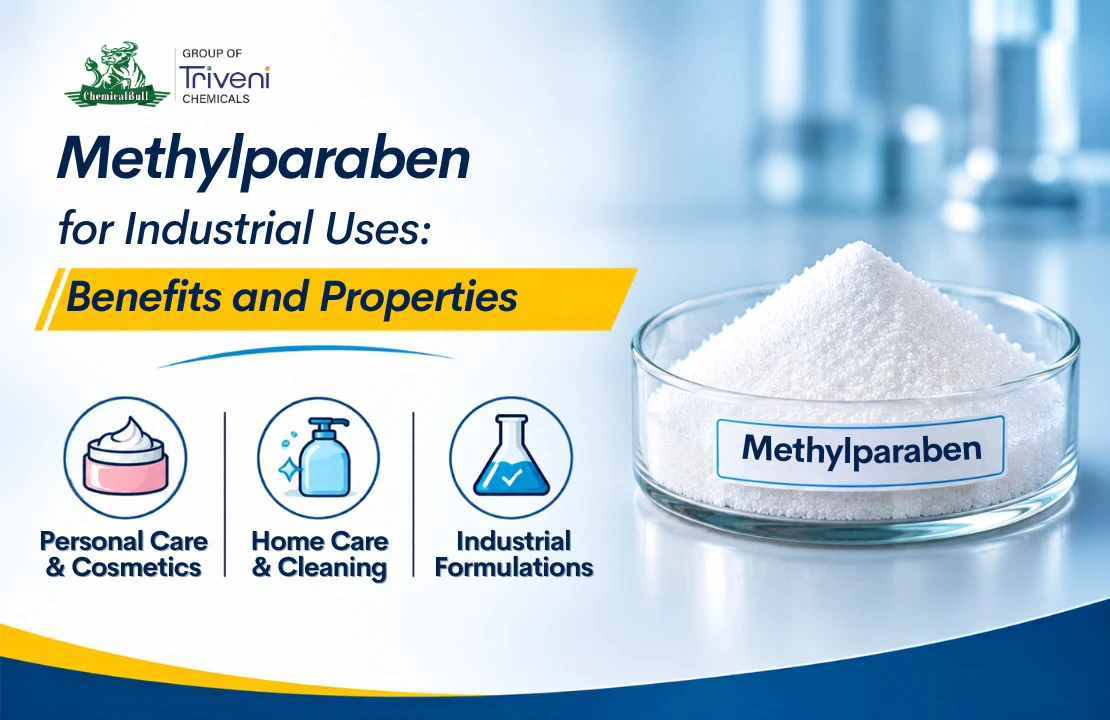
Methylparaben is an antimicrobial preservative used in suitable cosmetic, personal-care and pharmaceutical formulations. For formulation and procurement teams, selecting it involves checking compatibility, dissolution, grade requirements and the performance of the complete preservative system.
For specifications, availability and bulk pricing, contact Chemical Bull with your application, required grade, quantity and delivery location.
What Is Methylparaben?
Methylparaben is the methyl ester of para-hydroxybenzoic acid. It belongs to the paraben family of preservatives and is identified by CAS number 99-76-3.
It is typically supplied as small colourless crystals or a white crystalline powder. Its molecular formula is C₈H₈O₃, with a molecular weight of approximately 152.15 g/mol.
What Is Another Name for Methyl Paraben?
Common chemical names include:
- Methyl 4-hydroxybenzoate
- Methyl p-hydroxybenzoate
- Methyl hydroxybenzoate
These names describe the same chemical identity. Buyers should confirm the CAS number and grade when comparing quotations or technical documents.
What Is Methylparaben Used For?
Methylparaben is used to help inhibit microbial growth in compatible formulations. It supports product preservation rather than providing the main moisturising, cleansing or conditioning effect.
Manufacturer application guidance includes creams, lotions, shampoos, conditioners, liquid soaps, wet wipes and colour cosmetics.
|
Application |
Purpose of methylparaben |
Important formulation checks |
|
Skincare creams and lotions |
Supports microbial preservation |
Dissolution, pH, emulsion compatibility and preservation testing |
|
Shampoos and liquid cleansers |
Forms part of the preservative system |
Surfactant compatibility, appearance and microbial protection |
|
Hair conditioners and styling products |
Helps protect susceptible formulations |
Compatibility, distribution and finished-product testing |
|
Colour cosmetics |
Supports preservation where required |
Product format, ingredient interactions and packaging |
|
Pharmaceutical formulations |
Preservative in selected products |
Appropriate compendial grade and product-specific qualification |
Methylparaben in Skincare
Skincare manufacturers use preservatives to help protect susceptible products from microbial contamination. Water-containing creams and lotions require particular attention to the overall preservation strategy.
Methylparaben in skincare functions primarily as a preservative. It should not be presented as a moisturiser, skin-lightening ingredient or anti-ageing active.
For a manufacturer developing a lotion, the relevant question is whether the selected preservative system performs adequately in that particular formula. The answer depends on the ingredients, processing conditions, packaging and intended use.
Assess physical stability and microbial preservation separately. A cream that looks unchanged during storage may still require preservation testing to establish adequate protection.
Why Is Methylparaben Used in Creams?
When buyers search for “methylparaben cream,” they may be looking for its purpose in a finished formulation. In this context, methylparaben is generally part of the preservation system rather than the ingredient responsible for the cream’s principal benefit.
For formulators, incorporation and distribution are important. Confirm that the material dissolves adequately and remains compatible after cooling and storage.
Evaluate the complete emulsion, including its oil phase, water phase, emulsifiers and other additives. Approval should reflect the finished cream rather than the preservative’s performance in a simple solution.
Packaging should also form part of development. A jar and a pump pack can create different exposure conditions during use.
Methylparaben for Hair-Care Formulations
Searches for “methylparaben for hair” often concern shampoos, conditioners and styling products. Its role in these products is preservation.
It does not directly establish hair-growth, repair or conditioning benefits. Those functions depend on other ingredients and the finished formulation.
In a shampoo, evaluate methylparaben within the complete surfactant system. In a conditioner, assess compatibility with the conditioning base and other formulation components.
Check appearance, viscosity and separation alongside microbial preservation. A change in surfactants, fragrance, packaging or other ingredients may require renewed evaluation of the preservative system.
Other Commercial Applications
Liquid Soaps and Personal Cleansers
Methylparaben has documented applications in liquid soaps and shower products.
For these systems, confirm the working pH, incorporation method and compatibility with the full ingredient package. Preservation requirements should be established for the finished product and its intended packaging.
Colour Cosmetics
Selected colour cosmetics may require a preservative system, depending on their composition and susceptibility to contamination.
Product format matters. An emulsion foundation, for example, presents different formulation conditions from a predominantly dry powder.
Manufacturers should establish preservation requirements for the specific product rather than assuming that all cosmetics need the same ingredient or concentration.
Pharmaceutical Formulations
Methylparaben is also used as an antimicrobial preservative in selected pharmaceutical products.
Pharmaceutical buyers should specify the required compendial standard and quality requirements. Cosmetic and pharmaceutical grades should not be assumed interchangeable simply because they share the same chemical name.
Properties That Matter During Manufacturing
Solubility and Incorporation
Methylparaben has limited solubility in cold water, making its preparation and incorporation method important.
Follow the technical supplier’s guidance for the intended formulation. Confirm the required solvent system, processing conditions and behaviour after cooling.
A clear preparation at one stage does not establish that the preservative will remain adequately incorporated throughout storage.
Methylparaben vs Sodium Methylparaben
Methylparaben and sodium methylparaben are different supplied forms.
Clariant describes sodium methylparaben as having high cold-water solubility, allowing different incorporation options from the corresponding ester.
A substitution therefore requires review of composition, addition calculations, pH and finished-product performance. Do not replace one with the other solely on the basis of a similar name.
Formulation pH and Compatibility
The preservative system must suit the finished product’s pH and composition.
Supplier guidance can help identify an appropriate starting point, but product approval requires evaluation in the actual formulation. Ingredient interactions and distribution within the system can influence preservative performance.
Benefits for Formulation Manufacturers
Support for Microbial Protection
Methylparaben provides antimicrobial preservative activity in suitable systems. Manufacturer literature identifies activity against bacteria and fungi.
Its suitability should be demonstrated through an appropriate preservative efficacy or challenge test. It should not automatically be treated as sufficient on its own for every formulation.
Applications Across Multiple Product Types
Its documented application range makes methylparaben relevant to manufacturers producing several personal-care formats.
However, approval in one product does not establish suitability in another. Each formula and packaging combination needs appropriate assessment.
Defined Specifications for Repeat Purchasing
An agreed specification helps procurement and quality teams compare incoming batches consistently.
Relevant checks may include assay, appearance, identity and applicable impurity parameters. The required tests depend on the grade and intended application.
Selecting a Preservative System
Preservative selection begins with the complete product—not a universal dosage.
Consider formulation pH, water content, ingredient compatibility, manufacturing controls, packaging and intended use. Confirm the requirements applicable to the destination market.
Methylparaben may form part of a combined preservative system. The FDA notes that parabens are often used in mixtures to improve preservation effectiveness.
For questions about methylparaben for skin, keep the distinction clear: ingredient suitability and finished-product safety must be assessed for the intended use. Neither a supplier recommendation nor a raw-material COA replaces that assessment.
Methylparaben MSDS and Quality Documentation
Before approving Methylparaben, request the current MSDS or SDS, technical specification and representative batch COA.
For pharmaceutical requirements, identify the required compendial standard. For cosmetics, obtain the information needed for formulation and market-specific assessment.
Confirm that the product name, CAS number, grade and batch references are consistent across documents.
Follow the supplier’s handling and storage instructions, including requirements for keeping packaging properly closed.
Buying Methylparaben in Bulk
Manufacturers looking to buy methylparaben should compare technical suitability alongside commercial terms.
Bulk pricing depends on grade, specification, quantity, packaging, origin, availability and delivery requirements. Quotations are most useful when they cover equivalent material and documentation.
For repeat orders, confirm batch traceability, lead time and how changes in source or specification will be communicated.
Chemical Bull supports methylparaben sourcing enquiries for commercial formulation requirements. Request specifications and bulk pricing with your application, required grade, quantity, packaging preference, destination and delivery timeline.
Frequently Asked Questions
What is methylparaben used for?
It is used as an antimicrobial preservative in suitable cosmetic, personal-care and selected pharmaceutical formulations.
What is another name for methyl paraben?
Common names include methyl 4-hydroxybenzoate, methyl p-hydroxybenzoate and methyl hydroxybenzoate.
Why is methylparaben used in skincare?
It helps protect susceptible skincare formulations against microbial growth. Its primary role is preservation.
Is methylparaben used for hair growth?
Its role in hair-care formulations is preservation. It should not be described as a hair-growth ingredient.
Can methylparaben be used in creams?
Yes. It has documented cream and lotion applications, subject to formulation compatibility and preservation testing.
What should buyers provide when requesting a quotation?
Provide the grade or specification, application, quantity, packaging, delivery location, timeline and required documents.
Comment Section