Chemical Bull
2207
16-Jun-2026
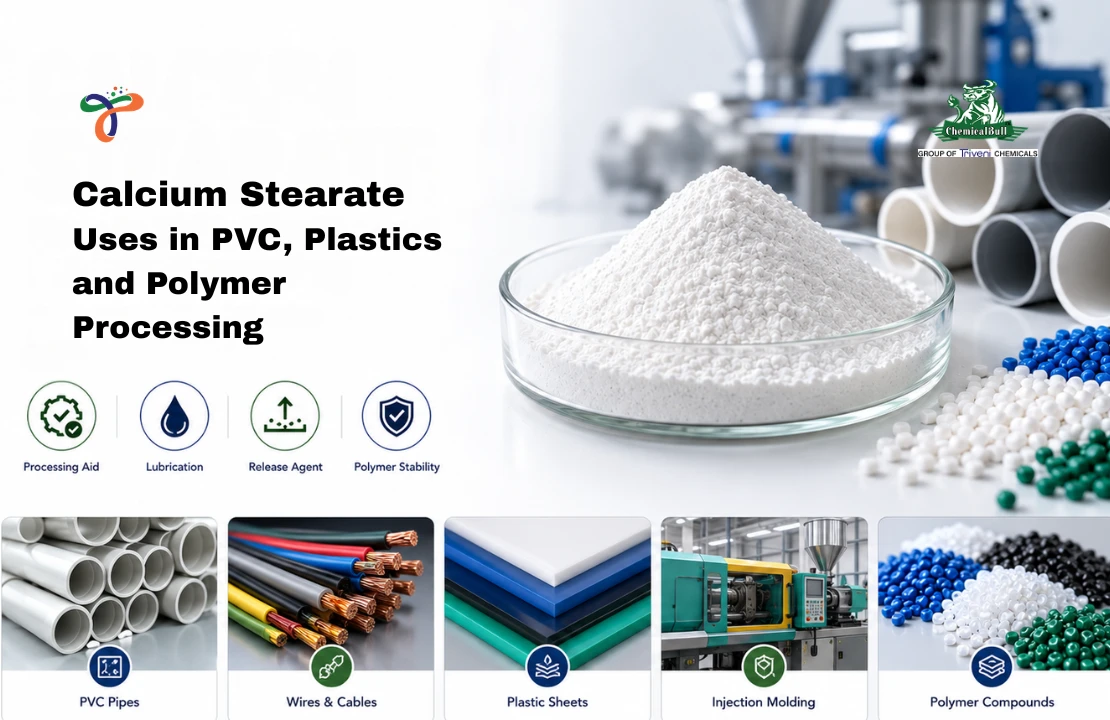
Calcium Stearate Uses in PVC, Plastics and Polymer Processing
Introduction: Why Calcium Stearate Matters in Polymer Processing
In PVC, plastics, and polymer processing, small additives often decide whether production runs smoothly or faces issues like poor melt flow, sticking, die build-up, uneven dispersion, surface defects, and processing instability. These problems can increase rejection rates, downtime, and overall production cost.
This is where Calcium Stearate becomes an important industrial additive. It is widely used as a lubricant, release agent, processing aid, acid scavenger, and dispersion support ingredient in PVC, plastic compounds, masterbatches, rubber, coatings, concrete, and other industrial systems.
For industries working with PVC pipes, profiles, sheets, films, cables, plastic additives, and polymer compounds, understanding Calcium Stearate uses helps improve processing efficiency, product finish, and formulation consistency.
For Calcium Stearate powder, emulsion, PVC additive grades, polymer processing grades, samples, COA, TDS, SDS, and bulk sourcing support, connect with ChemicalBull to compare suitable options from a reliable calcium stearate manufacturer and request a quote.
Quick Answer
Calcium Stearate is used in PVC, plastics, and polymer processing as a lubricant, mold release agent, processing aid, acid scavenger, and dispersion support additive. It helps improve melt flow, reduce sticking, support filler and pigment dispersion, improve surface finish, and enhance processing stability in rigid and flexible polymer systems.
What Is Calcium Stearate?
Calcium Stearate is the calcium salt of stearic acid. It belongs to the metallic stearate family and is commonly used in industrial formulations where lubrication, release, flow improvement, and hydrophobic behavior are required.
The common calcium stearate formula is C36H70CaO4. It is also known as calcium distearate or stearic acid calcium salt.
In appearance, it is usually a white to off-white fine powder with a waxy feel. It is practically insoluble in water, which makes it useful in applications where water repellency, lubrication, and low surface friction are important.
In polymer processing, Calcium Stearate is valued because it improves how materials move through equipment during extrusion, injection molding, calendering, compounding, and molding.
Calcium Stearate Properties at a Glance
|
Property |
Details |
|
Product Name |
Calcium Stearate |
|
Common Formula |
C36H70CaO4 |
|
CAS Number |
1592-23-0 |
|
Other Names |
Stearic Acid Calcium Salt |
|
Water Solubility |
Practically insoluble in water |
|
Main Industrial Role |
Lubricant, release agent, processing aid, dispersion support additive |
|
Key Applications |
PVC, plastics, polymers, rubber, concrete, coatings, pharma, cosmetics |
Calcium Stearate in PVC: Smoother Processing and Better Stability
PVC is sensitive to heat, friction, and processing conditions. During extrusion, calendering, or molding, the material needs the right balance of lubrication and stabilization support. Calcium stearate in PVC helps achieve that balance.
In PVC formulations, Calcium Stearate works as both an internal and external lubricant. It reduces friction between PVC particles and helps prevent sticking to screws, rolls, dies, and molds.
It also supports the stabilizer system by helping neutralize acidic by-products formed during PVC processing. This makes it useful in both rigid and flexible PVC formulations.
Why It Is Used in PVC
Calcium Stearate helps improve:
-
Melt flow
-
Processing stability
-
Surface finish
-
Mold and die release
-
Lubrication balance
-
Filler dispersion
-
Batch consistency
In many formulations, it is used with waxes, calcium-zinc stabilizers, zinc stearate, plasticizers, fillers, and other processing additives.
Calcium Stearate in Plastics: Better Flow, Release and Finish
In plastics, Calcium Stearate is used to improve processability and surface quality. It helps the polymer move more smoothly through processing equipment and reduces friction during compounding, extrusion, and molding.
As one of the commonly used calcium stearate plastic additives, it supports cleaner release from molds and better dispersion of fillers, pigments, and other additives.
This makes it useful in applications where production efficiency and final product appearance both matter.
Calcium Stearate in Polymers: A Reliable Processing Additive
Calcium stearate in polymers works mainly as a lubricant and processing support additive. It helps reduce internal friction and improves the movement of polymer chains during processing.
As a calcium stearate polymer additive, it can also help fillers and pigments distribute more uniformly throughout the polymer matrix. Better dispersion often leads to better color consistency, smoother surfaces, and improved processing behavior.
Calcium Stearate is commonly used in:
-
PVC compounds
-
Polyolefins
-
Masterbatches
-
Rubber compounds
-
Filled polymer systems
-
Recycled plastic compounds
-
Engineering plastic blends
In polymer applications, the final performance depends on grade selection, particle size, dosage, mixing method, and compatibility with other additives.
Calcium Stearate as a PVC Stabilizer Support Additive
Many formulators search for calcium stearate PVC stabilizer, but technically, Calcium Stearate is not usually used as a complete stabilizer by itself. It acts more as a stabilizer support additive and lubricant.
During PVC processing, heat can lead to acidic degradation. Calcium Stearate helps neutralize acidity and reduce processing stress. When used with suitable stabilizer packages, it supports better thermal behavior and smoother processing.
This makes it useful in calcium-zinc stabilizer systems and other PVC additive packages where lubrication and acid-neutralizing support are required.
Calcium Stearate Emulsion in Industrial Formulations
While powder form is common in PVC and plastics, calcium stearate emulsion is preferred in some water-based or surface-treatment systems. The emulsion form can improve handling, dosing, and uniform application.
Calcium Stearate emulsion is used in industries such as paper, coatings, textiles, rubber, construction, and mold release systems.
Calcium Stearate Solubility and Why It Matters
Calcium stearate solubility is an important property in formulation design. Calcium Stearate is practically insoluble in water, which supports its use as a hydrophobic additive, lubricant, and release agent.
In PVC, plastics, and polymer melts, it does not need to dissolve in water. Instead, it disperses into the system during mixing and processing. Proper dispersion is important for consistent lubrication, smooth surface finish, and reliable performance.
For best results, the correct grade and particle size should be selected according to the final application.
Formulation Guidance for PVC, Plastics and Polymer Systems
Calcium Stearate should be selected based on the formulation type and processing method. The same grade may not perform equally in PVC, plastics, concrete, coatings, and emulsion systems.
In PVC and polymer processing, dosage and mixing order are important. Too little may not provide enough lubrication, while too much can affect mechanical properties, fusion behavior, or final surface quality.
Calcium Stearate Price and Market Factors
Calcium Stearate price depends on grade, purity, particle size, application type, packaging, raw material cost, order quantity, and location. Industrial grades used in PVC and plastics may differ from cosmetic, pharma, food, or emulsion grades.
The calcium stearate market is supported by strong demand from PVC pipes, plastic masterbatches, cable compounds, construction chemicals, rubber processing, coatings, and polymer additives.
When comparing Calcium Stearate suppliers, it is better to compare technical suitability along with price. A lower-cost grade may not be the right option if it causes poor dispersion, inconsistent processing, or quality variation.
How to Choose the Right Calcium Stearate Grade
The right Calcium Stearate grade depends on the application. PVC processing needs consistent lubrication and stabilizer support. Plastic compounding needs dispersion, flow, and release performance. Concrete and construction systems need hydrophobic behavior and moisture resistance.
For polymer processing, choose a grade that gives good dispersion, stable melt behavior, and smooth surface finish. For emulsion-based systems, choose a calcium stearate emulsion that fits the process and application method.
Frequently Asked Questions
-
What is calcium stearate?
Calcium Stearate is the calcium salt of stearic acid and belongs to the metallic stearate family. It is used as a lubricant, release agent, processing aid, acid scavenger, hydrophobic additive, and dispersion support ingredient in PVC, plastics, polymers, concrete, coatings, rubber, cosmetics, and pharma formulations. -
What is calcium stearate used for?
Calcium Stearate is used for PVC processing, plastic compounding, polymer lubrication, mold release, filler dispersion, concrete water resistance, coatings, rubber processing, cosmetic formulations, and tablet lubrication. In PVC and plastics, it mainly improves flow, reduces sticking, supports release, and improves processing consistency. -
What is another name for calcium stearate?
Another name for Calcium Stearate is calcium distearate. It is also known as stearic acid calcium salt, calcium octadecanoate, or calcium soap in industrial and chemical references. -
Why is calcium stearate used in PVC?
Calcium Stearate is used in PVC because it improves lubrication, melt flow, processing stability, mold release, and surface finish. It also supports stabilizer systems by helping neutralize acidic by-products during PVC processing. -
Is calcium stearate used as a polymer additive?
Yes. Calcium Stearate is widely used as a polymer additive in PVC, plastics, masterbatches, rubber compounds, filled polymer systems, and recycled plastic compounds. It supports lubrication, release, dispersion, and processing consistency.
Conclusion
Calcium Stearate plays an important role in PVC, plastics, and polymer processing because it improves lubrication, flow, release, dispersion, surface finish, and processing stability. It is also useful in concrete, coatings, rubber, cosmetics, and other industrial applications where hydrophobicity and processing support are needed.
For Calcium Stearate powder, calcium stearate emulsion, PVC additive grades, plastic additive grades, polymer additive grades, samples, COA, TDS, SDS, and bulk sourcing support, connect with ChemicalBull to compare suitable grades and request a quote.

Comment Section