Chemical Bull
534
17-Jun-2026
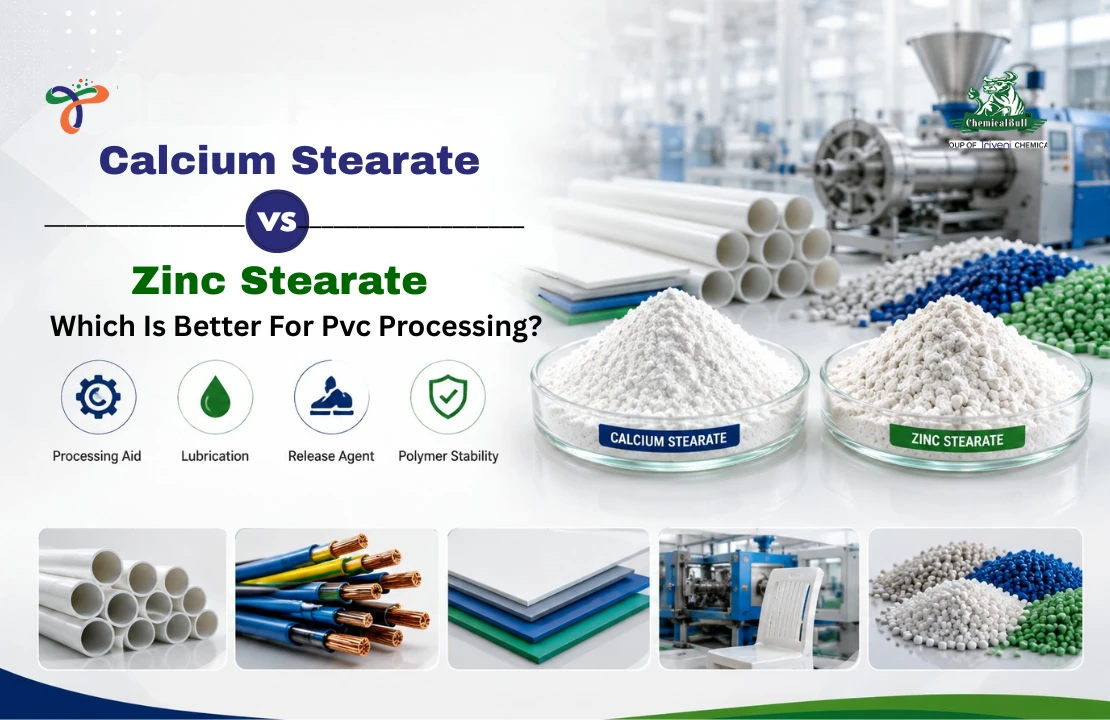
Calcium Stearate vs Zinc Stearate: Which is Better for PVC Processing?
Introduction: The PVC Additive Choice That Changes Processing Results
In PVC processing, the wrong stearate can cause poor fusion, sticking, die marks, weak surface finish, and unstable output. Calcium Stearate and Zinc Stearate solve different processing problems.
Both are metallic stearates. Both are used in PVC and plastics. But they do not solve the same problem in the same way. Calcium Stearate is usually selected for smoother processing, acid-neutralizing support, and lubrication balance. Zinc Stearate is often selected for stronger release, anti-sticking performance, and improved surface finish.
For Calcium Stearate, Zinc Stearate, PVC additive grades, samples, COA, TDS, SDS, and bulk sourcing support, ChemicalBull helps you compare suitable grades and request a quote.
Quick Answer
Calcium Stearate is better for PVC processing when the goal is stable extrusion, lubrication balance, and support in calcium-zinc stabilizer systems. Zinc Stearate is better when the goal is strong mold release, reduced sticking, and smoother surface finish. In many PVC formulations, both are used together for balanced processing performance.
What Are Calcium Stearate and Zinc Stearate?
Calcium Stearate and Zinc Stearate are metallic salts of stearic acid. They are used as lubricants, release agents, stabilizer support additives, and processing aids in PVC, plastics, rubber, coatings, and polymer compounds.
In PVC processing, these additives help control friction between the resin, fillers, processing equipment, and molten compound. They also influence fusion, flow, surface finish, and release from metal surfaces.
The main difference is their processing behavior. Calcium Stearate gives a more balanced lubrication effect and supports thermal stability systems. Zinc Stearate gives stronger external lubrication and release performance.
Calcium Stearate vs Zinc Stearate: Quick Comparison Table
|
Point |
Calcium Stearate |
Zinc Stearate |
|
Chemical Type |
Calcium salt of stearic acid |
Zinc salt of stearic acid |
|
Appearance |
White to off-white powder |
White fine powder |
|
Main PVC Role |
Lubrication balance and stabilizer support |
Release, anti-sticking, and surface finish |
|
Lubrication Behavior |
Balanced internal and external effect |
Stronger external lubrication |
|
Fusion Impact |
Helps controlled processing |
Can delay fusion if overdosed |
|
Release Performance |
Good |
Excellent |
|
Surface Finish |
Good |
Very good |
|
Stability Support |
Useful in Ca-Zn systems |
Useful in combined stabilizer systems |
|
Best Application Area |
PVC pipes, profiles, sheets, cables |
Molded parts, flexible PVC, surface-sensitive products |
|
Common Use Style |
Often used with waxes and stabilizers |
Often used for release and anti-blocking support |
How Calcium Stearate Works in PVC Processing
Calcium Stearate helps PVC compounds move smoothly through processing equipment. It reduces friction during mixing, extrusion, calendering, and molding.
It is especially useful in PVC systems where processing stability is important. In rigid PVC pipes and profiles, Calcium Stearate helps maintain smoother flow and better output consistency.
Calcium Stearate also supports calcium-zinc stabilizer systems. During PVC processing, heat can create acidic by-products. Calcium Stearate helps reduce the impact of acidity and supports smoother processing when used with the right stabilizer package.
Best Use Cases for Calcium Stearate
-
PVC pipe extrusion
-
PVC profile extrusion
-
PVC sheets and films
-
Cable compounds
-
Rigid PVC compounds
-
Flexible PVC compounds
-
Calcium-zinc stabilizer systems
-
Filled PVC compounds
Main Benefits in PVC
-
Improves processing flow
-
Supports lubrication balance
-
Helps reduce friction
-
Supports PVC stabilizer systems
-
Improves filler dispersion
-
Helps maintain extrusion consistency
-
Reduces processing stress
-
Supports smoother surface finish
How Zinc Stearate Works in PVC Processing
Zinc Stearate is well known for its release and anti-sticking performance. It reduces adhesion between PVC compounds and metal surfaces such as molds, rolls, dies, and processing equipment.
This makes it useful when the main issue is sticking, surface drag, rough finish, or poor release. Zinc Stearate can help PVC parts come out cleaner and smoother.
In molded PVC parts, sheets, footwear, flexible PVC, and surface-sensitive applications, Zinc Stearate is often used because it supports a cleaner surface appearance and easier release.
Best Use Cases for Zinc Stearate
-
Molded PVC parts
-
Flexible PVC products
-
PVC footwear
-
PVC sheets
-
PVC flooring
-
Cable compounds
-
Rubber-plastic blends
-
Coatings and surface applications
Main Benefits in PVC
-
Improves mold release
-
Reduces sticking
-
Supports smoother surface finish
-
Helps reduce surface drag
-
Improves processing cleanliness
-
Supports pigment and filler dispersion
-
Works as a strong external lubricant
-
Helps reduce blocking in selected systems
The Main Difference: Stability Support vs Release Performance
The easiest way to understand the difference is this:
Calcium Stearate supports processing balance. Zinc Stearate supports release and surface finish.
Calcium Stearate is usually preferred when the PVC compound needs stable flow, controlled lubrication, and support in stabilizer systems.
Zinc Stearate is usually preferred when the formulation needs stronger anti-sticking action, cleaner release, or better surface smoothness.
Neither one is always “better” for every PVC formulation. The better choice depends on what problem the formulation needs to solve.
Which Is Better for PVC Extrusion?
For PVC extrusion, Calcium Stearate is often the better starting choice because extrusion needs stable flow, controlled lubrication, and consistent processing.
In pipe and profile extrusion, too much external lubrication can affect fusion and output consistency. Calcium Stearate helps support smoother movement without making the compound overly slippery when used at the right dosage.
Zinc Stearate can still be useful in extrusion, especially when surface finish or die release needs improvement. However, it must be balanced carefully because excessive external lubrication may affect fusion behavior.
For PVC extrusion:
-
Choose Calcium Stearate for stable flow and processing balance.
-
Use Zinc Stearate when more release or surface finish improvement is needed.
-
Use both carefully when the formulation needs balanced lubrication and cleaner output.
Which Is Better for PVC Molding?
For PVC molding, Zinc Stearate is often preferred because release performance is more important. Molded products need clean separation from the mold surface and a smooth final finish.
Zinc Stearate reduces sticking and helps improve release during molding. It is especially useful in flexible PVC, footwear, molded articles, and surface-sensitive products.
Calcium Stearate may still be used when the formulation also needs better stability support or balanced lubrication.
For PVC molding:
-
Choose Zinc Stearate for mold release and anti-sticking.
-
Choose Calcium Stearate when processing stability is also important.
-
Use both when release and stability are both required.
Which Is Better for Rigid PVC?
Rigid PVC products such as pipes, profiles, sheets, and panels need stable processing and controlled fusion. In these applications, Calcium Stearate is commonly preferred because it supports lubrication balance and stabilizer performance.
Zinc Stearate may be added in smaller amounts when the final product needs improved surface finish or reduced equipment sticking.
Better choice for rigid PVC:
Calcium Stearate is usually the stronger option for processing stability, while Zinc Stearate can be used as a supporting additive for release and finish.
Which Is Better for Flexible PVC?
Flexible PVC products often need easier processing, better release, smooth surfaces, and compatibility with plasticizers. In these applications, Zinc Stearate can be more useful when anti-sticking and surface finish are the priority.
Calcium Stearate can still be valuable when the formulation needs processing stability and support with stabilizer systems.
Better choice for flexible PVC:
Zinc Stearate is often better for release and surface feel, while Calcium Stearate supports lubrication balance and processing control.
Can Calcium Stearate and Zinc Stearate Be Used Together?
Yes, Calcium Stearate and Zinc Stearate are often used together in PVC processing. Their combination gives better control than using either one alone.
Calcium Stearate helps with processing stability, lubrication balance, and acid-neutralizing support. Zinc Stearate improves release, anti-sticking behavior, and surface finish.
This combination is especially useful in calcium-zinc stabilizer systems, PVC compounds, masterbatches, sheets, cables, pipes, and profiles.
How to Choose the Right Additive for PVC Processing
Choose Calcium Stearate when your PVC formulation needs stable processing, controlled lubrication, and support in stabilizer systems. It is a strong choice for extrusion-based applications such as pipes, profiles, sheets, and cables.
Choose Zinc Stearate when your PVC formulation needs better release, less sticking, smoother surface finish, and cleaner molded parts. It is useful in molding, flexible PVC, flooring, footwear, and surface-sensitive applications.
Choose a combination of Calcium Stearate and Zinc Stearate when the formulation needs both processing stability and release performance.
Before scale-up, test the additive package in the actual PVC formulation. Dosage, resin type, filler loading, stabilizer system, wax balance, temperature, and processing method can all affect the final result.
|
If Your PVC Problem Is |
Better Choice |
|
Poor extrusion stability |
Calcium Stearate |
|
Sticking to mold or die |
Zinc Stearate |
|
Rigid PVC pipe processing |
Calcium Stearate |
|
Mold release issue |
Zinc Stearate |
|
Need balanced lubrication |
Calcium + Zinc Stearate |
|
Surface finish improvement |
Zinc Stearate |
|
Ca-Zn stabilizer system |
Calcium Stearate + Zinc Stearate |
Frequently Asked Questions
-
Which is better for PVC processing: Calcium Stearate or Zinc Stearate?
Calcium Stearate is better for stable extrusion, lubrication balance, and support in calcium-zinc stabilizer systems. Zinc Stearate is better for mold release, anti-sticking performance, and smoother surface finish. Many PVC formulations use both together for balanced processing performance. -
What is Zinc Stearate used for in PVC?
Zinc Stearate is used in PVC as an external lubricant, mold release agent, anti-sticking additive, and surface finish improver. It helps reduce adhesion to metal surfaces and supports cleaner processing in molding, calendering, extrusion, and compounding. -
What is Calcium Stearate used for in PVC?
Calcium Stearate (CAS 1592-23-0) is used in PVC as a lubricant, processing aid, acid-neutralizing support additive, and stabilizer system component. It helps improve flow, reduce friction, support extrusion stability, and improve processing consistency in rigid and flexible PVC compounds. -
Can Calcium Stearate and Zinc Stearate be used together?
Yes. Calcium Stearate and Zinc Stearate can be used together in PVC formulations. Calcium Stearate supports processing balance and stabilizer performance, while Zinc Stearate improves release and surface smoothness. -
Which stearate is better for PVC pipes?
Calcium Stearate is usually better for PVC pipes because pipe extrusion needs stable flow, controlled fusion, and consistent processing. Zinc Stearate may be used in smaller amounts when better release or surface finish is required. -
Can too much Zinc Stearate affect PVC processing?
Yes. Too much Zinc Stearate can delay fusion, affect processing balance, or create surface issues in some PVC systems. It should be used at the correct dosage and tested with the full formulation before scale-up.
Conclusion
Calcium Stearate and Zinc Stearate are both useful in PVC processing, but they perform different jobs. Calcium Stearate is better for extrusion stability, lubrication balance, and stabilizer support. Zinc Stearate is better for release, anti-sticking, and surface finish.
For many PVC formulations, the strongest result comes from using both in the right balance.
For Calcium Stearate, Zinc Stearate, PVC additive grades, samples, COA, TDS, SDS, and bulk supply support, connect with ChemicalBull to compare suitable grades for extrusion, molding, pipes, profiles, cables, and flexible PVC formulations.

Comment Section