Chemical Bull
911
02-Jul-2026
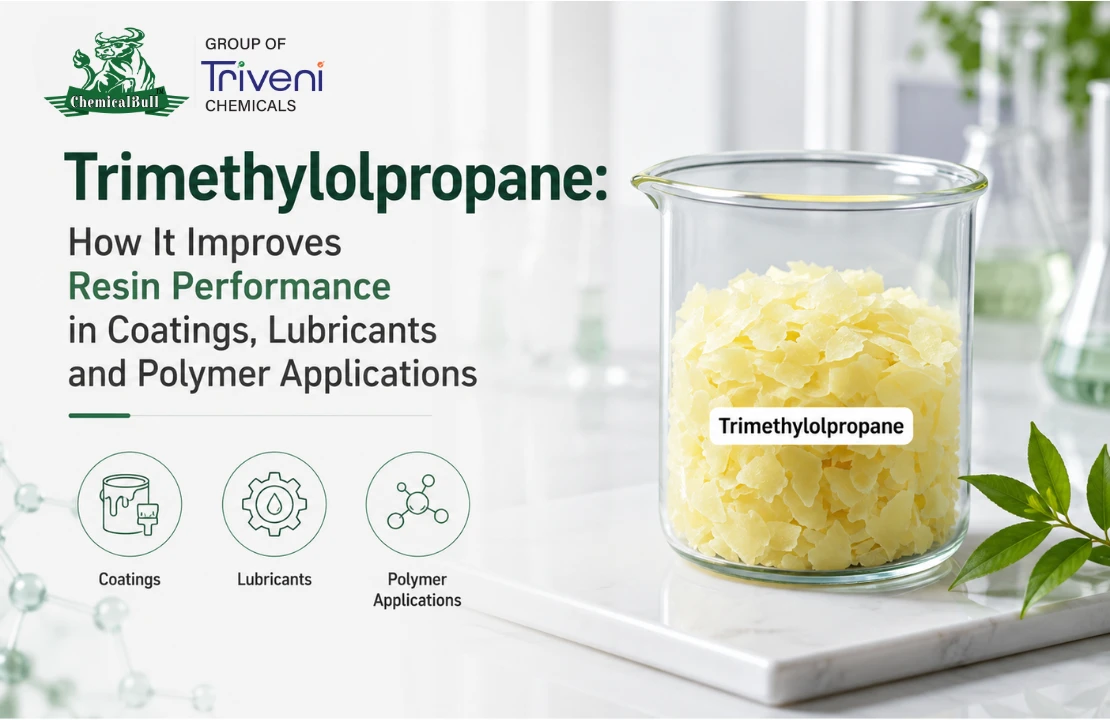
Trimethylolpropane: How It Improves Resin Performance in Coatings, Lubricants and Polymer Applications
In industrial chemistry, the performance ceiling of a resin, coating, or lubricant is often determined not by the base polymer, but by the polyol building block used in its synthesis. Trimethylolpropane (TMP), a high-purity trifunctional polyhydric alcohol with CAS number 77-99-6, is one of the most important of these building blocks. Its unique three-hydroxyl molecular architecture gives resin chemists a precise tool for engineering cross-link density, thermal stability, chemical resistance, and mechanical durability into finished industrial materials that standard diols and monofunctional alcohols simply cannot achieve.
This guide explains how TMP functions chemically, why its trifunctionality drives performance improvements across resin systems, and what specific performance gains it delivers in coatings, synthetic lubricants, UV-curable systems, and polymer applications. For industrial-grade Trimethylolpropane supply with reliable quality documentation, ChemicalBull is a trusted trimethylolpropane chemical distributor serving manufacturers across India and global export markets with high-purity TMP flakes and competitive bulk pricing.
What Is Trimethylolpropane (TMP)?
Trimethylolpropane is a branched, trifunctional aliphatic triol, meaning each molecule carries three primary hydroxyl (-OH) groups available for chemical reaction. This trifunctionality is the core of everything TMP does in resin synthesis.
|
Property |
Details |
|
Chemical Name |
2-Ethyl-2-(hydroxymethyl)-1,3-propanediol |
|
Synonyms |
TMP, 2-Ethyl-2-Hydroxymethyl-1,3-Propanediol |
|
CAS Number |
77-99-6 |
|
Molecular Formula |
C₆H₁₄O₃ |
|
Molecular Weight |
134.17 g/mol |
|
Physical Form |
White crystalline solid / flakes |
|
Boiling Point |
260°C |
|
Flash Point |
160°C |
|
Solubility |
Soluble in water and polar organic solvents |
|
Functionality |
Trifunctional (3 primary -OH groups) |
The three primary hydroxyl groups in TMP are highly reactive toward isocyanates (in polyurethane synthesis), acids and anhydrides (in alkyd and polyester resin synthesis), and acrylate groups (in UV-curable systems). This reactivity across multiple chemistries is what makes TMP a truly cross-industry raw material.
The Core Chemistry: Why Trifunctionality Matters in Resin Performance
To understand how TMP improves resin performance, it is essential to understand what cross-linking does in a polymer network and why three reactive sites per molecule are so significantly better than two.
Cross-Link Density and Its Effect on Resin Properties
In any thermosetting resin system, the cross-link density, the number of chemical bonds connecting different polymer chains per unit volume, directly determines:
- Hardness and scratch resistance of the cured film or component
- Chemical and solvent resistance: denser networks are harder for solvents to penetrate
- Thermal stability: more cross-links mean more energy is required to disrupt the polymer network
- Mechanical strength and elasticity balance: cross-link density controls the trade-off between rigidity and flexibility
A difunctional polyol (two hydroxyl groups) creates a linear or lightly branched polymer chain. A trifunctional polyol like TMP introduces a branch point at every monomer unit that is incorporated, creating a three-dimensional cross-linked network rather than a linear chain. The result is dramatically higher cross-link density, which translates directly into superior performance across every property listed above.
The Branching Advantage
TMP's ethyl side chain (the "prop" in trimethylolpropane) adds a degree of hydrophobic character and steric bulk to the resin backbone without reducing reactivity. This subtle structural feature:
- Reduces water sensitivity of the cured resin relevant for exterior coatings and marine applications
- Improves compatibility with hydrophobic oil and solvent phases in resin formulations
- Contributes to better gloss retention in alkyd coatings exposed to UV and weathering
TMP in Industrial Coatings
- Alkyd Resin Coatings: Alkyd resins are the backbone of oil-based paints, industrial maintenance coatings, and wood finishes and are synthesized by reacting polyols with fatty acids and dicarboxylic acids or anhydrides. When TMP replaces glycerol (the traditional trifunctional polyol in alkyd synthesis), formulators gain measurable improvements.
- Hardness and drying speed: TMP-based alkyd resins develop hardness faster during the oxidative drying process, resulting in faster return-to-service times for applied coatings.
- Gloss and gloss retention: The branched structure of TMP contributes to a more uniform polymer network that supports better initial gloss and significantly improved gloss retention after UV exposure, a critical requirement in architectural and automotive refinish coatings.
- Weather and chemical resistance: The denser cross-linked network of TMP-based alkyds resists degradation from moisture, acids, and UV radiation better than glycerol-based equivalents, extending the service life of exterior coatings.
Polyurethane Coatings
In polyurethane coating systems, TMP reacts with isocyanate hardeners to form highly cross-linked, durable urethane networks. TMP-based polyurethane coatings are used where maximum performance is required:
- 2K polyurethane coatings for automotive OEM and refinish: TMP provides the polyol component that reacts with aliphatic or aromatic isocyanates to produce high-gloss, chemical-resistant topcoats
- Industrial floor coatings: TMP contributes to the abrasion and chemical resistance that floor systems must maintain under heavy traffic
- Aerospace and marine coatings: where long-term durability against UV, salt spray, and fuel/chemical exposure is non-negotiable
The stoichiometry between TMP's three hydroxyl groups and the isocyanate hardener is critical; the 1:3 ratio of TMP to isocyanate sites allows formulators to precisely engineer the cross-link density and thereby tune the hardness, flexibility, and pot life of the final coating system.
UV-Curable Coatings and Acrylates
In radiation-curable systems, TMP is reacted with acrylic acid or acrylate esters to produce Trimethylolpropane Triacrylate (TMPTA), one of the most widely used trifunctional monomers in UV and electron-beam curing. TMPTA contributes:
- Rapid cure speed: three acrylate groups per molecule participate simultaneously in free-radical polymerization, creating a dense cross-linked network in fractions of a second
- High hardness and scratch resistance: in cured films, essential for UV-cured wood coatings, overprint varnishes, and optical fiber coatings
- Shrinkage control: when blended with other mono- and difunctional acrylates to optimize final film properties
TMP's role here is as a structural scaffold; the ethyl-branched core positions three polymerizable acrylate groups in optimal geometry for fast, dense network formation.
TMP in Synthetic Lubricants
One of TMP's most commercially significant applications outside the coatings industry is in the synthesis of polyol ester synthetic lubricants. TMP is reacted with fatty acids, typically C5 to C10 linear acids, through esterification of all three hydroxyl groups to produce TMP triesters (or mixed esters).
These TMP-based polyol esters outperform mineral oils and other synthetic base oils in demanding lubrication environments because of:
Superior viscosity-temperature relationship:
TMP ester lubricants maintain a stable viscosity across a wide temperature range, critical in applications where the lubricant must perform from cold start conditions to operating temperature extremes.
Excellent thermal and oxidative stability:
The fully esterified TMP structure has no free hydroxyl groups to participate in oxidative degradation, giving TMP esters significantly better thermal stability than mineral oils at the same viscosity grade.
Biodegradability:
TMP esters derived from natural fatty acids are more readily biodegradable than mineral oil-based lubricants, a growing requirement in environmentally sensitive applications such as forestry, marine, and food-processing equipment.
Applications of TMP-based lubricants:
- Aviation turbine oils
- Automotive engine oils and gear oils
- Compressor lubricants for high-temperature operation
- Environmentally acceptable lubricants (EALs) for marine applications
TMP in Polymer Systems
Polyurethane Foams and Elastomers
In polyurethane foam and elastomer production, TMP serves as a chain extender and cross-linker added at low levels to introduce branching into the polymer backbone. Even small additions of TMP (1%–5% of the polyol blend) significantly improve:
- Compression set resistance in flexible foams
- Dimensional stability and heat resistance in rigid foams
- Tear strength and abrasion resistance in cast and thermoplastic polyurethane elastomers
PVC Stabilizers
TMP participates in the synthesis of organic PVC stabilizers, particularly in liquid mixed-metal stabilizer systems. Its hydroxyl groups react with metal carboxylates to form stabilizer complexes that prevent PVC dehydrochlorination during processing, extending the thermal processing window and improving the colour stability and service life of finished PVC articles.
Powder Coatings and Polyester Resins
In thermosetting powder coating systems based on polyester-epoxy or polyester-TGIC chemistry, TMP is incorporated as a branching polyol in the polyester resin backbone. The resulting branched polyester resins cure into dense, durable powder coating films with superior:
- Edge coverage and film build uniformity
- Chemical and corrosion resistance
- Overbake resistance important for powder coatings applied to complex metal substrates processed through high-temperature ovens.
Frequently Asked Questions
1. What is Trimethylolpropane (TMP) used for in coatings?
TMP is used as a trifunctional polyol cross-linking agent in alkyd, polyurethane, and UV-curable coating systems, improving hardness, chemical resistance, gloss retention, and weatherability.
2. Why does TMP improve resin performance compared to diols?
Three hydroxyl groups create a three-dimensional cross-linked network rather than a linear chain, delivering higher cross-link density, hardness, chemical resistance, and thermal stability.
3. What is TMPTA and how is it related to TMP?
Trimethylolpropane Triacrylate (TMPTA) is produced by reacting TMP with acrylic acid. It is a key trifunctional monomer in UV-curable coatings, inks, and adhesives.
4. How does TMP improve synthetic lubricant performance?
TMP reacts with fatty acids to form polyol ester lubricants with superior viscosity-temperature stability, oxidative resistance, and biodegradability versus mineral oils.
5. What industries use TMP most widely?
Coatings (alkyd, polyurethane, UV-curable), synthetic lubricants, polyurethane foams and elastomers, PVC stabilizers, and powder coatings are the primary industrial end-use sectors.
6. What purity grade of TMP is required for resin synthesis?
High-purity TMP (typically ≥99%) with low colour (APHA ≤10) and low moisture content is required for resin applications where impurities affect network uniformity, colour, or reaction speed.
7. Is TMP hazardous to handle?
TMP has a high flash point (160°C) and is not classified as highly toxic. Standard industrial PPE gloves, eye protection, and dust control are sufficient for safe handling. Always refer to the MSDS for detailed guidance.
Conclusion
Trimethylolpropane's performance-improving role in resin systems across coatings, lubricants, and polymers comes down to a single structural advantage: three primary hydroxyl groups per molecule that create dense, three-dimensional cross-linked networks where bifunctional alternatives produce only linear chains. This trifunctionality translates directly into harder, more chemically resistant, more thermally stable coatings; longer-lasting, more thermally stable synthetic lubricants; and structurally superior polyurethane foams, elastomers, and powder coating resins that withstand demanding industrial environments.
For high-purity Trimethylolpropane flakes with Certificate of Analysis, MSDS, and competitive bulk pricing for industrial resin synthesis, connect with Chemical Bull, a trusted trimethylolpropane chemical distributor supporting coatings manufacturers, lubricant formulators, and polymer producers across India and international markets.

Comment Section