Chemical Bull
636
04-Jul-2026
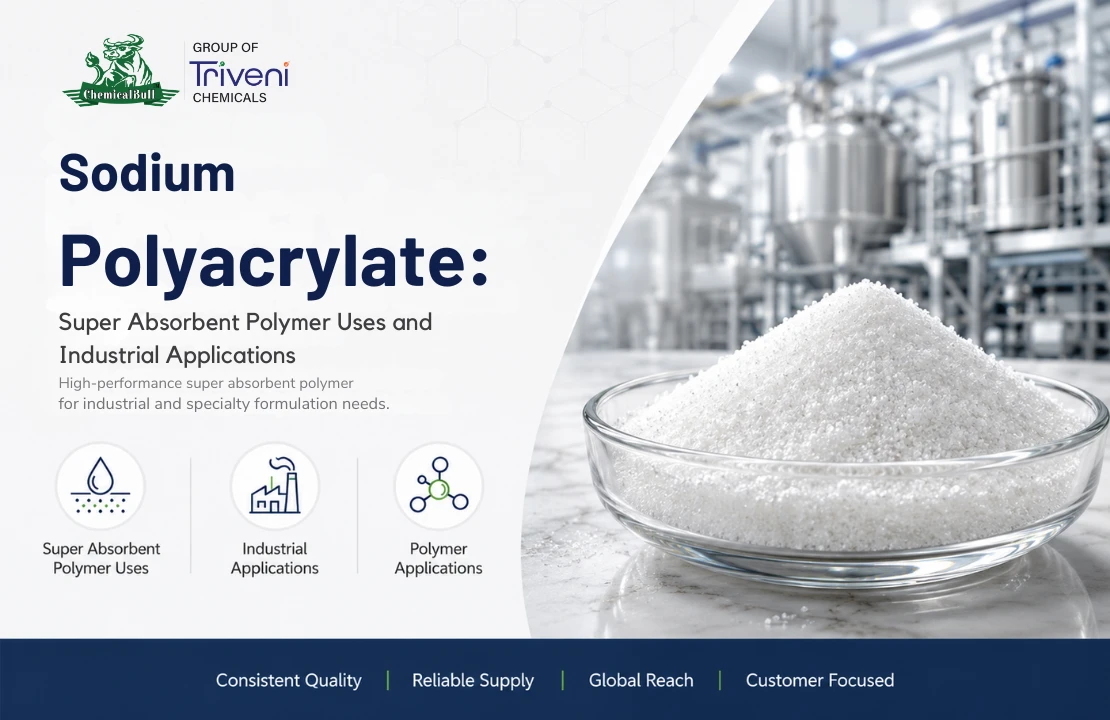
Sodium Polyacrylate: Super Absorbent Polymer Uses and Industrial Applications
Sodium Polyacrylate is one of the most remarkable functional polymers in modern industrial chemistry. As a crosslinked superabsorbent polymer (SAP), it is capable of absorbing and retaining up to 300 to 800 times its own weight in deionized water, converting from a dry powder into a firm, stable hydrogel in seconds. This extraordinary water-locking capacity, combined with its non-toxic profile, chemical stability, and availability in multiple particle grades, makes Sodium Polyacrylate a critical raw material across a wide range of industries.
The thing that makes Sodium Polyacrylate so important is not the amount of water it takes in and how well it holds that water under pressure, over time, as well as under various environments. This combination of performance opens possibilities that go beyond the realm of consumer hygiene products and can be used in the fields of construction, agriculture, telecommunications, oilfield operations, and the management of industrial waste.
For industrial-grade Sodium Polyacrylate with consistent absorption performance and full documentation, connect with trusted sodium polyacrylate manufacturers at ChemicalBull for bulk supply, COA, MSDS, and technical-grade support across India and global markets.
For a technical comparison of Sodium Polyacrylate versus Polyacrylamide in terms of mechanism, charge type, and industrial selection, refer to our dedicated guide on Sodium Polyacrylate vs Polyacrylamide: Understanding the Difference. This blog focuses on Sodium Polyacrylate applications and industrial uses.
Chemical Identity and Superabsorbent Mechanism:
|
Property |
Details |
|
Chemical Name |
Sodium Polyacrylate |
|
Molecular Formula |
(C3H3NaO2)n |
|
CAS Number |
9003-04-7 |
|
Polymer Type |
Crosslinked superabsorbent polymer (SAP) |
|
Physical Form |
White granules or powder |
|
Absorption Capacity |
300 to 800 times own weight (deionized water) |
|
Ionic Character |
Anionic |
|
pH of Aqueous Gel |
Approximately 6 to 8 |
|
Regulatory Status |
Non-toxic; approved for hygiene and agricultural use |
Sodium Polyacrylate absorbs water through osmotic pressure. The dissociated sodium ions within the crosslinked polymer chain create a concentration gradient that draws water molecules into the polymer network. Once inside, the water is physically trapped by the crosslinked structure and cannot be released by gravity, though it can be displaced under significant compressive pressure. This mechanism is what distinguishes a true superabsorbent polymer from a conventional sponge or absorbent material.
Application 1: Hygiene and Personal Care Products
The hygiene industry is the single largest consumer of Sodium Polyacrylate globally. It is the primary functional component of the absorbent core in baby diapers, adult incontinence products, feminine hygiene products, and medical wound dressings.
In diaper construction, SAP granules are embedded between nonwoven fabric layers. When urine contacts the SAP, it instantly gels, locking the liquid away from the skin surface. This gel maintains its integrity under the mechanical pressure of movement and body weight, keeping skin dry and reducing the risk of rash and irritation. In medical wound dressings, SAP absorbs wound exudate and maintains a moist wound environment that promotes healing while preventing maceration of surrounding tissue.
The performance specifications for hygiene-grade SAP focus on centrifuge retention capacity (CRC), absorption under load (AUL), and gel blocking resistance, all verified in batch testing by quality suppliers.
Application 2: Agriculture and Horticulture
In agricultural applications, Sodium Polyacrylate functions as a soil water retention agent. When incorporated into soil or growing media, SAP particles absorb rainfall or irrigation water and release it slowly to plant roots as the surrounding soil dries. This behaviour addresses one of the most significant challenges in dryland and semi-arid agriculture: water loss through evaporation and drainage before plant roots can access it.
Practical benefits:
- Reduced irrigation frequency: SAP-treated soil can reduce irrigation requirements by 30 to 50 percent in field crops, making it valuable in water-scarce regions.
- Improved seedling establishment: SAP applied near the root zone supports seedling survival during critical early growth stages when roots are shallow.
- Erosion and runoff control: SAP particles in topsoil reduce surface runoff by retaining a portion of rainfall within the soil structure.
- Container and greenhouse growing: In nurseries and potted plant production, SAP extends the interval between watering and reduces plant stress from inconsistent irrigation.
Agricultural-grade SAP is typically applied at 1 to 5 grams per kilogram of soil, adjusted based on soil type, crop, and local rainfall patterns.
Application 3: Construction and Civil Engineering Waterproofing
Sodium Polyacrylate is used in construction where swelling, water-blocking, and waterproofing are required. Its ability to expand significantly on water contact makes it effective in several critical applications.
Waterstop and sealant applications:
SAP-impregnated strips installed at construction joints in concrete tunnels, basements, and water-retaining structures swell on groundwater contact, filling the joint gap and preventing further ingress. This self-sealing behaviour provides ongoing protection even when joint geometry changes due to structural movement or thermal expansion.
Bentonite-SAP composite geomembranes:
Sodium Polyacrylate blended with bentonite clay in geosynthetic clay liner (GCL) systems is used in landfill containment, pond lining, and environmental remediation. The SAP component enhances sealing capacity at lower bentonite loadings, improving overall liner performance.
Cementitious waterproofing additives:
SAP particles in cementitious coatings absorb free mixing water and release it slowly during curing, improving internal curing and reducing shrinkage cracking in concrete structures.
Application 4: Cable and Wire Manufacturing
One of the most technically specific industrial uses of Sodium Polyacrylate is in the water-blocking of telecommunications and power cables. Modern cables, particularly fibre optic cables and high-voltage power cables, must prevent water from migrating along their length if the outer jacket is punctured or damaged. Water migration can cause signal degradation, corrosion, and electrical faults over significant distances.
SAP is integrated into cable water-blocking systems in two forms:
- SAP-coated tapes and yarns: Nonwoven tapes coated with SAP powder are wrapped around cable cores. If water enters the cable through a breach, the SAP swells rapidly to seal the breach and prevent longitudinal water travel along the cable.
- SAP-filled loose tube structures: In fibre optic cables, SAP powder or SAP-coated filling compounds fill the interstitial spaces within loose tube structures, providing redundant water-blocking protection throughout the cable cross-section.
This application requires SAP grades with fast absorption kinetics, high gel strength, and compatibility with cable materials and filling compounds used in cable construction.
Application 5: Oilfield and Mining Applications
In the oil and gas industry, Sodium Polyacrylate is used in specific water-control applications. SAP is incorporated into certain water-based drilling fluids to modify fluid loss characteristics in well sections where formation water influx needs to be controlled. SAP-based formulations are also used in pipeline repair systems where swelling-in-place provides a temporary seal around a compromised section pending full repair.
In mining operations, SAP is used in tailings management to accelerate dewatering and solidification, converting liquid mineral slurry tailings into a semi-solid form for safer containment and transport. SAP coatings on certain explosives formulations also protect ammonium nitrate from moisture absorption in humid underground environments.
Application 6: Waste Solidification and Spill Management
The sodium Polyacrylate is extensively used for the solidification of medical and industrial waste. A variety of types of liquid waste are not able to be moved or eliminated in liquid form because of the regulations. SAP transforms liquid waste quickly into a gel that is non-flowing. It fulfills the legal requirements for solid waste disposal, and transport minimizes leakage and spill dangers during handling. It is also compatible with conventional disposal options, such as incineration or landfill.
SAP is utilized in emergency response kits for hydrocarbon and chemical spills. It is used when the rapid immobilisation of liquids prevents the spread of environmental contamination.
Application 7: Food Packaging and Cold Chain
Food-contact-grade Sodium Polyacrylate is used in fresh food packaging as absorbent pads beneath fresh meat and seafood in retail trays, absorbing drip and exudate to maintain a clean presentation and extend shelf life by reducing bacterial growth in pooled liquid. SAP-based gel packs also provide temperature control in cold chain transport without the mess and water damage associated with melting ice.
Grade Selection and Quality Parameters
|
Application |
Key SAP Grade Parameters |
|
Hygiene products |
High CRC, high AUL, low gel blocking |
|
Agriculture |
Controlled release rate, UV stability, particle size |
|
Cable manufacturing |
Fast absorption kinetics, high gel strength |
|
Construction |
High swell pressure, durability in alkaline environments |
|
Waste solidification |
Broad compatibility, high absorption rate |
Frequently Asked Questions
1. What is Sodium Polyacrylate used for industrially?
It is used in hygiene products, agricultural soil conditioning, construction waterproofing, cable water-blocking, oilfield operations, waste solidification, and food packaging applications.
2. How much water can Sodium Polyacrylate absorb?
High-quality SAP absorbs 300 to 800 times its own weight in deionized water. Absorption capacity is reduced in saline solutions due to ion interference.
3. Is Sodium Polyacrylate safe for agricultural use?
Yes. Agricultural-grade SAP is non-toxic to plants, soil microorganisms, and groundwater at recommended application rates. It biodegrades slowly over time in soil.
4. What is the CAS number for Sodium Polyacrylate?
CAS 9003-04-7. Molecular formula (C3H3NaO2)n.
5. What grade of Sodium Polyacrylate is used in cable manufacturing?
Cable-grade SAP requires fast absorption kinetics, high gel strength under confinement, and compatibility with cable filling compounds and jacketing materials.
6. Can Sodium Polyacrylate be used for liquid waste solidification?
Yes. SAP converts liquid medical, chemical, and industrial waste into a non-flowing gel suitable for regulated solid waste transport and disposal.
7. What is the difference between SAP in diapers and SAP in agriculture?
Diaper-grade SAP is optimised for rapid absorption and gel retention under pressure. Agricultural-grade SAP is designed for slower, controlled moisture release to plant roots and UV resistance for outdoor exposure.
Conclusion
Sodium Polyacrylate's superabsorbent mechanism, stable hydrogel formation, and broad chemical compatibility make it one of the most versatile industrial polymers available across application sectors. From the absorbent core of a baby diaper and the soil conditioning of dryland agriculture to the water-blocking of a fibre optic cable and the solidification of industrial liquid waste, SAP delivers consistent, measurable performance wherever water retention and control are required.
Understanding the specific grade requirements for each application is the key to sourcing effectively. For industrial-grade Sodium Polyacrylate with application-specific grade guidance, Certificate of Analysis, MSDS, and bulk supply support, connect with Chemical Bull, a trusted partner among sodium polyacrylate manufacturers serving hygiene manufacturers, agricultural product suppliers, construction chemical producers, and industrial buyers across India and global export markets.
Comment Section