Chemical Bull
127
03-Jul-2026
Introduction
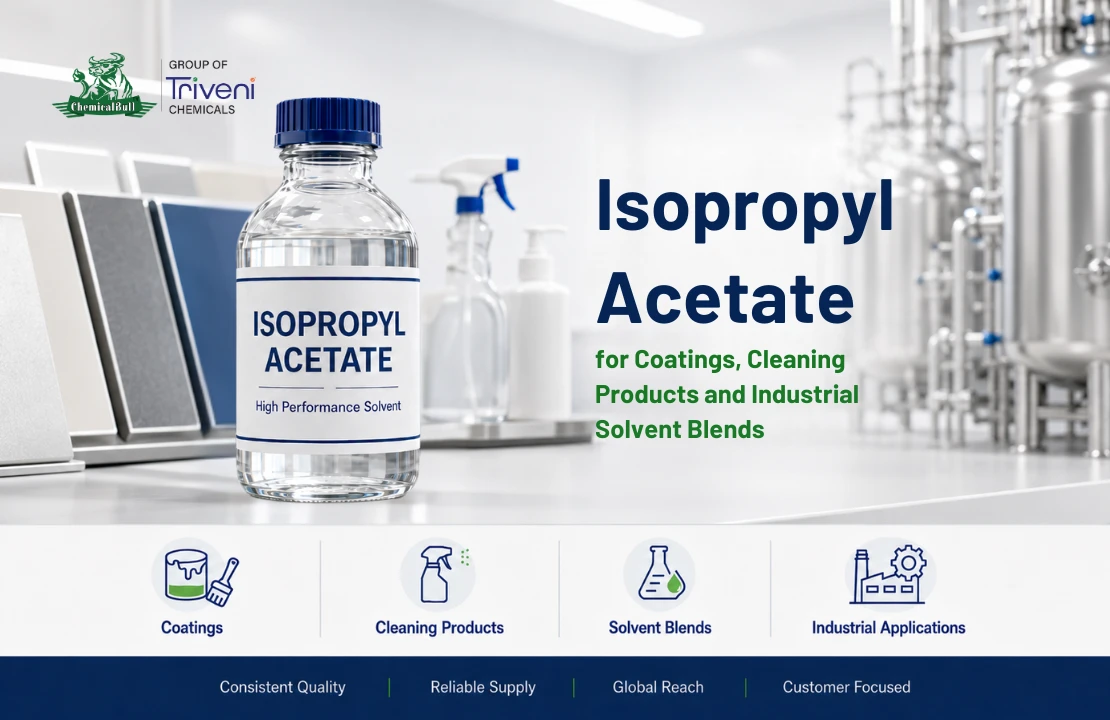
Isopropyl Acetate is an important ester solvent used in coatings, cleaning products, printing inks, adhesives and industrial solvent blends. It is known for its fast evaporation, good solvency, low viscosity and clean drying performance. These properties make it useful in formulations where quick drying, smooth application and low residue are required.
For industrial buyers and formulators, Isopropyl Acetate is selected when a solvent needs to support processing efficiency and final product quality. It is especially useful in solvent-based systems where evaporation rate, compatibility and surface finish play an important role.
As an Isopropyl Acetate supplier, Chemical Bull supports B2B buyers with sourcing requirements for coatings, cleaning products, inks, adhesives and solvent blend formulations.
This blog explains what Isopropyl Acetate is, its key properties, industrial uses, benefits, safety points and sourcing support for B2B buyers.
What Is Isopropyl Acetate?
Isopropyl Acetate is an organic ester solvent. It is also known as isopropyl ethanoate or propan-2-yl acetate. Its CAS number is 108-21-4, and its molecular formula is C5H10O2.
It is generally available as a clear, colourless liquid with a fruity ester-like odour. Due to its solvent strength and quick evaporation, it is used in many industrial formulations where fast drying and clean performance are required.
Isopropyl Acetate is compatible with many organic solvents, making it suitable for solvent blends used in coatings, cleaning products, inks, adhesives and industrial processing.
Key Properties and Identification of Isopropyl Acetate
| Parameter | Details |
|---|---|
| Chemical name | Isopropyl Acetate |
| CAS No. | 108-21-4 |
| Molecular formula | C5H10O2 |
| Molecular weight | 102.13 g/mol |
| Chemical class | Ester solvent |
| Appearance | Clear, colourless liquid |
| Odour | Fruity ester-like odour |
| Main function | Industrial solvent |
| Common applications | Coatings, cleaning products, inks, adhesives and solvent blends |
Why Isopropyl Acetate Is Used in Industrial Formulations
Isopropyl Acetate is used because it provides a practical balance of solvency, evaporation speed and formulation flexibility. It helps dissolve or dilute selected resins, oils, residues and organic materials.
In industrial formulations, it can support faster drying, better application flow, smooth surface finish, good cleaning performance and easy blending with other solvents. Its clean evaporation also helps reduce residue after use, which is important in coatings, cleaning products and printing applications.
For production teams, these benefits can help improve process efficiency and formulation consistency.
Industrial Applications of Isopropyl Acetate
Isopropyl Acetate is used in several industrial formulations because of its fast evaporation, good solvency and clean drying performance. It helps improve processing, application flow and surface quality in coatings, cleaning products, solvent blends, inks, adhesives and selected aroma applications.
Coatings and Surface Finishes
Isopropyl Acetate is used in coating formulations where fast drying and smooth film formation are required. It helps dissolve or dilute selected resins and supports better application during spraying, brushing, rolling or coating processes.
In coatings, Isopropyl Acetate may improve drying speed, surface flow and finish quality. It can also help reduce surface defects when used in the right solvent blend. The final performance depends on the resin system, pigment load, formulation balance and drying conditions.
Cleaning and Degreasing Products
Isopropyl Acetate is useful in industrial cleaning products because it can help dissolve oils, greases, adhesive residues and organic contaminants. Its fast evaporation helps surfaces dry quickly after cleaning.
It may be used in degreasing formulations, industrial surface cleaners, equipment cleaning products, residue-removal blends and wipe solvent systems. For cleaning applications, formulators should check material compatibility, flammability, ventilation and worker safety before use.
Industrial Solvent Blends
Isopropyl Acetate is widely used as a component in industrial solvent blends. These blends are designed to achieve the right balance of evaporation speed, solvency power, odour profile and application performance.
In solvent blends, Isopropyl Acetate can help adjust drying speed, viscosity, solvency strength, cleaning efficiency and surface wetting. It can be blended with other solvents depending on the end-use requirement. Such blends are used in coatings, inks, adhesives, cleaning products and chemical processing systems.
Industries That Use Isopropyl Acetate
Isopropyl Acetate is used across several industries that need fast-drying solvent performance. Paint and coating manufacturers use it for resin dilution, drying control and surface finish. Cleaning product formulators use it for degreasing and residue removal. Printing ink manufacturers use it for solvent action and drying support.
It is also used in adhesives, packaging, industrial maintenance, chemical processing and specialty formulation work. Its flexibility makes it useful wherever a fast-evaporating ester solvent is required.
How to Choose the Right Isopropyl Acetate Grade
Industrial buyers should select Isopropyl Acetate based on application requirement and quality parameters. A suitable grade can help maintain production consistency and reduce formulation issues.
Before selection, buyers should check purity level, appearance, colour, moisture content, acidity, residue after evaporation, packaging size, COA availability, SDS availability and batch consistency. For regular production, it is better to test the material in the actual formulation before bulk procurement.
Buyers should also confirm delivery timelines and logistics support, especially when Isopropyl Acetate is required for continuous manufacturing.
Typical Specifications Buyers Should Check
Procurement and quality teams should check important specifications before approving Isopropyl Acetate for industrial use. Purity affects solvent strength and consistency. Water content may affect sensitive formulations. Acidity can influence formulation stability. Residue after evaporation is important for clean drying applications.
COA and SDS documents should also be reviewed before purchase. These documents help confirm batch quality, safety information and handling requirements. For bulk users, consistent specification control is important because solvent variation can affect drying speed, surface finish and final product performance.
Industrial Sourcing Support for Isopropyl Acetate
For coatings, cleaning products and solvent blend formulations, buyers should focus on purity, packaging size, documentation and delivery reliability. Consistent solvent quality is important because it can affect drying speed, surface finish, cleaning performance and formulation stability.
Chemical Bull supports B2B sourcing of Isopropyl Acetate for industrial buyers, formulators and procurement teams across coating, cleaning, ink, adhesive and solvent blend applications.
Share your required quantity, packing size and delivery location with Chemical Bull to get Isopropyl Acetate sourcing support for your industrial requirements.
Frequently Asked Questions
-
What is Isopropyl Acetate used for?
Isopropyl Acetate is used as an industrial solvent in coatings, cleaning products, printing inks, adhesives and solvent blends. It helps improve drying speed, solvency and application performance. -
What is the CAS number of Isopropyl Acetate?
The CAS number of Isopropyl Acetate is 108-21-4. -
Is Isopropyl Acetate used in coatings?
Yes, Isopropyl Acetate is used in coating formulations to support resin dilution, faster drying, smooth application and better surface finish. -
Can Isopropyl Acetate be used in cleaning products?
Yes, it can be used in industrial cleaning products for degreasing, residue removal and quick-drying surface cleaning applications. -
Is Isopropyl Acetate flammable?
Yes, Isopropyl Acetate is flammable. It should be stored and handled away from heat, sparks, open flames and ignition sources. -
How should Isopropyl Acetate be stored?
It should be stored in tightly closed containers in a cool, dry and well-ventilated place, away from heat, sunlight and incompatible materials.
Conclusion
Isopropyl Acetate is a useful ester solvent for coatings, cleaning products and industrial solvent blends. Its fast evaporation, good solvency and clean drying performance make it suitable for applications where drying speed, surface quality and cleaning efficiency are important.
For manufacturers, formulators and procurement teams, the right grade of Isopropyl Acetate should be selected based on purity, moisture content, residue, packaging, documentation and supply consistency. With proper handling and storage, it can support efficient production and reliable formulation performance.
Comment Section