Chemical Bull
758
04-Jul-2026
Ethyl Acetate vs Methyl Acetate vs Butyl Acetate: Which Solvent Is Right for Your Industry?
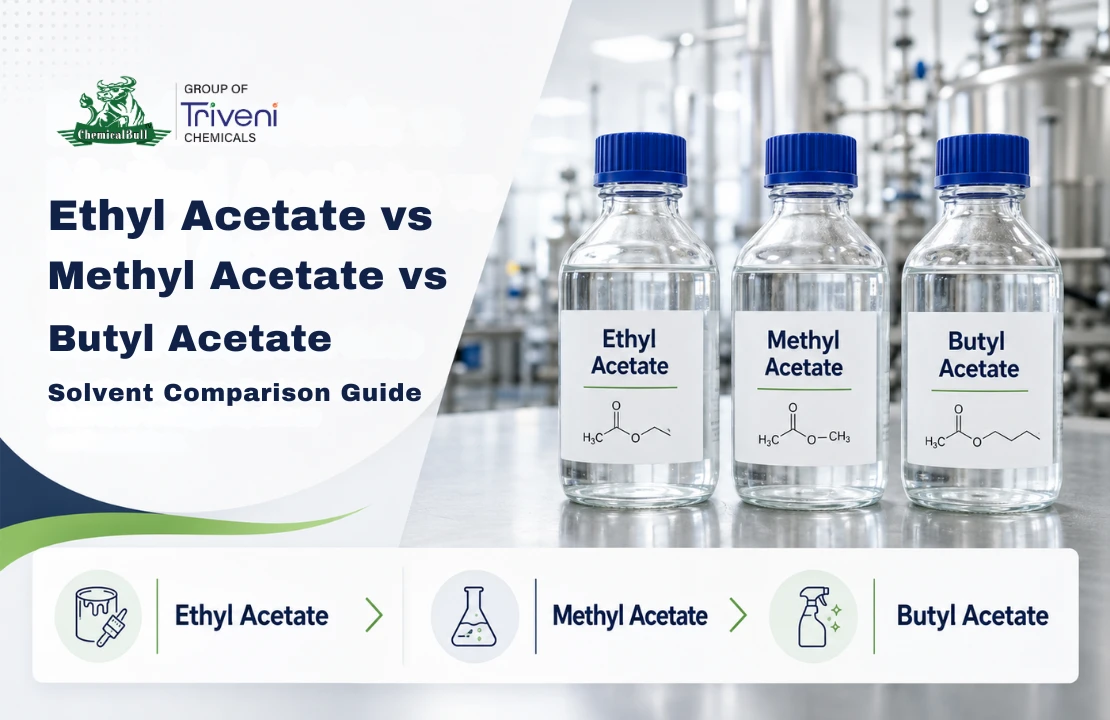
When selecting an industrial solvent, many buyers compare Ethyl Acetate, Methyl Acetate, and Butyl Acetate because they belong to the same family of acetate esters. While they share similar chemical characteristics, each solvent behaves differently during manufacturing.
The biggest differences are drying speed, solvency, boiling point, and the finish they produce in coatings, inks, adhesives, and other formulations.
If you're wondering which acetate solvent is best for your application, this guide compares all three side by side and explains where each one performs best.
Quick Answer
Ethyl Acetate is the most versatile choice for general-purpose industrial applications. Methyl Acetate evaporates the fastest and is preferred where rapid drying is essential. Butyl Acetate evaporates more slowly, making it ideal for coatings that require excellent flow, leveling, and a premium surface finish.
Ethyl Acetate is widely used in coatings, printing inks, adhesives and industrial formulations because it offers balanced evaporation and strong solvency. For bulk sourcing, Chemical Bull is a reliable Ethyl Acetate Supplier supporting industrial buyers with quality material, documentation and India-wide delivery.
What Is the Difference Between Ethyl Acetate, Methyl Acetate and Butyl Acetate?
Although all three solvents are acetate esters, they differ because of their molecular structure. As the carbon chain becomes longer, the solvent evaporates more slowly and provides a longer working time during application.
This difference directly affects coating quality, production speed, and formulation performance.
|
Property |
Ethyl Acetate |
Methyl Acetate |
Butyl Acetate |
|
CAS Number |
141-78-6 |
79-20-9 |
123-86-4 |
|
Molecular Formula |
C₄H₈O₂ |
C₃H₆O₂ |
C₆H₁₂O₂ |
|
Chemical Family |
Acetate Ester |
Acetate Ester |
Acetate Ester |
Even though these solvents dissolve many similar materials, manufacturers choose one over another depending on the drying speed and finish required in the final product.
Ethyl Acetate vs Methyl Acetate vs Butyl Acetate Comparison
The table below highlights the most important differences that buyers usually compare.
|
Property |
Ethyl Acetate |
Methyl Acetate |
Butyl Acetate |
|
Evaporation Rate |
Fast |
Very Fast |
Slow |
|
Boiling Point |
77°C |
57°C |
126°C |
|
Solvency Power |
Excellent |
Good |
Excellent |
|
Drying Speed |
Fast |
Fastest |
Moderate |
|
Odor |
Fruity |
Mild Sweet |
Fruity |
|
Best For |
Coatings, Printing Inks |
Adhesives, Aerosols |
Automotive Coatings, Lacquers |
|
Cost |
Medium |
Low-Medium |
Medium |
From this comparison, it becomes clear that no solvent is universally better. Each is designed to solve a different formulation challenge.
Ethyl Acetate: Balanced Performance for Multiple Industries
Ethyl Acetate is often considered the benchmark solvent because it balances evaporation rate with excellent solvency. It dries quickly enough to support efficient manufacturing while still allowing coatings and inks to spread evenly across the surface.
This balance makes it one of the most widely used ester solvents in industries such as paints, printing inks, pharmaceuticals, packaging, cosmetics, adhesives, and specialty chemicals.
Instead of replacing every solvent in a formulation, Ethyl Acetate is commonly selected because it performs well across different resin systems without making the drying process either too fast or too slow.
Methyl Acetate: The Best Choice for Fast Drying
Methyl Acetate has the lowest boiling point among these three solvents, which allows it to evaporate extremely quickly. This characteristic is valuable in production environments where reducing drying time can increase manufacturing efficiency.
Fast evaporation helps shorten production cycles and allows products to move through processing lines more quickly. Because of this, Methyl Acetate is commonly found in fast-drying adhesives, aerosol formulations, industrial cleaners, and specialty coatings.
However, the same rapid evaporation can become a limitation in applications where coatings require additional time to level before drying. In those situations, a slower solvent generally produces a smoother finish.
Butyl Acetate: Ideal for Premium Surface Finish
Unlike Methyl Acetate, Butyl Acetate evaporates slowly. This longer evaporation time allows coatings to remain wet for a greater period, helping the film spread more uniformly before drying.
The result is improved gloss, fewer surface defects, better leveling, and a smoother appearance. These characteristics explain why Butyl Acetate is widely used in automotive refinishing, wood coatings, decorative paints, screen printing inks, and premium lacquers.
Manufacturers often choose Butyl Acetate when the appearance of the finished product is more important than achieving the fastest drying time.
Which Solvent Should You Choose?
The right solvent depends on the performance your formulation requires rather than simply choosing the strongest solvent.
|
Industry |
Recommended Solvent |
Reason |
|
Industrial Paints |
Ethyl Acetate |
Balanced drying and solvency |
|
Packaging Inks |
Ethyl Acetate |
Consistent printing performance |
|
Aerosol Products |
Methyl Acetate |
Very fast evaporation |
|
Fast-Dry Adhesives |
Methyl Acetate |
Quick bonding |
|
Automotive Coatings |
Butyl Acetate |
Better gloss and leveling |
|
Wood Finishes |
Butyl Acetate |
Smooth finish with controlled drying |
|
Screen Printing Inks |
Butyl Acetate |
Longer open time |
A simple way to remember the difference is:
- Choose Methyl Acetate when production speed is the highest priority.
- Choose Ethyl Acetate when you need balanced overall performance.
- Choose Butyl Acetate when surface finish and coating quality are the primary objectives.
Can These Solvents Replace Each Other?
Many formulators ask whether these solvents can be substituted for one another.
The answer is sometimes, but not always.
Although they belong to the same chemical family, replacing one solvent with another changes evaporation rate, drying time, viscosity, resin compatibility, and final coating appearance. A substitution may also affect VOC compliance and overall formulation stability.
For this reason, solvent replacement should always be validated through laboratory testing before commercial production.
Frequently Asked Questions
-
Is Methyl Acetate the same as Ethyl Acetate?
No. Methyl Acetate evaporates much faster because of its lower boiling point, while Ethyl Acetate provides a better balance between drying speed and solvency. -
Which dries faster: Ethyl Acetate or Butyl Acetate?
Ethyl Acetate dries considerably faster than Butyl Acetate, making it suitable for applications where shorter drying times are required. -
Which acetate solvent is best for automotive coatings?
Butyl Acetate is commonly preferred in automotive coatings because its slower evaporation helps improve gloss, flow and leveling.
-
Which acetate solvent is safest to use?
All three solvents are flammable and should be handled according to their Safety Data Sheets (SDS). Proper ventilation, suitable protective equipment, and safe storage practices are essential for industrial use. -
Which solvent is best for fast-drying adhesives?
Methyl Acetate is generally preferred for fast-drying adhesives because it evaporates very quickly and supports faster bonding in selected adhesive systems.
Conclusion
Ethyl Acetate, Methyl Acetate, and Butyl Acetate each offer distinct advantages depending on the formulation and manufacturing process. Methyl Acetate is suited to high-speed production where rapid evaporation is essential. Ethyl Acetate provides a well-balanced combination of solvency and drying performance, making it a preferred choice across many industries. Butyl Acetate delivers slower evaporation, allowing coatings and inks to achieve better leveling, gloss, and overall finish.
Understanding these differences helps manufacturers select the most suitable solvent for improved product quality, processing efficiency, and consistent performance.
Bulk Supply of Acetate Solvents
Whether you require Ethyl Acetate, Methyl Acetate, or Butyl Acetate for coatings, adhesives, printing inks, pharmaceuticals, cosmetics, or industrial formulations, Chemical Bull supplies bulk quantities with consistent quality, complete technical documentation (COA, TDS, and MSDS), flexible packaging options, and reliable delivery across India to support industrial procurement needs.

Comment Section



