Chemical Bull
213
06-Jul-2026
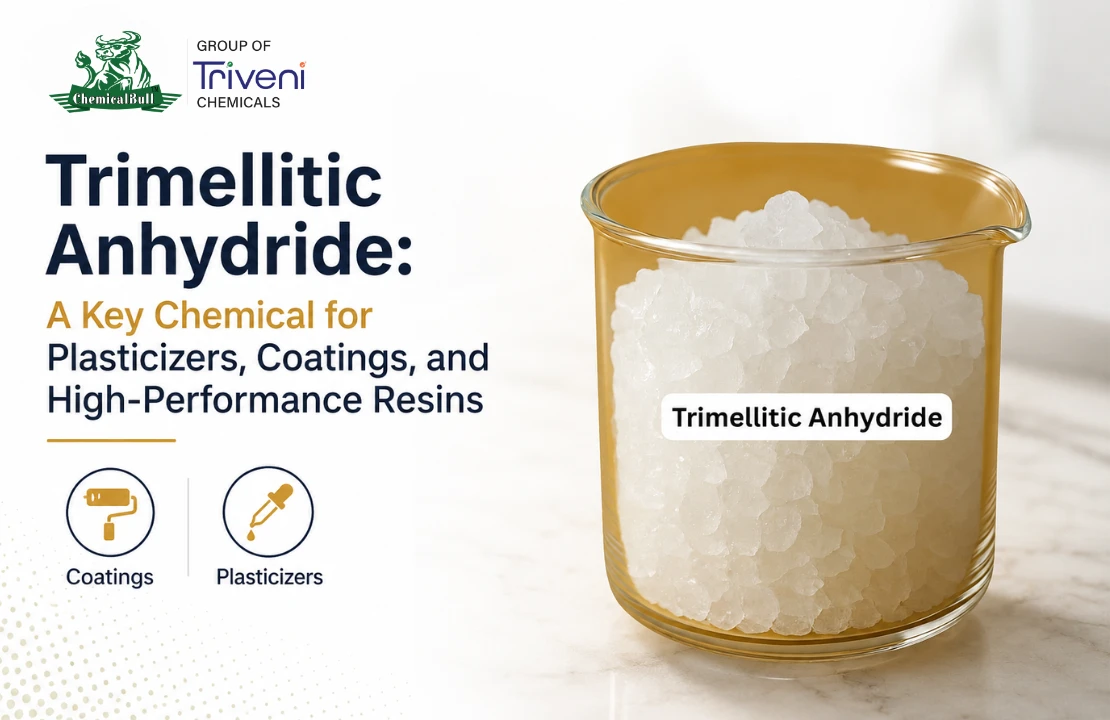
Trimellitic Anhydride: A Key Chemical for Plasticizers, Coatings, and High-Performance Resins
The Trimellitic Anhydride (TMA, CAS 552-30-7) can be described as a trifunctional chemical intermediate that has a distinctive dual Reactivity. It has two anhydride groups, cyclic as well as a carboxylic acid free compound on the benzene ring. This allows it to take part in two distinct reactions in the same formula.
This dual functionality makes TMA far more versatile than conventional phthalic anhydride or isophthalic acid in demanding applications. Manufacturers across the plasticizer, coatings, resin, and polymer industries rely on it wherever formulations require exceptional thermal stability, chemical resistance, and long-term mechanical durability.
For high-purity Trimellitic Anhydride with COA, MSDS, and a reliable bulk supply, ChemicalBull is a trusted trimellitic anhydride supplier serving plasticizer producers, coating manufacturers, and resin formulators across India and global export markets.
Chemical Identity and Key Properties
|
Property |
Details |
|
Chemical Name |
Trimellitic Anhydride |
|
Synonyms |
TMA, 1,2,4-Benzenetricarboxylic Acid Anhydride |
|
CAS Number |
552-30-7 |
|
Molecular Formula |
C9H4O5 |
|
Molecular Weight |
192.12 g/mol |
|
Physical Form |
White to off-white crystalline solid |
|
Melting Point |
165 to 169°C |
|
Functionality |
Bifunctional: anhydride group and free carboxylic acid group |
|
Key Reactions |
Esterification, imidization, polyester formation, epoxy curing |
|
Industrial Purity |
99% minimum for industrial applications |
Application 1: Plasticizer Production
The largest single use of TMA is in the production of trimellitate ester plasticizers, primarily Trioctyl Trimellitate (TOTM) and Tri-2-ethylhexyl Trimellitate (TEHTM). These are produced by reacting TMA with C8 to C10 alcohols, consuming all three acid groups of the TMA molecule.
Why Trimellitate Plasticizers Outperform Phthalates:
|
Performance Property |
Trimellitate (TMA-based) |
Standard Phthalate |
|
Molecular weight |
Higher (trifunctional) |
Lower (difunctional) |
|
Heat resistance |
Superior |
Moderate |
|
Plasticizer migration |
Very low |
Higher |
|
Volatility |
Low |
Higher |
|
Extractability by oils/solvents |
Very low |
Moderate |
Key industry applications:
- Wire and cable insulation: PVC cables for automotive, aerospace, and industrial wiring require trimellitate plasticizers to meet SAE, UL, and CSA temperature ratings
- Automotive interiors: Dashboard and door panel PVC compounds use TOTM for low fogging and long-term surface stability
- Medical PVC: TOTM is used as a phthalate-free plasticizer in certain blood bags and medical tubing
- High-temperature electrical components: Cable jackets, connectors, and terminal blocks requiring thermal longevity
Application 2: Powder Coatings
TMA is a key monomer in polyester resins for thermosetting powder coating systems. In polyester-epoxy hybrid powder coatings, TMA-modified polyester resins react with epoxy resins during curing to form a denser, more uniform cross-linked network.
Performance improvements TMA delivers in powder coatings:
- Higher cross-link density: Improves film hardness, chemical resistance, and mechanical durability
- Flexible acid value control: Allows higher acid values without excessively increasing molecular weight, giving formulators greater resin design flexibility
- Corrosion resistance: TMA-based polyester resins outperform simpler aromatic polyester chemistries over metal substrates in outdoor architectural and industrial equipment applications
- Overbake resistance: Improves thermal stability of the cured film, reducing yellowing and gloss loss when parts are accidentally over-baked
Powder coating grades of TMA require consistent purity, controlled particle size, and low APHA colour for reproducible resin synthesis and uniform film quality.
Application 3: Polyester and Alkyd Resins for Liquid Coatings
Beyond powder coatings, TMA is used in polyester and alkyd resins for liquid coating systems.
How TMA adds value in liquid coatings:
- High-solid coatings: TMA-based polyesters achieve high molecular weight with lower viscosity than linear polyesters, enabling reduced-VOC formulations
- Alkyd resin improvement: Produces faster drying, harder films, and better resistance to saponification compared to standard phthalic anhydride-based alkyds, which is relevant in marine and industrial maintenance coatings
- Metal adhesion: The carboxylic acid groups from TMA interact with metal oxide layers, improving direct-to-metal adhesion and reducing the need for adhesion-promoting primers
Application 4: Electrical Insulation Varnishes and Polyimide Systems
One of TMA's most demanding applications is in polyamide-imide (PAI) polymers and wire enamel varnish systems for electrical insulation.
How PAI Synthesis Works with TMA
TMA reacts with aromatic diamines through condensation. The anhydride group forms imide linkages and the free carboxylic acid group forms amide linkages, producing PAI polymers that combine:
- High thermal stability of polyimides
- Processability of polyamides
|
Application |
Performance Requirement |
|
Magnet wire enamel (motors, transformers) |
Thermal class H (180°C) and above |
|
High-temperature wire insulation |
Resistance to thermal degradation, abrasion, solvents |
|
Flexible PCB substrates |
High thermal stability for electronics |
|
Wire enamel overcoats |
Class H and Class C thermal rating compliance |
The imide rings formed from TMA's anhydride group are significantly more thermally stable than ester or amide linkages alone, which is why TMA is the standard intermediate for Class H and above insulation systems.
Application 5: Adhesives, Sealants, and Specialty Polymers
TMA contributes to high-performance adhesive and polymer systems in two primary ways:
Epoxy adhesive curing: TMA acts as a hardener in epoxy adhesive formulations, contributing both anhydride and carboxylic acid functionality to the cross-linking network. TMA-cured epoxy systems deliver better thermal stability and elevated-temperature performance than conventional amine-cured systems.
Engineering polymer synthesis: TMA is a monomer in polyetherimide and polyester-imide engineering polymer families used in aerospace, automotive, and electronics manufacturing where long-term thermal and mechanical performance is required.
Grade and Purity Requirements:
|
Application |
Minimum Purity |
Key Quality Parameters |
|
Plasticizer synthesis (TOTM/TEHTM) |
99% |
Low colour, low moisture, low free acid |
|
Powder coating polyester resin |
99% |
Consistent particle size, low APHA |
|
Wire enamel and PAI synthesis |
99.5% and above |
Ultra-low colour, low metal impurities |
|
Adhesive and epoxy curing |
99% |
Low moisture, controlled acid value |
Always request a COA confirming purity (GC or HPLC), melting point, colour (APHA or Gardner), moisture content, and heavy metals when sourcing TMA for resin synthesis or plasticizer production.
Frequently Asked Questions
1. What is Trimellitic Anhydride used for?
TMA is used in plasticizer production (TOTM, TEHTM), powder coating polyester resins, alkyd resins, electrical insulation varnishes, polyamide-imide polymers, and epoxy curing agents.
2. Why is TMA preferred over phthalic anhydride in some applications?
TMA is trifunctional with three reaction points per molecule. This produces trimellitate plasticizers with higher molecular weight, lower volatility, and better heat resistance than difunctional phthalate plasticizers.
3. What is the CAS number for Trimellitic Anhydride?
CAS 552-30-7, molecular formula C9H4O5, molecular weight 192.12 g/mol.
4. What is TOTM and how is it related to TMA?
Trioctyl Trimellitate (TOTM) is produced by esterifying TMA with 2-ethylhexanol or octanol. It is one of the most important high-temperature PVC plasticizers for wire and cable insulation.
5. Is TMA used in powder coatings?
Yes. TMA is a key monomer in polyester resins for thermosetting powder coatings, improving cross-link density, corrosion resistance, and overbake stability.
6. What purity grade is required for wire enamel production?
Wire enamel and PAI synthesis typically require 99.5% or higher purity with very low colour and metal impurity content for consistent imide formation and film performance.
7. How should TMA be stored?
Store in a cool, dry location away from moisture. Exposure to moisture hydrolyses the anhydride group to trimellitic acid, reducing reactivity in esterification and imide-forming reactions.
Conclusion
Trimellitic Anhydride is a high-value chemical intermediate whose dual functionality makes it irreplaceable across plasticizer production, powder and liquid coatings, electrical insulation, and high-performance adhesive systems. No simpler aromatic anhydride can replicate the combination of trifunctional esterification capacity, imide-forming reactivity, and resin branching contribution that TMA delivers.
Understanding the specific purity, particle size, and documentation requirements for each application is essential for consistent process performance. For high-purity Trimellitic Anhydride with Certificate of Analysis, MSDS, and bulk supply support, connect with Chemical Bull, a trusted trimellitic anhydride supplier serving coatings manufacturers, resin producers, plasticizer formulators, and industrial buyers across India and global export markets.

Comment Section