Chemical Bull
1976
26-Jun-2026
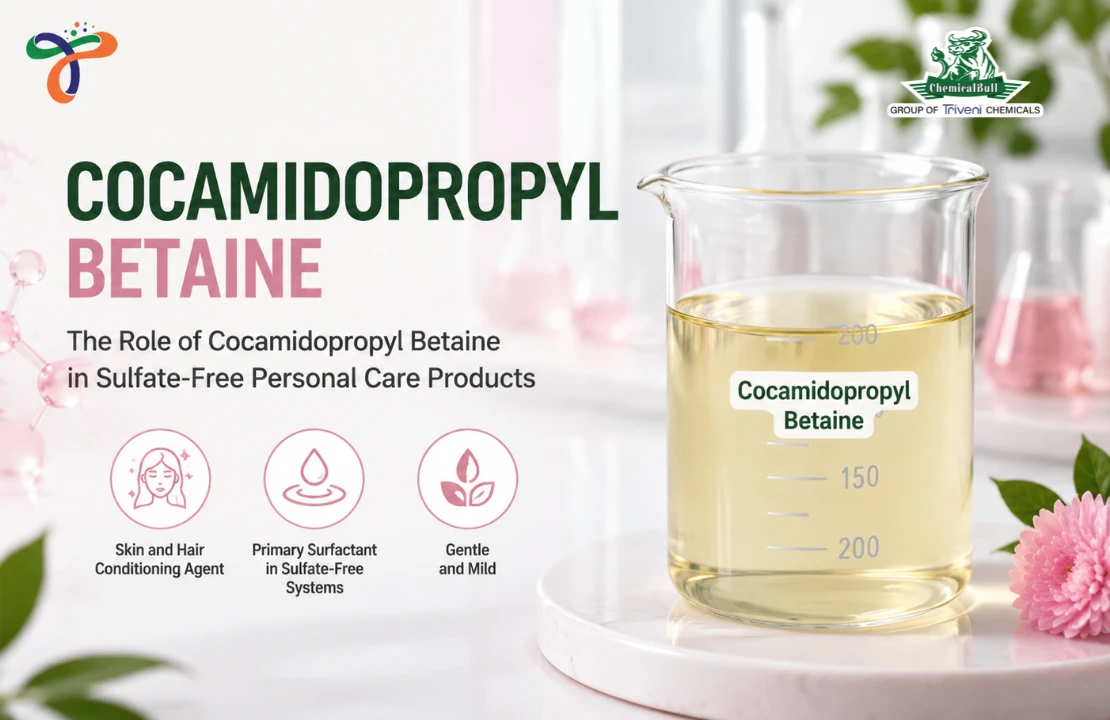
The Role of Cocamidopropyl Betaine in Sulfate-Free Personal Care Products
The shift toward sulfate-free personal care formulations is one of the most significant changes reshaping the cosmetic industry. Consumers across skin types — sensitive, dry, colour-treated, and baby — are actively seeking cleansing products that deliver effective cleaning without the harshness of traditional sulfate surfactants like sodium lauryl sulfate (SLS) and sodium laureth sulfate (SLES). At the centre of this formulation shift is Cocamidopropyl Betaine (CAPB) — a mild, coconut-derived amphoteric surfactant that has become essential to modern sulfate-free personal care product development.
CAPB brings a unique combination of gentle cleansing, foam stabilization, skin conditioning, and broad surfactant compatibility that makes it the go-to ingredient in sulfate-free shampoos, body washes, face cleansers, hand washes, and baby care products.
If you are developing sulfate-free formulations, connect with a reliable cocamidopropyl betaine supplier who provides cosmetic-grade CAPB with full COA, TDS, and SDS documentation for your production needs.
What Is Cocamidopropyl Betaine?
Cocamidopropyl Betaine is an amphoteric surfactant — it carries both a positive and a negative charge within the same molecule, depending on the system's pH. This dual-charge character is the foundation of CAPB's formulation advantages and its exceptionally mild skin and scalp profile.
|
Property |
Details |
|
INCI Name |
Cocamidopropyl Betaine |
|
Abbreviation |
CAPB |
|
CAS Number |
61789-40-0 / EC: 263-058-8 |
|
Origin |
Derived from coconut fatty acids |
|
Ionic Character |
Amphoteric (zwitterionic) |
|
Physical Form |
Clear to pale yellow viscous liquid |
|
Solubility |
Highly water-soluble across wide pH range |
|
pH Stability |
Effective across pH 4.0–9.0 |
|
Active Content |
30%–35% active matter |
Its coconut origin and amphoteric nature make it significantly less irritating than SLS/SLES — ideal for sensitive skin, dry skin, children, and frequent-use cleansing products.
Why CAPB Is Central to Sulfate-Free Formulation
Sulfate surfactants at cleansing concentrations can disrupt the skin's lipid barrier, cause scalp dryness and irritation, strip natural oils from hair, accelerate colour fade, and irritate the eyes in rinse-off products. Sulfate-free formulation addresses these concerns — but replacing sulfates creates a new challenge: how to maintain effective cleansing and acceptable foam while being genuinely gentle.
Cocamidopropyl Betaine solves this directly. Its amphoteric character makes it compatible with all surfactant types — anionic, cationic, and non-ionic — meaning it functions as a universal cosurfactant in virtually any cleansing base. It also reduces the critical micelle concentration (CMC) of the overall system, enabling effective cleansing at lower total surfactant concentrations, and buffers the irritation potential of stronger anionic surfactants by interacting with them electrostatically to reduce their binding to skin proteins.
Core Functions of Cocamidopropyl Betaine
1. Primary Surfactant in Sulfate-Free Systems
In fully sulfate-free formulations, CAPB acts as the primary cleansing surfactant, most effectively when blended with complementary mild surfactants such as Sodium Cocoyl Isethionate (SCI), Decyl Glucoside, Sodium Lauroyl Sarcosinate, or Disodium Laureth Sulfosuccinate. At 10%–30% of the formula (as supplied), CAPB contributes meaningful cleansing efficacy while anchoring the mildness profile of the complete system.
2. Foam Booster and Stabilizer
Sulfate-free surfactants often produce less voluminous or less stable foam compared to SLS/SLES — a key consumer perception challenge. CAPB addresses this by increasing foam density, extending foam persistence during the cleansing process, and improving foam creaminess — the sensory quality consumers associate with premium cleansing products. This foam-enhancing function is critical in sulfate-free shampoos and body washes where lather is a primary purchase driver. In conventional liquid soap and cleansing formulations, formulators may also use Cocamide DEA for liquid soap manufacturing to support foam stability, viscosity, and overall formulation performance.
3. Mildness Enhancer
When combined with anionic surfactants in reduced-sulfate systems, CAPB acts as a mildness enhancer — forming ion pairs with anionic surfactant molecules, reducing their interaction with skin proteins, and lowering eye irritation potential. This mechanism is why CAPB is the standard ingredient in baby shampoo "no more tears" formulations worldwide.
4. Skin and Hair Conditioning Agent
CAPB contributes a measurable conditioning effect in rinse-off products. During rinsing, its cationic character interacts with the negatively charged surface of damaged or chemically treated hair, depositing a thin conditioning film that reduces static, improves combability, and adds softness post-wash. On skin, it leaves a non-tight, smooth after-feel — important for body wash and face cleanser differentiation.
5. Viscosity Modifier and Antistatic Agent
CAPB contributes to the natural viscosity of liquid cleansing systems through micellar network interactions — reducing dependence on salt thickening, which is often ineffective in sulfate-free bases. Its cationic character at lower pH values also gives it antistatic properties, reducing static charge buildup on hair fibers — particularly valuable in fine hair and dry climate formulations.
Skin and Scalp Safety Profile
|
Attribute |
Notes |
|
Irritation potential |
Very low; significantly lower than SLS/SLES |
|
Eye irritation |
Low — standard in "no tears" baby formulations |
|
pH compatibility |
Optimal between pH 4.5–7.0 for most personal care applications |
|
Colour-treated hair |
Safe; does not accelerate colour fade |
|
Scalp microbiome |
Non-disruptive at recommended concentrations |
|
Allergen note |
Rare sensitization linked to amidoamine impurities — always specify low-amidoamine cosmetic grade |
Formulation Tips for Working with CAPB
- Specify cosmetic-grade CAPB with low amidoamine content. Residual amidoamine impurities in lower-grade material are responsible for occasional sensitization reports. Always verify impurity specification with your supplier before use in sensitive skin or baby formulations.
- Add at room temperature. CAPB is a liquid and does not require heating, making it suitable for both cold-process and hot-process manufacturing.
- Target 30%–50% of total surfactant active matter. This ratio consistently delivers the best balance of mildness, foam volume, and cleansing efficacy across sulfate-free systems.
- Supplement with polymeric thickeners. Salt thickening is less effective in sulfate-free bases. Combine CAPB's natural viscosity contribution with hydroxyethylcellulose, carbomer, or xanthan gum for consumer-preferred product consistency.
- Confirm pH after formulation. Target pH 5.0–6.5 for shampoos, 5.5–7.0 for body wash, and 4.5–5.5 for face cleansers and intimate hygiene — CAPB performs optimally and most gently within these ranges.
For formulators working on facial cleansing systems, CAPB is especially useful where mild cleansing, foam quality and formulation balance are important. You can also read our detailed guide on Cocamidopropyl Betaine Supplier for Face Wash & Facial Cleanser to understand its role in facial cleanser formulations, surfactant combinations, viscosity support and B2B sourcing considerations.
Frequently Asked Questions
1. What does Cocamidopropyl Betaine do in sulfate-free products?
CAPB provides mild cleansing, boosts and stabilizes foam, conditions skin and hair, and bridges compatibility between different surfactant types in sulfate-free formulations.
2. Is Cocamidopropyl Betaine actually sulfate-free?
Yes. CAPB is an amphoteric surfactant with no sulfate groups — it is a key ingredient in certified sulfate-free shampoos, body washes, and face cleansers.
3. Is CAPB safe for sensitive and baby skin?
Yes. CAPB has a well-documented safety record and is used globally in baby shampoos and sensitive skin formulations; always use low-amidoamine cosmetic grade for maximum mildness.
4. What is the INCI name for Cocamidopropyl Betaine?
The INCI name is Cocamidopropyl Betaine — this appears exactly this way on finished product ingredient labels.
5. What is the recommended usage level in a sulfate-free shampoo?
Typically 8%–20% as supplied (30–35% active), depending on the complete surfactant system and desired foam and mildness profile.
6. Can CAPB be used as the sole surfactant?
It can, but it performs best blended with complementary mild surfactants to achieve optimal foam volume, viscosity, and cleansing performance in consumer-ready products.
7. Is Cocamidopropyl Betaine suitable for colour-treated hair products?
Yes — its mildness preserves colour vibrancy, and its conditioning effect reduces cuticle roughness that leads to colour fade, making it ideal for colour-care shampoos.
Conclusion
Cocamidopropyl Betaine has earned its position as one of the most important ingredients in sulfate-free personal care formulations. Its amphoteric chemistry, coconut-derived origin, universal surfactant compatibility, foam-boosting capability, and proven mildness across sensitive, baby, colour-treated, and scalp-sensitive applications make it the formulation backbone of modern gentle cleansing products.
From sulfate-free shampoos and body washes to face cleansers, baby care, and intimate hygiene — CAPB delivers the performance balance formulators need and the gentleness consumers expect. For cosmetic-grade Cocamidopropyl Betaine with low amidoamine content, Certificate of Analysis, TDS, SDS, and bulk supply support, connect with ChemicalBull — a trusted cocamidopropyl betaine supplier serving personal care manufacturers across India and global export markets.
Comment Section