Chemical Bull
805
26-Jun-2026
Why Is Calcium Stearate Used in Construction Chemicals?
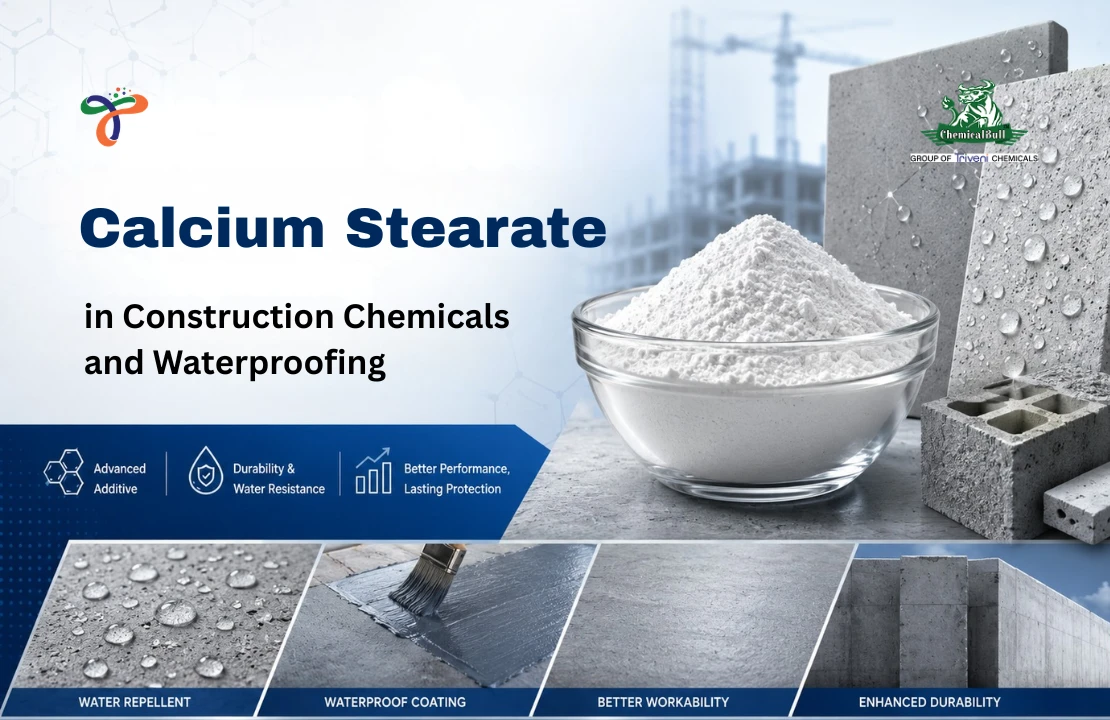
Calcium Stearate is used in construction chemicals as a hydrophobic additive, water-repellent agent, lubricant, and powder processing aid. In waterproofing compounds, dry mix mortars, wall putty, plaster, concrete admixtures, tile adhesives, and coatings, it helps reduce water absorption, improve moisture resistance, support powder flow, and increase the durability of cement-based systems.
For manufacturers, it is useful because it supports both product performance and production consistency when the correct grade, dosage, and blending method are selected.
Key Takeaway for Manufacturers
If your construction chemical formulation needs better water resistance, reduced moisture pickup, smoother dry mix handling, and improved durability, Calcium Stearate can be a practical additive to evaluate. It is especially useful in cement-based and powder systems where hydrophobicity and blend consistency are important.
Introduction
Water damage is one of the most common reasons for construction product failure. Concrete, mortar, plaster, wall putty, tile adhesives, coatings, and cement-based dry mix systems can absorb moisture if the formulation is not properly protected. This may lead to seepage, damp patches, cracks, poor surface finish, reduced durability, and shorter service life.
This is why hydrophobic additives are important in modern construction chemistry. Calcium Stearate is one such additive used to improve water resistance, reduce moisture absorption, and support better durability in cement-based and dry powder formulations.
In construction products, this additive is valued because it can help create a water-repellent effect without changing the basic role of cement, fillers, polymers, or binders when used at suitable levels. It is commonly considered in waterproofing compounds, concrete admixtures, dry mix mortars, wall putty, plaster, tile adhesives, coatings, and construction-grade powder blends.
What Is Calcium Stearate in construction chemicals?
Calcium Stearate (CAS 1592-23-0) is a metallic stearate made from calcium and stearic acid. It is usually available as a fine white powder with hydrophobic properties. Because it is not easily soluble in water, it is useful in formulations where moisture resistance and water repellency are required.
In construction chemicals, it is not used as a cement replacement. It works as a functional additive that supports water resistance, powder handling, surface protection, and processing behavior.
Why Construction Chemical Manufacturers Use Calcium Stearate
Construction chemical manufacturers use Calcium Stearate when they need better water resistance, powder flow, moisture protection, and batch consistency in cement-based or dry mix products.
It is useful for companies manufacturing waterproofing compounds, wall putty, tile adhesives, cement plasters, grouts, repair mortars, concrete admixtures, and dry powder construction blends.
For manufacturers, Calcium Stearate can help improve the performance of the final product while also supporting easier dry blending and better handling during production. This makes it a practical additive for both performance-driven and production-focused construction chemical formulations.
Formulation Benefits for Manufacturers
Manufacturer Need | How Calcium Stearate Helps |
Better water resistance | Supports hydrophobic performance |
Dry mix flow improvement | Helps reduce powder handling issues |
Moisture protection | Reduces water absorption in cement-based systems |
Batch consistency | Supports uniform additive distribution when blended properly |
Wall putty durability | Helps improve resistance to dampness |
Waterproofing performance | Supports water-repellent action |
Cost-effective additive system | Works as a practical hydrophobic additive |
Better product reliability | Supports long-term moisture resistance |
How Calcium Stearate Works in Waterproofing
Concrete and mortar have pores and capillaries. Water can enter through these pathways, especially when the structure is exposed to rain, groundwater, humidity, or leakage.
Calcium Stearate works by adding hydrophobic behavior to the formulation. Its fatty acid structure helps repel water and reduce moisture movement through the cementitious matrix.
In simple terms:
Cement and mortar naturally absorb water through pores.
Calcium Stearate helps reduce water attraction.
The formulation becomes more moisture-resistant.
Water absorption may reduce when the additive is properly used.
The final structure can show better resistance to dampness and seepage.
Calcium Stearate is especially useful in waterproofing compounds where water repellency and dry powder performance are both important.
Where Calcium Stearate Is Used in Construction Chemicals
Calcium Stearate is used in construction formulations where moisture resistance, powder handling, and durability are important. Instead of working as a main binder, it supports the performance of cement-based and dry mix systems by improving hydrophobic behavior and reducing water sensitivity.
1. Waterproofing Compounds
In cementitious waterproofing compounds, this additive helps reduce water absorption and supports internal water-repellent performance. It is useful in dry powder waterproofing blends, plaster waterproofing additives, mortar waterproofing systems, and roof or terrace protection products.
For related product categories, visit our waterproofing chemicals for cement-based formulations page.
2. Dry Mix Mortars
Dry mix mortars need smooth powder flow, uniform blending, and stable performance after water addition. The selected grade can help improve hydrophobicity, reduce moisture sensitivity, and support better handling in repair mortars, masonry mortars, tile adhesives, grouts, and skim coats.
3. Wall Putty and Cement Plaster
Wall putty and plaster are often exposed to humidity, seepage, and damp surfaces. A hydrophobic stearate additive can help improve moisture resistance, reduce water penetration, and support better surface durability in interior and exterior wall applications.
4. Concrete and Admixture Systems
Concrete is porous, so moisture can move through capillaries over time. In concrete-related formulations and admixture systems, the material can support water resistance, reduce moisture uptake, and help improve durability in floors, walls, terraces, basements, and other exposed areas. In some powder-based construction blends, calcium stearate anti caking agent performance may also help improve handling and reduce moisture-related clumping.
5. Coatings and Surface Protection
In selected construction coatings and surface treatment systems, it can support water repellency, anti-caking behavior, powder flow, and moisture protection. This makes it useful in exterior coatings, roof-related products, and mineral-based dry coating blends.
6. Manufacturer Use Case
For manufacturers, the main value is not only waterproofing performance. It can also support dry blending, powder flow, batch consistency, and product reliability when the right particle size, moisture level, purity, and dosage are selected.
Calcium Stearate vs Other Waterproofing Additives
Calcium Stearate is one of many additives used in waterproofing and construction chemicals. Its main strength is hydrophobicity and compatibility with powder-based systems.
Additive Type | Main Function | How Calcium Stearate Compares |
Calcium Stearate | Water repellency and hydrophobic support | Good for powder blends and cementitious systems |
Silicone additives | Strong water repellency | Often used for surface treatment or advanced systems |
Acrylic polymers | Flexibility and bonding | More useful where film formation is needed |
Redispersible polymer powder | Adhesion and flexibility | Often used with dry mix mortars |
Wax additives | Water repellency and surface protection | Useful in coatings and dry mix systems |
Stearates | Hydrophobicity and lubrication | Calcium Stearate is commonly used in cement-based products |
Calcium Stearate is often selected when formulators need a cost-effective, powder-compatible water-repellent additive.
For formulators comparing metallic stearates beyond construction use, our related guide on calcium stearate vs zinc stearate explains how both additives behave in PVC and polymer processing.
How to Use Calcium Stearate in Construction Formulations
Calcium Stearate should be added according to the formulation requirement and tested before commercial use. The right level depends on the product type, cement content, filler loading, binder system, water demand, and performance target.
The additive should be dispersed properly in the dry blend or formulation system to avoid uneven performance. In dry mix products, uniform mixing is especially important because poor distribution can lead to inconsistent water resistance.
Formulation Checks
Before using Calcium Stearate, formulators should check:
Cement compatibility
Water absorption reduction
Workability
Setting time
Strength development
Adhesion performance
Powder flow
Dispersion quality
Surface finish
Long-term water resistance
Storage stability
Where Calcium Stearate Works Best
Calcium Stearate is best suited for construction products where water resistance and powder performance are important.
If the formulation needs... | Calcium Stearate can help with... |
Reduced water absorption | Hydrophobic support |
Better waterproofing behavior | Water-repellent action |
Dry mix powder flow | Processing and handling support |
Wall putty moisture resistance | Improved durability |
Plaster water resistance | Reduced moisture penetration |
Concrete protection | Lower water sensitivity |
Coating stability | Moisture and surface support |
Cement-based product durability | Better resistance to dampness |
How Manufacturers Should Select Calcium Stearate Grade
For manufacturing use, Calcium Stearate grade selection should be based on technical suitability, not only price. A low-cost grade may create production issues if the particle size, moisture, purity, or dispersion behavior is not suitable for the formulation.
Important Grade Selection Points
Particle size
Moisture content
Purity
Bulk density
Powder flow behavior
Dispersion performance
Compatibility with cement and fillers
COA, TDS, and SDS availability
Packing size
Batch-to-batch consistency
Bulk supply capacity
Application suitability for construction chemicals
Manufacturers should always request a sample and test the material in the actual formulation before approving it for regular production.
Buying Calcium Stearate for Construction Chemicals
When buying Calcium Stearate for construction applications, do not select only by price. Grade consistency, particle size, moisture level, purity, documentation, and bulk supply reliability matter.
For consistent construction-grade supply, manufacturers should choose a reliable calcium stearate powder manufacturer that can provide samples, COA, TDS, SDS, particle size details, and bulk packing support.
Choose a grade that fits the target product, whether it is waterproofing compound, concrete additive, wall putty, mortar, plaster, coating, or dry mix formulation.
Frequently Asked Questions
What is Calcium Stearate used for in construction chemicals?
Calcium Stearate is used as a hydrophobic additive, water-repellent agent, lubricant, and processing aid in construction chemicals. It is commonly used in waterproofing compounds, concrete admixtures, dry mix mortars, wall putty, plaster, coatings, tile adhesives, and cement-based formulations.
How does Calcium Stearate help in waterproofing?
It helps reduce water absorption by adding hydrophobic behavior to cement-based systems. It supports water repellency and can reduce moisture penetration through pores and capillaries when used properly.
Is Calcium Stearate used in concrete?
Yes. It can be used in concrete-related formulations and admixtures to support water resistance, improve moisture protection, and reduce water absorption. Dosage and compatibility should be tested because concrete performance depends on the complete formulation.
What documents should I ask for before buying Calcium Stearate powder?
Always ask for the COA (Certificate of Analysis), TDS (Technical Data Sheet), SDS (Safety Data Sheet), particle size data, moisture content report, packing details, and application suitability confirmation before placing a bulk order.
Does Calcium Stearate affect cement strength?
It should be used at the correct dosage. Excessive use may affect water interaction, bonding, setting, or strength development in some cementitious systems. Proper testing is needed before scale-up.
Conclusion
Calcium Stearate is a practical, cost-effective hydrophobic additive used across a wide range of construction chemical products in India and globally. Its primary value in construction formulations is reducing water absorption, improving moisture resistance, and supporting better durability in cement-based systems — from waterproofing compounds and concrete admixtures to dry mix mortars, wall putty, plaster, and tile adhesives.
For manufacturers, the additive is also useful because it can support powder flow, dry mix handling, batch consistency, and product reliability when the correct grade is selected. The key is to test the material in the final formulation, use the right dosage, and choose a supplier that can provide consistent quality with proper technical documents.
For construction-grade Calcium Stearate, samples, COA, TDS, SDS, and bulk supply support, connect with ChemicalBull to source suitable material for waterproofing compounds, wall putty, dry mix mortars, plaster, tile adhesives, and concrete admixture manufacturing.


Comment Section



