Chemical Bull
149
26-Jun-2026
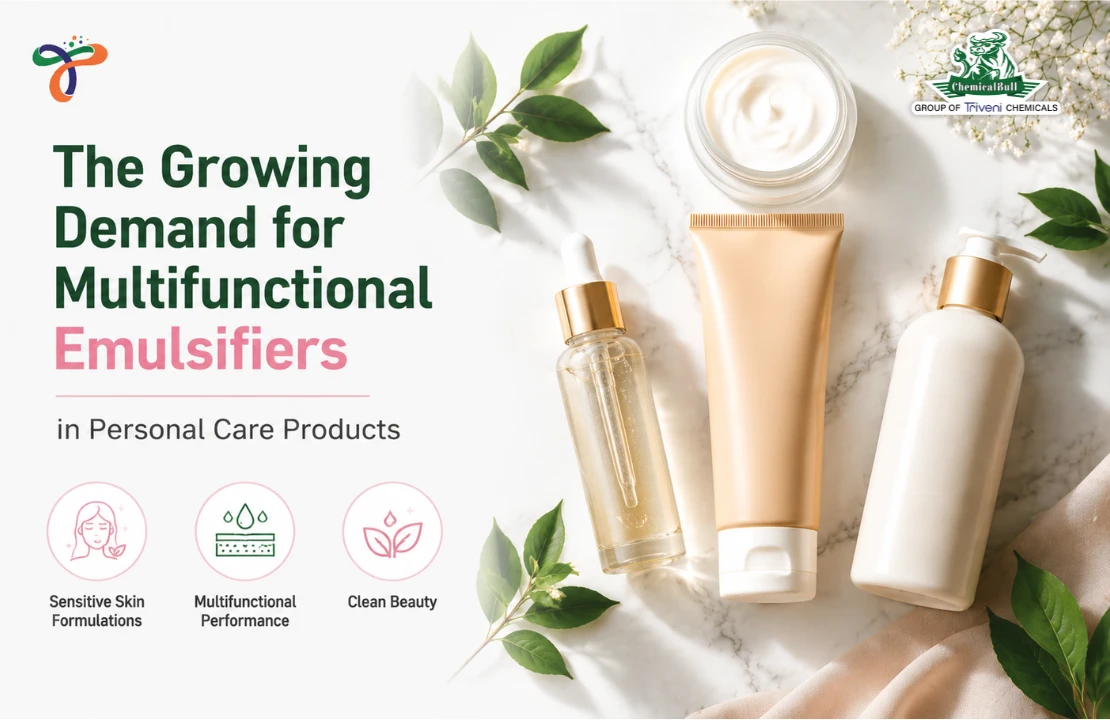
The Growing Demand for Multifunctional Emulsifiers in Personal Care Products
Personal care formulation has grown significantly more complex. Consumers now expect products that hydrate, protect, treat, and perform — all in a single application. This has put pressure on formulators to do more with fewer ingredients, reduce formulation complexity, and deliver cost-efficient stability without compromising performance or aesthetics. At the heart of this evolution is a growing demand for multifunctional emulsifiers — ingredients that go beyond simply binding oil and water, contributing to solubilization, texture, stability, and active ingredient delivery all at once.
This trend is reshaping how personal care brands approach ingredient selection, driving formulators toward proven non-ionic emulsifier systems that carry multiple roles within a single formula. For those sourcing high-performance emulsifiers for skin care, hair care, and cosmetic formulations, ChemicalBull is a reliable polysorbate 40 manufacturer offering batch-tested, cosmetic-grade supply with full COA, TDS, and MSDS documentation for industrial and commercial production.
What Does "Multifunctional" Mean in Emulsifier Science?
In traditional formulation science, an emulsifier had one job: to reduce interfacial tension between oil and water phases to keep them mixed in a stable emulsion. The modern definition of a multifunctional emulsifier extends far beyond this. Today, a high-performing emulsifier in personal care is expected to simultaneously deliver two or more of the following roles within the same formulation:
- Emulsification — stabilizing O/W or W/O emulsion systems
- Solubilization — dissolving fragrance compounds, essential oils, and oil-soluble actives into aqueous bases without cloudiness
- Co-surfactant function — improving foam quality, mildness, or cleansing efficacy when combined with primary surfactants
- Active ingredient delivery — stabilizing and uniformly distributing cosmetic actives (retinol, vitamin C derivatives, botanical extracts)
- Texture contribution — influencing skin feel and product viscosity without additional texture modifiers.
The fewer single-function ingredients a formula requires, the simpler, more cost-effective, and more label-friendly the formulation becomes — without sacrificing performance.
Why the Demand for Multifunctional Emulsifiers Is Growing
1. Clean Beauty and Shorter Ingredient Lists
The clean beauty movement has created consumer pressure for shorter, more transparent ingredient lists. Brands are being asked to justify every ingredient on their label — and single-function ingredients that can be replaced by one multifunctional alternative are increasingly seen as unnecessary. Multifunctional emulsifiers allow brands to reduce total ingredient count while maintaining or improving formulation performance.
2. Formulation Cost Efficiency and Sustainability
With raw material costs rising globally, formulators are under pressure to reduce ingredient count without compromising quality. A single emulsifier that also solubilizes fragrance, stabilizes actives, and improves texture reduces the need for separate solubilizers and co-emulsifiers — directly lowering bill-of-materials cost. Sustainability goals reinforce this: choosing one multifunctional emulsifier over three or four single-function ingredients simplifies sourcing, reduces carbon footprint, and supports supply chain efficiency.
3. Rise of Hybrid Product Formats and Sensitive Skin Formulations
The popularity of BB creams, tinted SPF moisturizers, and serum-foundations means formulations must simultaneously perform as emulsions, active delivery systems, and UV filters — demanding emulsifiers capable of handling silicones, UV filter oils, pigment dispersions, and conditioning oils in one stable system. At the same time, growth in sensitive skin, baby care, and natural personal care has increased demand for mild, non-ionic emulsifiers that are skin-compatible across a wide pH and temperature range without the irritation risks of some ionic emulsifiers.
Key Properties That Define a High-Performance Multifunctional Emulsifier
Not every emulsifier qualifies as genuinely multifunctional. The properties below define an ingredient capable of carrying multiple roles effectively:
High HLB Value and Versatility:
A high HLB (typically 12–18) indicates water-compatibility and stable O/W emulsion formation. The emulsifier should also blend with lower HLB co-emulsifiers to achieve a wide range of target HLB values for different oil phases.
Broad Oil-Phase Compatibility:
It must stabilize diverse oils — mineral, vegetable, silicones, esters, waxes, and UV filters — without requiring grade changes between formulation types.
Solubilization Capacity:
The ability to solubilize fragrance oils, essential oils, and oil-soluble actives into aqueous systems is essential for clear and translucent personal care products.
pH and Temperature Stability:
Performance must hold across pH 4.0–8.0 and a wide temperature range, in the presence of electrolytes, preservatives, and active cosmetic ingredients.
Skin Safety and Regulatory Acceptance:
Non-ionic character, low irritation potential, and global regulatory approval (EU, US FDA, India BIS) across multiple product categories are non-negotiable for commercial launch.
Polysorbate 40: A Multifunctional Emulsifier in Personal Care
Among the commercially established emulsifier systems in personal care, Polysorbate 40 (Polyoxyethylene (20) Sorbitan Monopalmitate, CAS 9005-66-7) — also known as Tween 40 — is a strong example of a non-ionic emulsifier that delivers genuine multifunctionality across personal care product categories.
|
Property |
Details |
|
HLB Value |
~15.6 |
|
Physical Form |
Clear to pale yellow viscous liquid |
|
Solubility |
Fully miscible with water |
|
Ionic Character |
Non-ionic |
|
pH Stability |
Stable across pH 3–9 |
|
Melting Point |
-5°C |
Polysorbate 40 is produced by ethoxylating sorbitan monopalmitate with 20 moles of ethylene oxide. Its high HLB value of approximately 15.6 makes it strongly hydrophilic — highly suited to oil-in-water emulsion systems that dominate the personal care market.
How Polysorbate 40 Delivers Multifunctionality
As an O/W Emulsifier:
Its high HLB stabilizes oil-in-water emulsions across a range of oil phases — from light esters and vegetable oils to mineral oils and silicones — making it suitable for moisturizing creams, body lotions, facial serums, and sunscreen formulations.
As a Solubilizer:
At appropriate concentrations, Polysorbate 40 solubilizes fragrance oils, essential oils, vitamin E acetate, and oil-soluble actives into aqueous bases — maintaining product clarity and stability in tonics, mists, and lightweight serums without cloudiness or phase separation.
As an Emulsion Stabilizer and Wetting Agent:
Polysorbate 40 forms a stable interfacial film between oil and water droplets, preventing coalescence over time and reducing dependence on additional stabilizing polymers. It also improves how a finished product spreads and absorbs across the skin surface without a heavy or greasy after-feel.
In HLB Blending Systems:
Polysorbate 40 is blended with lower HLB co-emulsifiers (such as Sorbitan Monopalmitate / Span 40, HLB ~6.7) to achieve a specific target HLB for any oil phase — giving formulators flexibility across product types from one consistent emulsifier system.
Personal Care Applications of Polysorbate 40
|
Product Category |
Role of Polysorbate 40 |
|
Moisturizing creams and lotions |
O/W emulsifier, emulsion stabilizer |
|
Facial serums and tonics |
Solubilizer for actives and fragrance |
|
Sunscreen formulations |
UV filter oil emulsifier, film stabilizer |
|
Hair conditioners and masks |
Co-emulsifier in conditioning emulsions |
|
Body mists and hair sprays |
Fragrance and oil solubilizer |
|
Baby skin care |
Mild non-ionic emulsifier in gentle formulations |
|
Makeup and colour cosmetics |
Pigment and oil dispersant in emulsion bases |
Choosing the Right Multifunctional Emulsifier: Key Considerations
Selecting the right emulsifier requires evaluating the target HLB of your oil phase, the composition of your oils (polar esters, silicones, vegetable oils, or mineral oils), and the product format — clear tonics require high solubilization capacity, while creams need film-forming stability. Always confirm the emulsifier grade meets regulatory requirements for your target market (EU, US, India) and product category, and source with a full COA (confirming HLB, acid value, hydroxyl value, and heavy metals), TDS, and MSDS for quality control and regulatory compliance.
Frequently Asked Questions
1. What is a multifunctional emulsifier in personal care?
A multifunctional emulsifier performs two or more formulation roles — emulsification, solubilization, stabilization, and wetting — reducing the need for multiple single-function ingredients in a formula.
2. What is Polysorbate 40 used for in personal care?
Polysorbate 40 is used as an O/W emulsifier, fragrance and oil solubilizer, and emulsion stabilizer in creams, lotions, serums, sunscreens, hair care products, and body mists.
3. What is the HLB value of Polysorbate 40?
Polysorbate 40 has an HLB value of approximately 15.6, making it strongly hydrophilic and well-suited for the oil-in-water emulsion systems that dominate the personal care market.
4. Why are brands choosing multifunctional emulsifiers?
Brands choose multifunctional emulsifiers to shorten ingredient lists for clean beauty positioning, reduce formulation and sourcing costs, and meet sustainability goals without sacrificing product performance.
5. Is Polysorbate 40 safe for skin care products?
Yes — Polysorbate 40 is a non-ionic, well-tolerated emulsifier approved under EU Cosmetics Regulation, US FDA cosmetic guidelines, and India BIS standards for personal care use.
6. How is Polysorbate 40 different from Polysorbate 20 or Polysorbate 80?
Polysorbate 40 is derived from palmitic acid (C16), Polysorbate 20 from lauric acid (C12), and Polysorbate 80 from oleic acid (C18:1) — each with a slightly different HLB and oil-phase compatibility profile.
7. What documentation should I request when sourcing Polysorbate 40?
Always request a COA (confirming HLB, acid value, hydroxyl value, heavy metals), Technical Data Sheet, and MSDS/SDS — required for quality control and regulatory submission in regulated markets.
Conclusion
The growing demand for multifunctional emulsifiers in personal care is a direct response to the industry's need for simpler, more efficient, and more transparent formulations. As brands face pressure from clean beauty trends, sustainability goals, cost efficiency requirements, and increasingly complex product formats, emulsifiers that can carry multiple functional roles within a single ingredient become strategically essential.
Polysorbate 40 exemplifies this multifunctionality — delivering reliable O/W emulsification, solubilization, emulsion stabilization, and wetting performance across a wide range of personal care product types, with an established safety profile and broad global regulatory acceptance.
For cosmetic-grade Polysorbate 40 with batch-tested COA, TDS, and MSDS documentation and bulk supply support, connect with ChemicalBull — a trusted polysorbate 40 manufacturer serving personal care manufacturers and formulators across India and global export markets.


Comment Section