Chemical Bull
280
27-Jun-2026
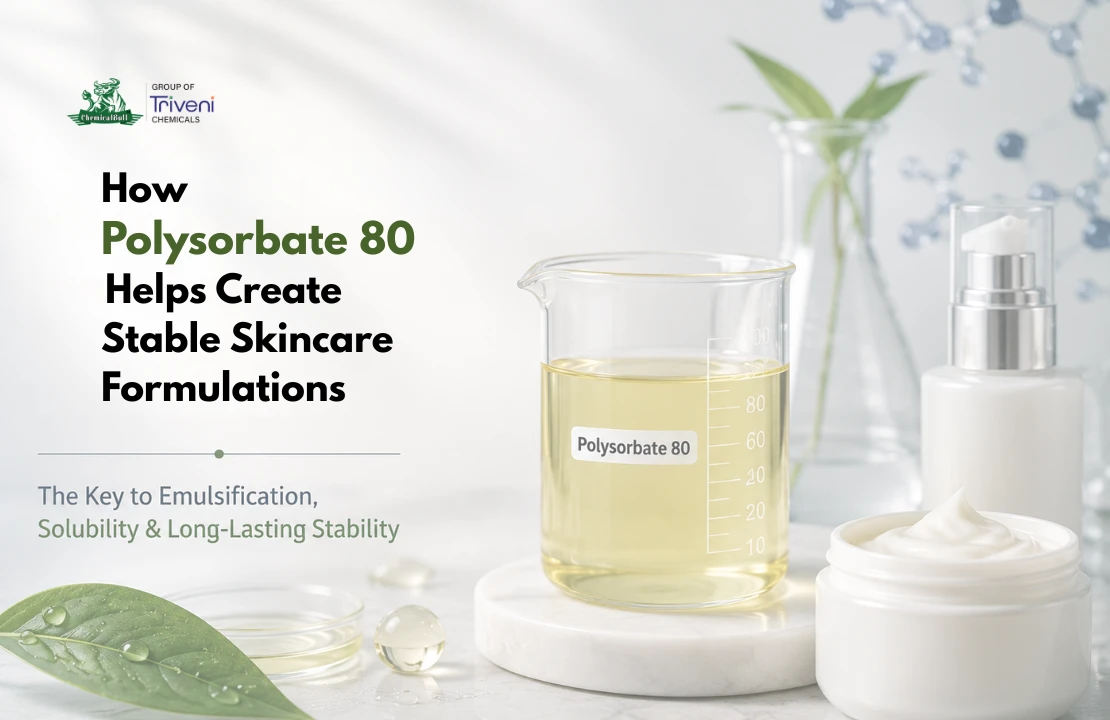
Introduction Polysorbate 80
In the sophisticated world of modern skincare, the leap from a concept to a high-performance product is paved with advanced chemical science. The efficacy, safety, and sensory appeal of a formulation—whether it is a feather-light hydrating serum or a decadent night cream—depend heavily on the integrity of its emulsion. Among the arsenal of tools available to cosmetic scientists, Polysorbate 80 stands out as a foundational pillar.
As the industry pivots toward more complex, "clean," and highly functional products, understanding the behavior of surfactants like Polysorbate 80 is no longer optional; it is a necessity. For manufacturers and brands aiming for consistent quality, sourcing this essential ingredient from a verified polysorbate 80 manufacturer is the first step toward ensuring that their products remain stable, safe, and luxurious from the first drop to the last.
Defining the Backbone: What is Polysorbate 80?
Polysorbate 80, frequently referred to in technical literature as Tween 80 or Polyoxyethylene (20) sorbitan monooleate, is a non-ionic surfactant. Its production is a testament to the intersection of natural sourcing and precise synthetic chemistry.
The Chemical Architecture
Polysorbate 80 is derived from the esterification of sorbitol (a sugar alcohol found in various fruits) with oleic acid (a fatty acid common in vegetable oils like olive oil). The resulting molecule is then ethoxylated, meaning ethylene oxide is reacted with the sorbitan ester. This process adds a significant polyethylene glycol (PEG) chain, which serves as the "hydrophilic" (water-loving) component of the molecule.
- Chemical Identity: Sorbitan mono-9-octadecenoate, poly(oxy-1,2-ethanediyl) derivs.
- The HLB Factor: With a Hydrophilic-Lipophilic Balance (HLB) value of approximately 15.0, Polysorbate 80 sits firmly in the high-HLB category. In the language of emulsion science, this identifies it as a superior candidate for Oil-in-Water (O/W) emulsification, where oil droplets must be finely dispersed within a continuous water phase.
Why Its Non-Ionic Nature Matters
Unlike anionic surfactants, which carry a negative charge and can be sensitive to electrolyte levels or pH fluctuations, non-ionic surfactants like Polysorbate 80 remain stable across a broad pH range (typically 4–7). This makes them incredibly versatile for formulations involving acidic actives like Vitamin C or basic environments, ensuring the product does not "break" or separate when additional ingredients are introduced.
Key Applications: Where is Polysorbate 80 Used?
To understand why this ingredient is a staple, we must look at where it is applied in daily skincare routines:
-
Solubilizing Fragrances & Essential Oils:
Have you ever noticed that adding oil-based fragrance to a water-based toner makes it turn cloudy? Polysorbate 80 acts as a bridge, "trapping" the fragrance oils in tiny structures called micelles, keeping the toner clear and stable. -
Oil-in-Water (O/W) Lotions and Creams:
This is its most common use. It ensures that the nourishing oils in your moisturizer stay evenly mixed with the hydrating water phase, preventing the cream from "splitting" on the shelf. -
Active Ingredient Delivery:
Many powerful skincare actives, like Vitamin E, are fat-soluble. Polysorbate 80 helps these actives dissolve into water-based serums so your skin can absorb them effectively. -
Face Mists and Toners:
Because it is non-sticky and clear, it is ideal for leave-on products where you want a smooth, light skin feel. -
Color Cosmetics:
In products like tinted moisturizers or sunscreens, it helps disperse pigments evenly, ensuring that the color doesn't settle at the bottom of the bottle.
The Mechanics of Emulsion Stability
Skincare emulsions are inherently thermodynamically unstable. Water and oil, by their very nature, want to separate. Polysorbate 80 prevents this through two primary scientific mechanisms.
Mechanism A: Reducing Interfacial Tension
The interface between oil and water is a high-energy barrier. When you stir oil into water, the surface tension acts as a "skin" that keeps them apart. Polysorbate 80 works by migrating to the interface, lowering the energy required to create new surface area. This allows the mixer to break down the oil phase into millions of tiny, sub-micron droplets with minimal energy input.
Mechanism B: Steric Stabilization
Simply creating small droplets is not enough; they must be prevented from "coalescing" (merging back into a single oil phase). This is where the ethoxylated chains of Polysorbate 80 act as a physical shield. These long, flexible chains extend out from the surface of the oil droplet into the water phase. When two oil droplets approach each other, these chains physically bump into each other, creating a spatial barrier that keeps the droplets separated. This is known as steric stabilization.
Stability Challenges and Troubleshooting
Even with the best ingredients, formulators often face stability hurdles. Understanding these is the mark of an expert scientist.
The "Creaming" and "Coalescence" Trap
- Creaming: This is when oil droplets rise to the top. It is usually a density issue. Increasing the viscosity of the water phase (using polymers like Carbomer or Glycerin) is the standard fix here.
- Coalescence: This is the breaking of the emulsion. If this occurs, it often means the emulsifier load is too low or the HLB balance is incorrect for the oil blend being used.
Troubleshooting Guide
If your formulation shows signs of instability:
- Check Your HLB Balance: Do not rely on Polysorbate 80 alone. It is almost always more effective when paired with a low-HLB co-emulsifier (such as Sorbitan Oleate or Glyceryl Monostearate). This creates a "mixed film" at the interface that is significantly more robust.
- Monitor Processing Temperature: Ensure the oil and water phases are heated to roughly the same temperature (typically 70–75°C) before homogenization. Improper temperatures can "shock" the emulsion, leading to poor droplet size distribution.
- Evaluate Electrolytes: High salt content can sometimes interfere with non-ionic surfactants. If you are adding minerals or extracts, account for their ionic strength during the planning phase.
Industrial Quality Control: What You Should Demand
As a procurement manager or formulator, you aren't just buying a chemical; you are buying the consistency of your entire product line. When choosing a polysorbate 80 supplier, there are technical benchmarks that must be verified:
- Peroxide Value: A high peroxide value indicates oxidation, which can lead to off-odors and product rancidity in your finished skincare.
- Acid Value: This measures the free fatty acid content. A high acid value can shift the pH of your final formulation, potentially destabilizing sensitive actives.
- Color/Appearance: High-purity Polysorbate 80 should be a clear-to-pale-yellow liquid. Darker batches can compromise the aesthetic of white creams and lotions.
- Documentation: Always request a Certificate of Analysis (COA) for every batch. The COA should confirm purity levels, moisture content, and heavy metal compliance.
The "Green" Shift: Sustainability and Future-Proofing
The beauty industry is rapidly moving toward "Clean Beauty" standards. Because Polysorbate 80 is derived from sorbitol (vegetable-based) and oleic acid, it is frequently viewed as a more sustainable, bio-derived alternative to purely synthetic surfactants.
Manufacturers are now focusing on:
- Biodegradability: Ensuring that the ethoxylation process meets modern environmental standards.
- Transparency: Providing supply chain visibility so brands can confidently claim their ingredients are responsibly sourced.
Why Partner with Chemicalbull?
In an industry where consistency defines your final product quality, Chemicalbull acts as a strategic bridge between raw material excellence and industrial performance. We specialize in providing high-purity Polysorbate 80 tailored to the specific requirements of the personal care industry.
By choosing to partner with us, you gain more than just a chemical; you gain:
- Rigorous Quality Assurance: We understand the sensitivities of skincare. Every batch we supply undergoes stringent testing to ensure that your emulsions remain stable and odor-free.
- Technical Partnership: Our team doesn’t just supply ingredients; we provide support. If you are facing stability issues in your lab, our technical experts are available to help you troubleshoot your formulation and optimize your emulsifier ratios.
- Supply Chain Reliability: We know that production delays can be costly. With our robust logistical network, we ensure just-in-time delivery for your manufacturing schedules, helping you stay ahead of market demand.
Conclusion
Stability is the hallmark of professional-grade skincare. It is the silent guarantee that the product the consumer opens in their home is as potent and perfect as it was the day it left your manufacturing floor. By integrating high-quality Polysorbate 80 into your formulations and partnering with a supplier that values technical integrity, you ensure your products remain effective, aesthetically pleasing, and competitive.
Frequently Asked Questions (FAQ)
-
Can I use Polysorbate 80 as a sole emulsifier?
While it is possible in some light lotions, it is highly recommended to pair it with a low-HLB emulsifier like Sorbitan Oleate for long-term stability and a more luxurious sensory experience. -
Does Polysorbate 80 interact with preservatives?
Generally, no. Its non-ionic nature makes it compatible with most standard preservative systems, but always conduct a preservative efficacy test (PET) to be certain. -
Is Polysorbate 80 safe for sensitive skin?
Yes, it is widely recognized as a mild surfactant. However, as with all cosmetic ingredients, formulation concentration and purity levels are key to safety. -
Why does my emulsion turn cloudy after adding fragrance?
This is likely a solubilization issue. You may need to increase your ratio of Polysorbate 80 to fragrance oil to ensure all fragrance molecules are fully encapsulated within the micelles.

Comment Section