Chemical Bull
295
27-Jun-2026
Quick Answer: What Is PEG 4000 Used For?
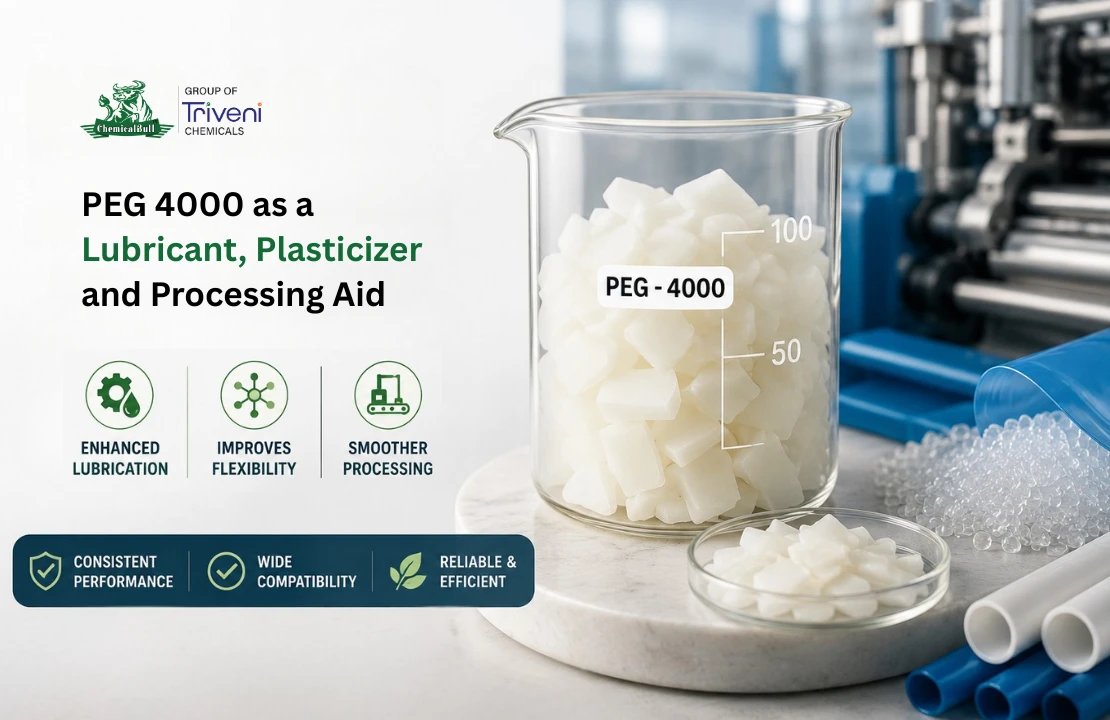
PEG 4000 is a solid polyethylene glycol grade used as a lubricant, binder, plasticizer, dispersing aid, and processing aid in rubber compounds, plastics, ceramics, pharmaceuticals, cosmetics, and industrial chemical manufacturing.
In rubber compounds, PEG 4000 helps improve filler dispersion, mixing behavior, compound handling, and batch consistency. In ceramics, it supports powder binding and shaping. In plastics, it can support flexibility and smoother processing. For industrial buyers, it is preferred because it is easy to handle, suitable for bulk production, and useful across multiple manufacturing systems.
Introduction
PEG 4000, also known as Polyethylene Glycol 4000, is an important industrial polymer used in rubber, plastic, ceramic, pharmaceutical, cosmetic, and specialty chemical applications. It belongs to the polyethylene glycol family, where each grade is selected according to molecular weight, physical nature, solubility, melting range, and end-use requirement.
This grade is usually supplied as a white to off-white solid, flakes, powder, or wax-like material. Its solid nature makes it useful in factories where controlled dosing, dry blending, melting, or batch addition is required.
Among its industrial uses, rubber compound manufacturing has strong search and business value. Rubber producers use PEG 4000 to improve filler dispersion, reduce processing difficulty, support mixing uniformity, and improve compound handling during production.
It is also used in plastic processing, ceramic production, pharmaceutical excipients, cosmetic bases, coatings, adhesives, and industrial formulations where lubrication, binding, or processing support is required.
What Is PEG 4000?
PEG 4000 is a polyethylene glycol grade with an average molecular weight close to 4000 g/mol. It is water-soluble and compatible with many industrial systems. Compared with lower PEG grades such as PEG 400, it is solid rather than liquid. Compared with higher grades such as PEG 6000, it is slightly lower in molecular weight and may offer easier processing in some applications.
Key Properties of PEG 4000
|
Property |
Details |
|
Product Name |
PEG 4000 |
|
Full Name |
Polyethylene Glycol 4000 |
|
Average Molecular Weight |
Around 4000 g/mol |
|
Appearance |
White to off-white waxy solid |
|
Solubility |
Soluble in water |
|
Melting Range |
60°C |
|
Main Function |
Lubricant, binder, plasticizer, processing aid |
|
Main Industries |
Rubber, plastics, ceramics, pharma, cosmetics, industrial chemicals |
PEG 4000 is not used as the main base ingredient in most industrial systems. It works as a supporting additive that improves processing, dispersion, lubrication, and handling.
PEG 4000 as a Lubricant
PEG 4000 is used as a lubricant because it helps reduce friction between ingredients during processing. In industrial production, friction can affect mixing, movement, shaping, and surface finish. A suitable PEG grade can make processing smoother and more controlled.
In rubber, plastic, and ceramic manufacturing, this material may help reduce sticking, improve flow, and support more even distribution of fillers or powders.
How PEG 4000 Works as a Lubricant
PEG 4000 works by reducing internal resistance between particles, fillers, polymers, and other ingredients. This helps the mixture move more easily during mixing, molding, extrusion, compression, or shaping.
It may support:
-
Smoother mixing
-
Better material flow
-
Reduced sticking during processing
-
More uniform ingredient distribution
Benefits of PEG 4000 Lubricant Use
|
Benefit |
Manufacturing Value |
|
Reduced friction |
Easier mixing and lower processing resistance |
|
Better flow |
Supports smoother movement during production |
|
Improved dispersion |
Helps fillers and additives spread evenly |
|
Cleaner handling |
May reduce sticking in selected systems |
|
Solid handling |
Easier to dose in flakes or powder type |
PEG 4000 in Rubber Compound
PEG 4000 in rubber compound is one of the most important industrial applications of this product. Rubber compound production depends on proper mixing, filler dispersion, additive distribution, and batch-to-batch consistency.
Rubber compounds often contain carbon black, silica, calcium carbonate, pigments, oils, activators, accelerators, and other additives. If these ingredients do not disperse properly, the final rubber product may show uneven strength, poor finish, weak processing behavior, or inconsistent quality.
PEG 4000 helps support rubber processing by improving the movement and distribution of fillers inside the rubber matrix. This makes it useful for compounders who want better processing control and stable production output.
Why PEG 4000 Is Used in Rubber Compounds
Rubber compound manufacturers use PEG 4000 because it can work as a processing aid and dispersion-supporting additive. It is especially useful in filled rubber systems where powder distribution and mixing uniformity are important.
It may help with:
-
Filler dispersion
-
Mixing uniformity
-
Compound handling
-
Processing consistency
PEG 4000 Benefits in Rubber Processing
|
Rubber Processing Need |
How PEG 4000 Helps |
|
Filler dispersion |
Supports even distribution of fillers |
|
Mixing support |
Helps reduce processing resistance |
|
Batch consistency |
Supports uniform compound behavior |
|
Lubrication |
Reduces internal friction during compounding |
|
Handling |
Supports smoother processing and movement |
Role in Rubber Mixing and Dispersion
In rubber manufacturing, dispersion is directly linked with product quality. Fillers such as carbon black, silica, and calcium carbonate must spread properly inside the rubber compound. Poor dispersion may affect tensile strength, elasticity, surface finish, and processing stability.
PEG 4000 can support movement of filler particles during mixing. It helps reduce resistance between ingredients and supports more uniform distribution. This can help manufacturers improve batch quality and reduce processing variation.
Rubber Manufacturing Applications
PEG 4000 may be used in several rubber manufacturing areas, depending on the compound design and processing method.
Common application areas include:
-
Filled rubber compounds
-
Molded rubber goods
-
Extruded rubber profiles
-
Industrial rubber sheets
The exact dosage should be tested in the actual rubber system because performance depends on filler loading, polymer type, mixing temperature, and final product requirement.
Why Rubber Compound Manufacturers Prefer PEG 4000
Rubber compound manufacturers prefer PEG 4000 because it gives a balance of solid handling, lubrication, and dispersion support. It is easier to store and dose compared with many liquid processing additives.
For factories producing rubber goods in bulk, consistent quality matters. Buyers should check melting range, appearance, moisture level, packing, and technical documents before regular purchase.
PEG 4000 as a Plasticizer
PEG 4000 can work as a plasticizer in selected polymer and industrial systems. A plasticizer helps improve flexibility, reduce brittleness, and support easier processing.
In compatible plastic or polymer blends, PEG 4000 can help soften the system and improve movement during production. It is not suitable for every polymer, so compatibility testing is important before scale-up.
How PEG 4000 Supports Flexibility and Processing
PEG 4000 can improve flexibility by reducing stiffness in selected systems. Its polymeric structure can also support smoother processing where a solid additive is preferred.
It may help improve:
-
Flexibility
-
Flow behavior
-
Surface finish
-
Processing smoothness
Applications as a Plasticizer
PEG 4000 may be considered in plastic, polymer, coating, adhesive, and industrial systems where controlled flexibility and processing support are required.
Its suitability depends on base polymer, dosage, processing temperature, and required final properties.
PEG 4000 as a Processing Aid in Ceramics
PEG 4000 is used in ceramic manufacturing because ceramic powders need temporary binding, shaping support, and controlled handling before firing. During ceramic production, powders must hold together properly during pressing, molding, drying, and movement.
This grade can work as a binder and processing aid by helping ceramic particles stay together before final thermal treatment.
Role in Ceramic Manufacturing
In ceramic systems, PEG 4000 can support powder binding and shaping. It helps improve green strength, which means the unfired ceramic body can be handled more easily before final processing.
It can support:
-
Powder binding
-
Green body strength
-
Shaping support
-
Smoother processing
Benefits in Ceramic Processing
|
Ceramic Need |
PEG 4000 Support |
|
Powder binding |
Helps particles stay together |
|
Shape retention |
Supports pressed or molded shapes |
|
Handling strength |
Reduces breakage before firing |
|
Lubrication |
Helps smoother movement during shaping |
|
Process control |
Supports more consistent production |
Industry-Wise Applications of PEG 4000
PEG 4000 is used across many industries because it offers different functions depending on the application. Its value changes according to the system: in rubber it supports dispersion, in ceramics it supports binding, in cosmetics it supports texture, and in pharma it works as an excipient.
|
Industry |
Application of PEG 4000 |
|
Rubber |
Processing aid, lubricant, filler dispersion support |
|
Plastics |
Plasticizer and processing support |
|
Ceramics |
Binder, lubricant, shaping aid |
|
Pharma |
Excipient, base material, tablet-related use |
|
Cosmetics |
Humectant, thickener, texture modifier |
|
Coatings |
Additive for texture and processing support |
|
Adhesives |
Binder and processing support |
|
Textile Chemicals |
Lubrication and finishing support |
PEG Grades Comparison Table
PEG grades differ mainly by molecular weight, physical nature, and use. Lower grades are usually liquid, while higher grades are usually solid or wax-like.
|
PEG Grade |
Common Use |
|
PEG 400 |
Solvent, carrier, humectant |
|
PEG 3350 |
Pharma excipient, laxative use |
|
PEG 3500 |
Binder, lubricant, processing aid |
|
PEG 4000 |
Rubber, ceramics, plastics, industrial use |
|
PEG 6000 |
Binder, lubricant, tablet coating, industrial use |
Which Grade Should Manufacturers Choose?
Choose PEG 4000 when the application needs a solid PEG grade with easier processing and good dispersion support. Choose PEG 6000 when higher molecular weight, harder texture, or stronger wax-like behavior is required.
Sourcing PEG 4000 from Manufacturers in India
PEG 4000 Manufacturer in India supply supports bulk requirements for rubber compounds, plastics, ceramics, pharmaceuticals, cosmetics, and industrial chemical applications. For manufacturers and bulk buyers, the main focus should be consistent grade quality, technical documentation, proper packing, reliable availability, and suitability for the final application.
A dependable supplier should understand industrial production needs and provide material that matches the buyer’s process, whether the requirement is for rubber processing, ceramic binding, plastic formulation, or general industrial use.
What Manufacturers Should Check Before Buying PEG 4000
Before buying PEG 4000 in bulk, manufacturers should check:
-
Grade specification and appearance
-
Moisture level and melting range
-
COA, TDS, and SDS availability
-
Packing size and bulk supply capacity
-
Application suitability and sample support
Why Consistent Grade Quality Matters
In industrial production, inconsistent raw materials can affect batch quality, processing behavior, and final product performance. PEG 4000 should be sourced from a supplier that can provide stable quality, proper documents, and reliable bulk supply.
A change in melting range, moisture level, physical type, or batch quality may affect rubber, ceramic, plastic, or pharma production.
Frequently Asked Questions
-
What is PEG 4000 used for?
PEG 4000 is used as a lubricant, plasticizer, binder, processing aid, dispersing aid, and additive in rubber compounds, plastics, ceramics, pharmaceuticals, cosmetics, and industrial chemicals. -
Is PEG 4000 used in rubber compounds?
Yes. PEG 4000 is used in rubber compounds as a processing aid, lubricant, and dispersion-supporting additive. It helps improve mixing, filler dispersion, handling, and batch consistency. -
What is the role of PEG 4000 as a lubricant?
PEG 4000 helps reduce friction between ingredients and improves material movement during processing. It is useful in rubber, plastic, ceramic, coating, and industrial manufacturing systems. -
Is PEG 4000 a plasticizer?
Yes. PEG 4000 can act as a plasticizer in selected systems where flexibility, smoother processing, and material softness are required. Compatibility testing is important before bulk use. -
What is the difference between PEG 4000 and PEG 6000?
PEG 4000 has an average molecular weight around 4000 g/mol, while PEG 6000 is around 6000 g/mol. PEG 6000 is usually harder and more wax-like, while PEG 4000 may be easier to process. -
What is the difference between PEG 400 and PEG 4000?
PEG 400 is a liquid grade with a molecular weight around 380–420 g/mol. PEG 4000 is a solid grade with a molecular weight around 4000 g/mol. PEG 400 is used mainly as a solvent or carrier, while PEG 4000 is used as a lubricant, binder, and processing aid. -
Where can manufacturers buy PEG 4000 in India?
Manufacturers can buy PEG 4000 in India from industrial chemical suppliers and bulk distributors that provide COA, TDS, SDS, proper packing, sample support, and consistent supply for rubber, plastic, ceramic, pharma, and cosmetic applications.
Conclusion
PEG 4000 is a versatile solid polyethylene glycol grade used in rubber, plastics, ceramics, pharmaceuticals, cosmetics, and industrial chemical manufacturing. Its main value comes from its ability to support lubrication, binding, dispersion, plasticizing, and smoother processing.
In rubber compounds, it helps improve mixing, filler dispersion, compound handling, and production consistency. In ceramics, it supports powder binding and shaping. In plastics, it can support flexibility and processing movement.
For manufacturers, choosing the right PEG 4000 grade is important. Buyers should check molecular weight, melting range, moisture level, powder or flake type, documentation, batch consistency, and supplier reliability before bulk purchase.
For PEG 4000 samples, COA, TDS, SDS, powder types, flake types, and bulk sourcing support, connect with ChemicalBull to source suitable material for rubber compounds, plastic processing, ceramic formulations, and industrial manufacturing.


Comment Section