Chemical Bull
257
27-Jun-2026
PEG 1000 Applications in Skin Care, Hair Care, and Beauty Products
Polyethylene Glycol 1000 — written as PEG 1000 in formulation science and listed as PEG-20 on cosmetic product labels under the INCI system — is a medium molecular weight, water-soluble polymer with a well-established role across skin care, hair care, and beauty product formulation. Positioned between the liquid low-molecular-weight PEG grades and the hard waxy high-molecular-weight grades, PEG 1000 exists as a soft, semi-solid material at room temperature that offers a unique combination of humectant activity, emollient texture, and formulation flexibility that neither adjacent grade can fully replicate.
For cosmetic formulators, product developers, and personal care brands looking to understand the specific value of PEG 1000 in beauty formulations — from daily moisturizers and body lotions to hair conditioners, serums, and lip treatments — this guide covers its identity, cosmetic functions, product applications, usage levels, skin compatibility, and formulation tips. For bulk cosmetic-grade supply with full documentation, connect with a reliable polyethylene glycol 1000 supplier offering batch-tested PEG 1000 with COA, TDS, and MSDS for personal care manufacturing.
Note: For PEG 1000's role as a pharmaceutical excipient in suppository bases and other dosage forms, refer to our guide on Polyethylene Glycol in Pharmaceutical Formulations. This blog focuses exclusively on PEG 1000 in cosmetic and beauty applications.
What Is PEG 1000? Identity and Cosmetic Profile
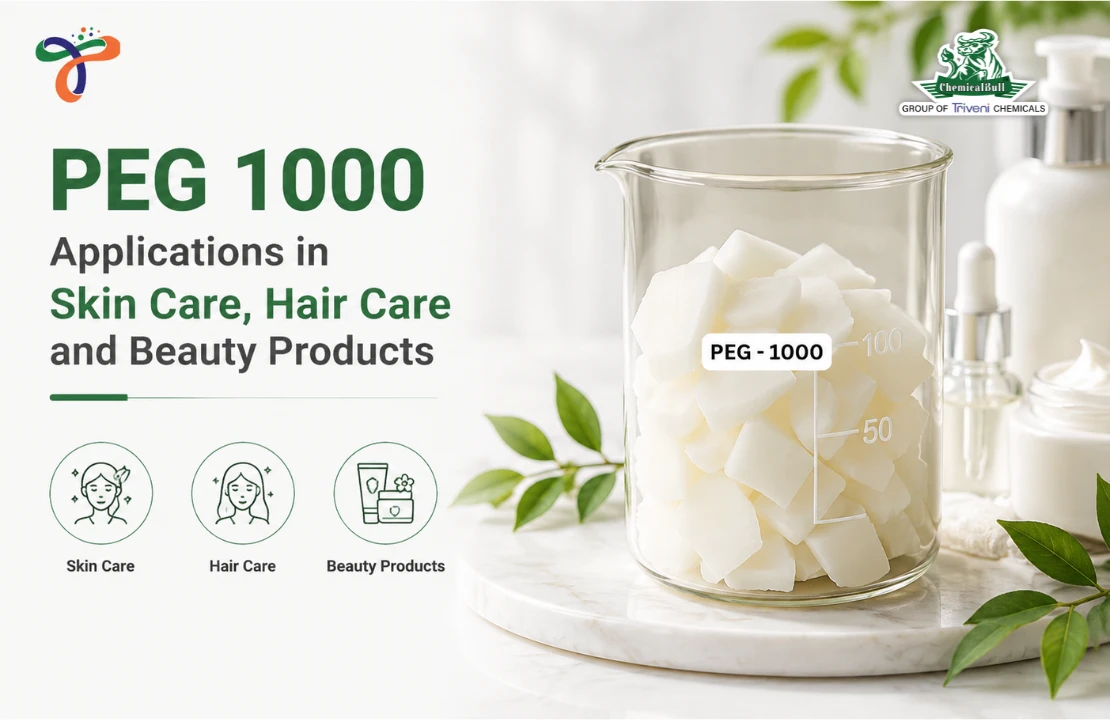
PEG 1000 is produced by polymerization of ethylene oxide to an average molecular weight of approximately 1000 g/mol. At room temperature, it is a soft, white to off-white waxy solid — firmer than paste-like PEG 600 but softer than hard-wax grades like PEG 3350. It melts at approximately 37–40°C, closely matching body temperature — a physical characteristic with direct relevance to its skin feel and cosmetic performance.
|
Property |
Details |
|
INCI Name |
PEG-20 |
|
Chemical Name |
Polyethylene Glycol 1000 |
|
Average Molecular Weight |
~1000 g/mol |
|
Physical Form |
Soft waxy solid at 25°C |
|
Melting Point |
~37–40°C |
|
Solubility |
Freely soluble in water |
|
Ingredient Class |
Humectant / emollient / texture agent |
|
Regulatory Status |
Permitted (EU CosIng, US FDA, India BIS) |
On cosmetic product labels, PEG 1000 appears as PEG-20 — indicating approximately 20 ethylene oxide repeat units in the polymer chain. Its medium molecular weight gives it properties adjacent grades cannot replicate: a near-body-temperature melt for smooth emollient skin feel, water-soluble semi-solid structure for texture contribution, and effective humectancy with a richer after-feel than fully liquid PEG grades. It is non-greasy, non-comedogenic at standard usage levels, and compatible with actives, preservatives, and emulsifiers across pH 4.5–8.0.
PEG 1000 Functions in Cosmetic Formulations
1. Humectant
PEG 1000 attracts and binds water molecules from the environment and the deeper layers of the skin, drawing moisture to the surface of the stratum corneum. This moisture-binding function maintains skin hydration over time, reduces the feeling of tightness after cleansing, and supports the skin's natural water content. Compared to lower molecular weight PEG grades, PEG 1000's humectancy comes with a richer, more cushioned skin feel — making it preferred in moisturizing creams and body lotions where both hydration performance and consumer sensory experience are priorities.
2. Emollient and Skin-Feel Modifier
Because PEG 1000 melts at approximately body temperature (37–40°C), it softens immediately upon skin contact during application — delivering a smooth, non-sticky emollient effect that improves product spreadability and leaves skin feeling soft and conditioned after absorption. This behaviour is particularly valuable in hand creams, body butters, night creams, and leave-on treatments where sustained skin softness is a key performance claim.
3. Texture, Consistency, and Solubilization Support
In semi-solid cosmetics, PEG 1000 contributes body and structural consistency — firm at room temperature, it melts and spreads at body temperature. This dual behaviour is valuable in stick products, cleansing balms, solid serums, and whipped body butters. It also assists in the solubilization of certain oil-soluble vitamins and botanical extracts within aqueous bases, helping maintain uniform ingredient distribution and preventing active ingredient separation in the formulation.
4. Hair Conditioning and Detangling Agent
In hair care, PEG 1000 deposits a thin, smooth film on the hair shaft that reduces fiber-to-fiber friction — improving wet and dry combability, reducing breakage during detangling, and imparting a smooth, manageable feel. Its full water solubility ensures clean rinsing in rinse-off products with no residue or build-up.
PEG 1000 Applications Across Beauty Product Categories
Moisturizers and Face Creams
In daily moisturizers, night creams, and rich face creams, PEG 1000 is dissolved in the heated water phase to contribute humectancy, emollient feel, and product body. Its near-body-temperature melting behaviour adds sensory richness without the greasiness of oil-phase emollients — making it suitable for all skin types, including combination and oily skin.
Typical usage level: 1% – 5%
Body Lotions, Hand Creams, and Body Butters
In body lotions and emulsified body butters, PEG 1000 adds body to lighter lotion systems and contributes a smooth, non-sticky skin feel. In hand creams — where fast-absorbing, non-greasy moisturization is essential — PEG 1000's body-temperature emolliency delivers immediate softness on application.
Typical usage level: 1% – 6%
Serums, Lip Care, and Cleansing Balms
In face serums and eye treatments, PEG 1000 functions as a humectant at low concentrations without adding opacity or heaviness to lightweight textures. In lip balms and lip masks, its soft, waxy form and body-temperature melt deliver a smooth, cushioned application feel. In cleansing balm formulations, PEG 1000 contributes to the semi-solid texture and supports the oil-to-milk transformation on water contact.
Typical usage level: 0.5% – 10% (varies by format)
Hair Conditioners and Masks
In rinse-off conditioners, deep conditioning masks, and leave-in treatments, PEG 1000 acts as a conditioning and detangling agent — reducing friction between hair fibers, improving wet combability, and leaving hair smooth and manageable. Its water solubility ensures clean rinsing without residue or build-up.
Typical usage level: 1% – 4%
Usage Levels Summary
|
Product Type |
Typical PEG 1000 Usage Level |
|
Face creams and moisturizers |
1% – 5% |
|
Body lotions and body butters |
1% – 4% |
|
Hand creams |
2% – 6% |
|
Face serums and eye treatments |
0.5% – 3% |
|
Lip balms and lip treatments |
2% – 8% |
|
Hair conditioners and masks |
1% – 4% |
|
Cleansing balms |
3% – 10% |
Skin Compatibility and Safety Profile
|
Safety Attribute |
Notes |
|
Irritation potential |
Very low at standard cosmetic usage levels |
|
Comedogenicity |
Non-comedogenic at typical concentrations |
|
pH compatibility |
Stable and effective across pH 4.5–8.0 |
|
Skin type suitability |
All skin types including sensitive, oily, and combination |
|
Eye area |
Suitable at low concentrations in eye creams |
|
Allergen status |
Not a recognized contact allergen |
|
Regulatory status |
Permitted under EU Cosmetics Regulation, US FDA, India BIS |
Formulation Tips for Working with PEG 1000
- Dissolve in the heated water phase at 70–80°C. Although PEG 1000 melts at 37–40°C, adding it to the water phase at 70–80°C ensures complete, uniform dissolution before combining with other phases.
- Test for crystallization on cooling. PEG 1000 may partially recrystallize during cooling in some formulations. Always conduct freeze-thaw stability testing (4°C/40°C cycling) to confirm finished product texture stability.
- Blend with adjacent PEG grades to fine-tune texture. Combining PEG 1000 with PEG 400 or PEG 600 allows precise control of semi-solid texture — more liquid PEG softens the system; more PEG 1000 adds body and structure.
- Specify cosmetic grade with full documentation. Request COA confirming average molecular weight, hydroxyl value, acid value, moisture content, and heavy metals — along with TDS and MSDS for compliance and quality control.
Frequently Asked Questions
1. What is PEG 1000 used for in cosmetics?
PEG 1000 is used as a humectant, emollient, and texture contributor in moisturizers, body lotions, hand creams, lip care, hair conditioners, and cleansing balms — delivering moisture retention and smooth skin feel.
2. What is the INCI name for PEG 1000?
The INCI name is PEG-20, which appears on finished cosmetic product ingredient lists. It indicates approximately 20 ethylene oxide repeat units in the polymer chain.
3. Is PEG 1000 safe for sensitive skin?
Yes. PEG 1000 is non-irritating, non-comedogenic, and non-allergenic at standard cosmetic usage levels, making it suitable for sensitive, dry, combination, and all skin types.
4. What makes PEG 1000 different from PEG 400 or PEG 4000 in cosmetics?
PEG 400 is a liquid used primarily as a solvent; PEG 4000 is a hard wax used as a texture structuring agent. PEG 1000's soft semi-solid form and near-body-temperature melting point give it a unique emollient skin feel and formulation flexibility that neither adjacent grade replicates.
5. What is the typical usage level of PEG 1000 in a face cream?
Typically 1%–5% in face creams and moisturizers, adjusted based on the target texture, skin feel profile, and the other humectant and emollient ingredients in the formula.
6. Can PEG 1000 be used in hair care products?
Yes. PEG 1000 is used in rinse-off conditioners, deep conditioning masks, and leave-in treatments as a conditioning and detangling agent. Its water solubility ensures clean rinsing without build-up.
Conclusion
PEG 1000 is a genuinely multifunctional cosmetic ingredient whose medium molecular weight, soft semi-solid form, and near-body-temperature melting point set it apart from both liquid and hard-wax PEG grades. Its combination of humectant moisture retention, emollient skin feel, structural texture contribution, and hair conditioning performance makes it a reliable and versatile choice for formulators developing moisturizers, body care, hand creams, lip treatments, conditioners, and cleansing balms across the full spectrum of personal care.
For cosmetic-grade PEG 1000 with Certificate of Analysis, Technical Data Sheet, MSDS, and bulk supply support, connect with ChemicalBull — a trusted polyethylene glycol 1000 supplier serving personal care manufacturers and cosmetic formulators across India and global export markets.
Comment Section