Chemical Bull
6982
13-Nov-2025
Introduction
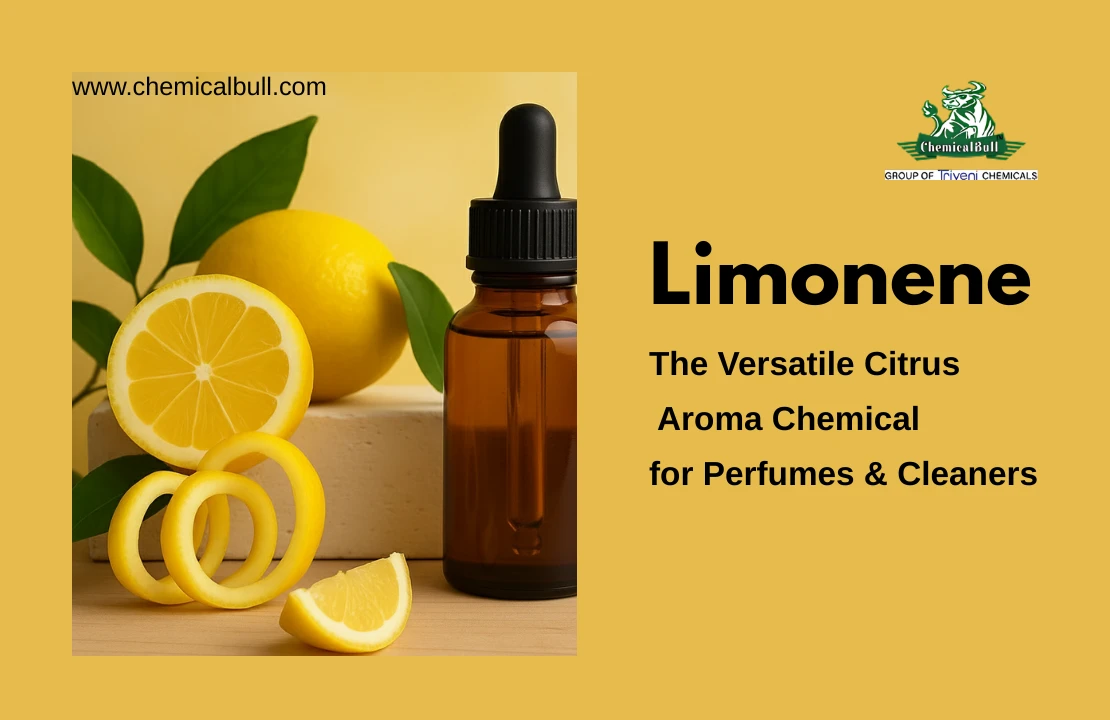
In the world of aroma chemicals, Limonene stands out as one of the most popular and naturally sourced compounds. Extracted mainly from orange and lemon peels, this cyclic terpene gives a fresh, citrusy, and zesty fragrance that instantly brightens perfumes, cosmetics, and cleaning products. It is widely recognised as a key aroma chemical for perfumes and natural cleaning formulations across multiple industries.
At Chemical Bull, we supply high-purity Limonene aroma chemicals used by perfume manufacturers, detergent formulators, and industrial cleaner producers across the globe. Whether you are a manufacturer, supplier, distributor, or trader, understanding this versatile citrus compound will help you make better sourcing and formulation decisions.
The Discovery of Limonene
Limonene was first identified in the 19th century by chemists exploring the natural essence of citrus fruits. When orange peels were cold-pressed to produce essential oils, a pleasant lemon-like aroma compound was discovered — later named Limonene after the Latin word “limon” (lemon).
Over time, scientists recognised that this terpene not only contributes to the fragrance of citrus oils but also acts as a powerful natural solvent, giving it importance in both fragrance and cleaning industries.
What Is Limonene?
Limonene is a monoterpene hydrocarbon (C₁₀H₁₆) found naturally in the rinds of citrus fruits like oranges, lemons, mandarins, and limes. It appears as a clear, colourless liquid with a pleasant lemon-like scent that is instantly recognisable in nature.
Chemically, limonene belongs to the terpene family, which is responsible for many natural aromas found in essential oils and plants. It is extracted from citrus peels using steam distillation or cold pressing, often as a by-product of orange juice production — making it both eco-friendly and cost-effective.
What makes limonene special is its dual nature — it provides a refreshing citrus fragrance for perfumes and personal care products, while also serving as a powerful natural solvent for cleaning and industrial applications. This rare combination of aroma and function makes limonene one of the most widely used natural chemicals in multiple industries today.
Different Forms/Types of Limonene
Limonene is a naturally occurring terpene that exists in two main forms — D-Limonene and L-Limonene.
Although both have the same chemical formula (C₁₀H₁₆), their molecular structure is mirror-imaged, giving them different aromas and slightly varied applications. These two forms are known as isomers, and each has its own importance in fragrance, cosmetic, and industrial formulations.
1. D-Limonene (Dextro-rotatory form)
D-Limonene is the most common and widely used form of limonene found in the peels of oranges, lemons, mandarins, and other citrus fruits. It has a refreshing, sweet, and lemon-like aroma that makes it a key ingredient in perfumes, flavourings, and eco-friendly cleaners.
Key Features & Applications:
-
Fragrance Use: D-Limonene provides a bright, zesty top note in perfumes, colognes, soaps, and personal care products. It blends well with floral, woody, and oriental accords.
-
Cleaning Products: Its natural degreasing and solvent properties make it ideal for use in citrus-based cleaners and air fresheners.
-
Health & Wellness: Research suggests it may have anti-inflammatory and antioxidant benefits, and it is sometimes used in dietary supplements.
-
Sustainability: As it is derived from citrus fruit waste (like orange peels), it’s considered an eco-friendly and biodegradable raw material.
D-Limonene dominates the market because of its pleasant fragrance, safety profile, and multi-functional use across perfumery and industrial sectors.
2. L-Limonene (Levo-rotatory form)
L-Limonene, although less common, is also an important natural terpene. It is mainly found in pine needles, conifers, and some non-citrus plants. Unlike D-limonene’s sweet orange aroma, this form has a piney, resinous, and slightly turpentine-like scent.
Key Features & Applications:
-
Fragrance Profile: Its woody and herbal note makes it suitable for use in masculine perfumes, forest-inspired scents, and aromatherapy formulations.
-
Industrial Applications: L-Limonene is sometimes used in industrial solvents, resin production, and speciality cleaning agents due to its stronger, sharper smell.
-
Therapeutic Effects: Similar to D-limonene, it may exhibit anti-stress and anti-inflammatory effects, making it useful in limited cosmetic and health applications.
-
Limited Availability: Because it’s rarer and extracted from non-citrus sources, L-Limonene is used on a smaller scale compared to D-Limonene.
How Limonene Is Made (Extraction Process)
Limonene is a natural citrus compound mainly obtained from the peel waste of oranges, lemons, limes, and mandarins. It is eco-friendly and renewable. The extraction process is as follows:
Cold Pressing
First, fresh citrus peels are mechanically pressed.
This releases essential oils, which naturally contain Limonene.
This step extracts the raw oil without using any chemicals.
Steam Distillation
The oil obtained from cold pressing is then heated with steam.
Steam distillation separates Limonene from other volatile components.
The purpose of this step is to isolate Limonene in a purer form.
Purification
The separated Limonene is further refined through fractional distillation.
This process produces high-purity D-Limonene (95–98%).
The result is a safe, effective product suitable for industrial and perfumery applications.
Limonene in Perfumery
Why Limonene Is Used in Perfumes
Limonene is known for its uplifting citrus aroma, making it a favourite top-note fragrance chemical. It adds freshness, brightness, and energy to perfume compositions.
It blends beautifully with floral, woody, and musky ingredients like Linalool, Citral, and Geraniol.
Applications in Perfumery
-
Used in fine fragrances, body sprays, and air fresheners.
-
Essential for creating citrus top-note perfumes.
-
Helps dissolve and stabilise other perfume ingredients as a natural solvent.
👉 Acts as a biodegradable base chemical for eco-friendly formulations.
To know more about other perfume ingredients, read our related blog on Heliotropin (Piperonal): Sweet Cherry Aroma Chemical for Perfumes.
Limonene in Cleaning Products
Why Limonene Is Used in Cleaners
Because of its natural degreasing and solvent properties, limonene is a key ingredient in eco-friendly cleaning chemicals. It replaces harsh petroleum-based solvents and offers a biodegradable, non-toxic alternative.
Common Industrial Applications
-
Household Cleaners: Floor, kitchen, and bathroom cleaners.
-
Industrial Degreasers: Remove grease, oil, tar, and adhesive residues.
-
Hand Cleansers: Used in heavy-duty industrial soaps.
-
Citrus Cleaner Formulations: Blended with surfactants for effective cleaning.
Limonene is ideal for companies looking to manufacture green cleaning solutions that meet environmental safety standards.
Benefits of Using Limonene
|
Category |
Benefits |
|
Perfumery |
Adds freshness, blends well, acts as top note |
|
Cleaning |
Natural solvent, biodegradable, effective degreaser |
|
Industrial |
Safe substitute for petroleum solvents |
|
Environmental |
Renewable, sustainable, biodegradable |
|
Commercial |
High demand and global availability |
Limonene Market and Industrial Use
Globally, the Limonene market has grown rapidly due to the shift toward green chemistry and increasing awareness about sustainable raw materials. Known for its natural citrus aroma, biodegradability, and eco-friendly profile, Limonene has become one of the most in-demand ingredients in various industries.
It’s widely used across:
-
Aroma Chemical Manufacturing – as a renewable base material for perfumes, colognes, and flavour blends.
-
Detergent and Soap Production – providing a refreshing citrus scent and natural degreasing power.
-
Cosmetic Formulations – used in skincare, essential oil blends, and haircare products.
-
Paints and Adhesive Removers – as a natural solvent alternative to petroleum-based chemicals.
-
Food Flavours and Fragrances – enhancing citrus notes in beverages, confectionery, and edible oils.
India has become a leading exporter of Limonene due to its abundant citrus fruit sources and strong chemical manufacturing infrastructure. The country supplies bulk and high-purity grades of Limonene for perfumery, personal care, and industrial cleaning applications.
In recent years, the demand for bio-based solvents and natural fragrance ingredients has increased rapidly. Global cosmetic, personal care, and home-cleaning brands are now replacing synthetic substitutes with natural Limonene for its pleasant aroma, safety, and sustainability. According to market insights, Asia-Pacific and Europe are the fastest-growing regions for Limonene consumption — especially in perfumery, home care, and eco-friendly cleaning product segments.
Comparison: Limonene vs Other Citrus Aroma Compounds
|
Chemical |
Aroma Profile |
Common Use |
Note |
|
Limonene |
Sweet orange, lemon |
Perfumes, Cleaners |
Natural solvent |
|
Citral |
Sharp lemon |
Soaps, Detergents |
Adds a strong lemon note |
|
Linalool |
Floral-woody |
Fine fragrances |
Balances citrus notes |
|
Geraniol |
Rose floral |
Perfumes, Cosmetics |
Adds sweetness |
Safety & Regulatory Information
Limonene is FDA-approved for use in food and cosmetics (in limited concentrations).
However, it can oxidise over time, which may cause mild skin sensitivity.
Handling Tips:
-
Use gloves during handling.
-
Avoid direct sunlight and air exposure.
-
Store in cool, dry, ventilated spaces.
Always ensure compliance with IFRA and REACH guidelines when formulating with Limonene for fragrance or cosmetic use.
Why Choose Chemical Bull for Limonene
-
High-purity grade suitable for industrial and perfumery use.
-
Bulk supply and export capabilities.
-
Technical formulation support for aroma & cleaning applications.
-
Trusted supplier network across India and abroad.
Visit our Aroma Chemicals page to explore more citrus aroma ingredients like Citral, Geraniol, and Linalool.
FAQs About Limonene
-
What is Limonene used in perfume?
It acts as a top note ingredient, providing a fresh citrus burst in fragrance compositions. -
Why is Limonene used in cleaning products?
It’s a natural degreaser and solvent, ideal for removing oil, grease, and stains effectively. -
Is Limonene FDA-approved?
Yes, it’s approved in trace quantities for flavouring and cosmetic applications. -
Who manufactures Limonene in India?
Chemical Bull is among the trusted Limonene manufacturers and suppliers serving both domestic and export markets. -
Is Limonene safe for skin?
Yes, when diluted properly, it’s safe. However, concentrated Limonene may cause irritation to sensitive skin. -
Is Limonene biodegradable and eco-friendly?
Yes, it’s a renewable, biodegradable, and non-toxic citrus-derived compound. -
What fruits contain Limonene?
Limonene is mainly found in orange, lemon, lime, grapefruit, and mandarin peels.
Conclusion
Limonene perfectly blends nature and innovation — offering both fragrance brilliance and cleaning performance.
From luxury perfumes to industrial degreasers, its versatile citrus power makes it a must-have for modern formulations.
If you’re looking for a trusted Limonene supplier in India, partner with Chemical Bull — your reliable source for high-purity aroma chemicals and eco-friendly cleaning ingredients.
Comment Section